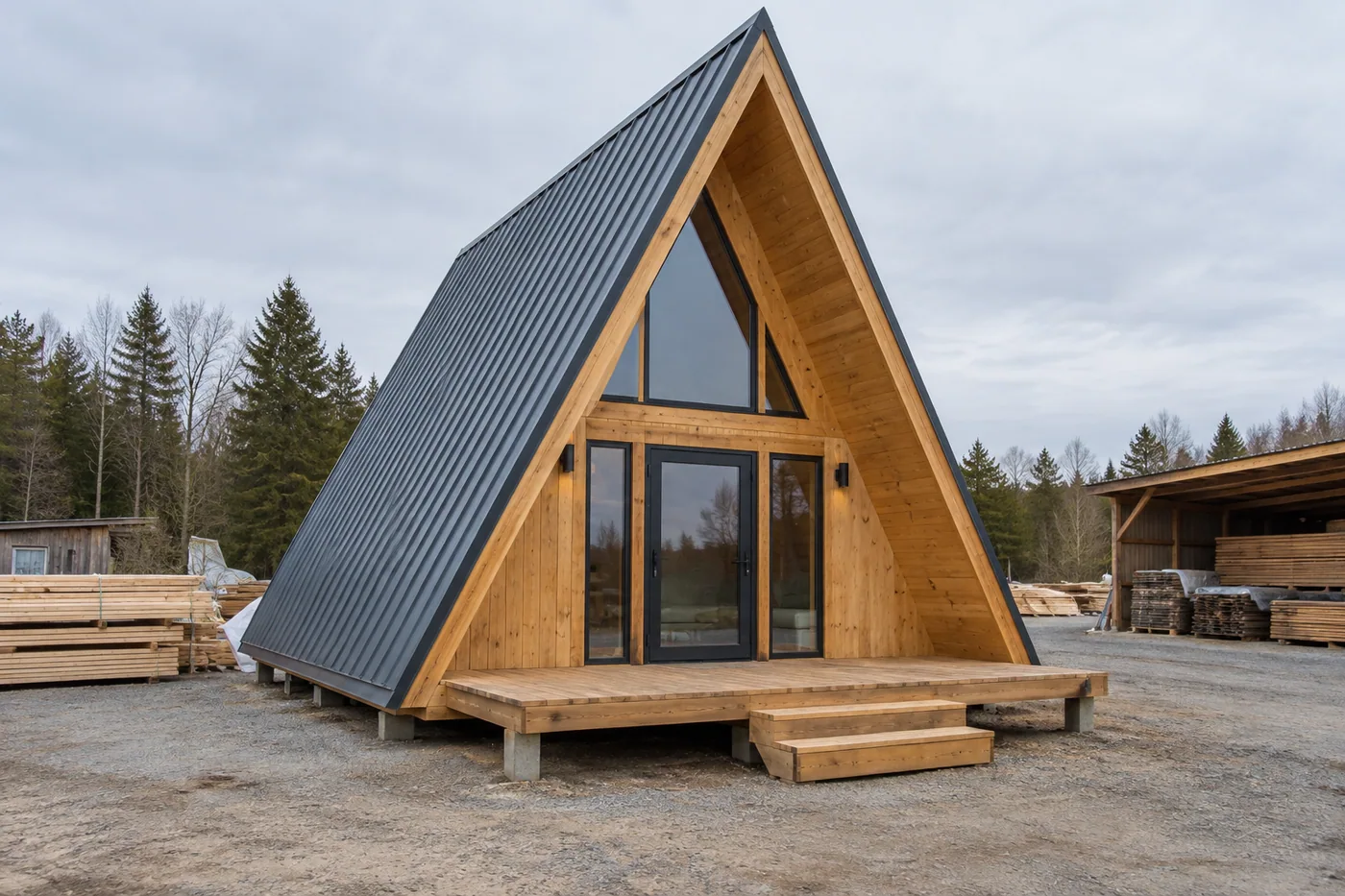
An A-frame prefab prototype should answer the uncertainties that matter to a repeat order: whether the accepted geometry can be assembled, whether critical interfaces have been reviewed, and whether changes can be transferred into production information. Agree the review scope and evidence beforehand. A visually finished sample is not, by itself, structural approval or proof of production consistency.
Introduction: the first unit should resolve questions, not just provide photographs
An A frame cabin prefab can look convincing long before its production details are settled. The sloping enclosure, triangular end walls and compact interior create interfaces that deserve deliberate review. For a buyer planning several units, the first cabin is an opportunity to learn while changes are still manageable.
A prototype is useful only when its purpose is defined. One buyer may need to rehearse assembly. Another may need to resolve window geometry or cleaning access. Combining every possible investigation into one sample can become expensive and confusing. Start with the decisions that would otherwise make a repeat order uncertain.
This article proposes a buyer's first-article review process. It does not give member sizes, connection capacities or a structural test procedure. Qualified designers, test providers and destination professionals must establish those requirements. Examples are hypothetical, and no factory testing or successful prototype programme is claimed for CabinWild.
1. Write the prototype questions before agreeing its price
List the unresolved questions in plain language. Can the proposed sequence be explained to the intended assembly crew? Is there a workable interface between the end-wall glazing and the sloping enclosure? Can the chosen furnishings be moved into the finished interior? Those are different questions and may require different evidence.
Classify each question as a design review, an assembly observation, an operational trial or a performance test. A photograph cannot replace a measurement, and a successful assembly rehearsal cannot establish thermal performance. The classification helps the buyer avoid paying for an attractive demonstration that leaves the actual purchasing risk untouched.
Agree which parts of the sample are representative of the proposed order. A hand-finished display cabin using different windows, connectors or insulation should not silently become the acceptance basis for production units. Record deviations and explain whether each one prevents a particular question from being answered.
2. Establish a controlled geometry and drawing reference
Identify the drawing revisions that define the prototype. Dimensions should distinguish structural reference points, finished surfaces and installation clearances. Without that distinction, two measurements can appear inconsistent while referring to different parts of the assembly. Ask the design team to resolve the reference system before the review begins.
For triangular glazing or a custom end wall, clarify who supplies the opening dimensions and who confirms manufacturing tolerances. The buyer should not invent an acceptable gap from a photograph. The relevant supplier and designer need a coordinated detail that addresses the actual materials and installation method.
Mark observations against the controlled drawing set. If an issue is found, record the location, measurement method and evidence without immediately prescribing an improvised repair. The first task is to establish what differs from the accepted information. The competent designer or responsible supplier can then evaluate the response.
3. Distinguish timber movement from an assembly mistake
Wood responds to moisture conditions, so the timing and context of dimensional observations matter. The USDA Forest Products Laboratory's Wood Handbook explains the relationship between wood and moisture. Use that background to ask informed questions, not to assign a universal movement allowance to every A-frame system.
Ask A frame cabin manufacturers to state the relevant material information and handling assumptions for their proposed system. Keep the discussion specific to the supplied members, panels and connections. A broad timber species name is not enough to define the entire assembly's behavior, particularly where several materials meet.
The prototype record should identify when observations were made and whether the cabin was partly enclosed, recently delivered or exposed during assembly. These details help a competent reviewer interpret the finding. Do not disguise an unresolved alignment problem as normal movement, or assume every visible change means a defective component.
Further reading: USDA Forest Products Laboratory: Wood Handbook.
4. Rehearse the information flow as well as the assembly
A useful assembly rehearsal checks whether components, labels, packing information and instructions work together. Record where the crew needs clarification or cannot find a part. The aim is to improve the delivery system, not to infer that an experienced demonstration team proves every future installer will work at the same speed.
Have qualified people plan the safe work method, temporary stability and handling. Do not ask a sales team to improvise lifting or access arrangements for a customer visit. Where UK work is involved, HSE guidance emphasizes proper planning and supervision of lifting operations. The actual method must be determined for the equipment, loads and site.
Distinguish elapsed demonstration time from a reliable installation forecast. Weather, base readiness, crew capability, site access and scope can all differ on the buyer's project. Retain observations that help build a realistic schedule, but avoid turning one rehearsal into a guaranteed assembly duration.
Further reading: HSE: planning and organizing lifting operations; Define cabin assembly service scope.
5. Use an acceptance matrix with explicit limits
Give every review item an evidence type, an accountable reviewer and a disposition. Not every item needs a test. Some require a drawing correction or an operational observation. A measured result still needs an agreed criterion before it can be described as accepted.
Keep the language narrow. An accepted window interface drawing is not acceptance of all weather performance. A completed fit-out walk-through is not an occupancy approval. This distinction protects the value of the evidence by preventing one satisfactory result from being stretched across unrelated questions.
| Question | Appropriate evidence to agree | Limit of the conclusion |
|---|---|---|
| Does the assembly match the accepted geometry? | Defined dimensional checks and marked drawings | Only the checked references and configuration |
| Can the supplied information support assembly? | Observed instruction and component issues | Not a guaranteed labour duration |
| Is an enclosure interface resolved? | Reviewed detail and any specified validation | Not a whole-building performance claim |
| Can operational tasks be completed? | Recorded furniture and cleaning trials | Only the represented task and layout |
| Are repeat units ready for release? | Closed issue register and updated production files | Not a waiver of subsequent inspection |
Turn these questions into a project brief
Send your proposed quantity, location and unresolved design questions. Ask which sample, drawing and inspection deliverables can be included in a project-specific quotation.
6. Review the enclosure as connected interfaces
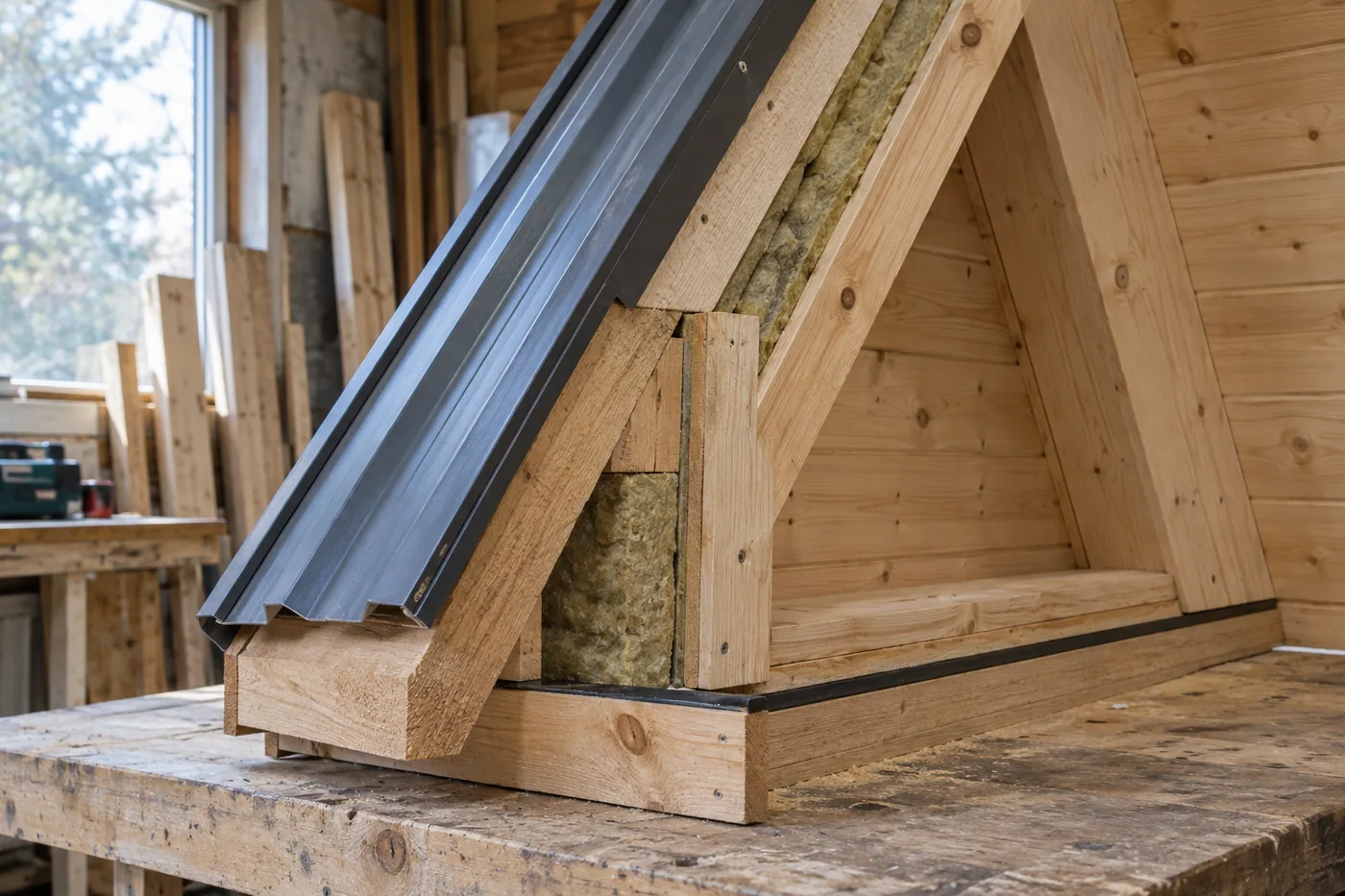
On an A-frame, roof, wall, glazing and floor edges meet in ways that can be visually distinctive but difficult to interpret from marketing images. Ask the design team to trace the intended water, air and thermal-control strategy through those junctions. Do not review each material as if its presence alone proves continuity.
EPA moisture-control guidance addresses design, construction and maintenance as connected activities. For a prototype review, the practical implication is to ask how important interfaces will be inspected, protected during assembly and accessed later. The publication is background guidance, not approval of a proposed cabin detail.
Where performance testing is specified, agree the competent provider, relevant method, specimen configuration and reporting requirements. Keep the result attached to the actual tested assembly and its limitations. Do not extrapolate a test on one component to a differently configured complete building without an appropriate technical basis.
Further reading: EPA: moisture control guidance for buildings.
7. Include the people who will operate the cabin
Furniture and everyday movement
Invite the operational team to review the represented layout before final finishes conceal easy changes. Use actual furniture dimensions and realistic luggage. Check the route from the entrance to storage and sleeping areas. Sloping surfaces can make an apparently generous plan less useful at the exact height where a person needs to reach or stand.
Document the task rather than a vague impression. For example, record whether the selected bed base can pass through the agreed doorway without dismantling an enclosure component. If the trial uses different furniture, state that limitation. A successful demonstration with a smaller item does not answer the original question.
Cleaning and replaceable components
Ask how staff will reach glazing, remove bedding and replace commonly serviced items. A dramatic high window may need a considered cleaning arrangement. The safe method and equipment should be reviewed by competent people rather than assumed from the floor plan.
Look for components that become inaccessible when the interior is completed. Agree whether access panels, removable finishes or different equipment locations are needed. These decisions should be returned to the coordinated design and production information, not left as a handwritten note for a future installer.
8. Turn prototype findings into production changes
Create one issue register with a unique reference for each finding. Record whether it is a nonconformity against the accepted information, a proposed improvement or an unanswered question. Those categories can have different commercial consequences, so avoid treating every buyer preference as a supplier defect.
For each accepted change, identify the affected drawing, component list, instructions and inspection plan. An amended sample is not enough if the production files remain unchanged. Ask the supplier how the new revision will be released and how obsolete information will be prevented from reappearing in repeat units.
Have the relevant professional review any change affecting safety or technical performance. A frame cabin builders may be able to explain practical assembly difficulties, but that does not automatically authorize a structural alteration. Keep design authority, production implementation and buyer preference approval distinct in the record.
9. Hypothetical review: a window decision changes more than the view
Suppose a resort buyer wants a larger triangular end window after seeing the prototype. The request initially sounds cosmetic. The window supplier needs a revised opening, the interior team needs to reconsider blind access and the local designer needs to review the changed enclosure and structural interfaces. None of those implications should be hidden in a sales confirmation.
The buyer records the requested benefit, asks for the consequences and defers release of the affected parts. The team compares retaining the original window with accepting the revised scope. Any price or programme adjustment is shown alongside the technical decision, not added later as an unexplained invoice difference.
When a solution is accepted, the supplier updates the controlled documents and identifies whether another targeted review is needed. The buyer does not demand a complete new prototype merely for appearance, but also does not assume the previous evidence covers the revised detail. The review scope follows the actual unresolved question.
This example illustrates a decision process, not a completed customer case or a recommended window design. Its value is the record: what changed, who assessed the implications, what remains unverified and which information now governs the repeat order.
10. Define a conditional or final production release
At the release meeting, separate closed items from outstanding matters. If only unaffected work may proceed, identify that boundary precisely. Do not use an overall approved stamp when the team still disagrees about a critical connection, service interface or required document.
A frame house manufacturers and their buyers should agree which prototype records will be retained with the order. Include the final drawing index, representative material schedule, unresolved limitations and approved changes. Also agree the order-specific shipment inspection plan; the prototype does not remove the need to verify what is actually supplied.
When comparing an A frame cabin prefab for sale, ask whether a prototype or first-article process is available and what it would include. It may not be proportionate for every single-unit purchase. For repeated or materially customized units, however, an explicit review can give the buyer a much clearer basis for the next commitment.
Further reading: Prepare pre-production cabin sample approvals.
Protect the reference sample after approval
Decide how the accepted prototype will remain identifiable while repeat production proceeds. A sample that is later modified for photography, demonstration or another customer's preferences can stop being a reliable comparison point. Record its accepted configuration, retain relevant photographs and documents, and label later changes in the record rather than quietly treating the altered sample as the original standard.
Agree what happens if a proposed production improvement differs from the reference. The supplier should identify the affected characteristic and provide the appropriate information for review. Acceptance of the prototype should not freeze every practical production detail unnecessarily, but neither should it authorize unrecorded substitutions that change the agreed outcome.
For remote buyers, specify which evidence will be supplied for the first repeat unit and how questions will be closed. A video call can help locate an issue but should not replace the released drawing or a required measured record. Keep the evidence appropriate to the characteristic under review, and retain the accepted disposition with the batch documentation.
Frequently asked questions
Does every A-frame order need a complete prototype?
No. The appropriate evidence depends on what is new, uncertain or consequential in the order. A standard configuration may need document review and targeted samples, while a repeated custom design may justify a first unit. Define the unanswered questions first, then agree a proportionate way to address them.
Can I use the supplier's existing display cabin?
Possibly, if its configuration and materials are relevant to the decision. Record differences from the proposed order and identify which questions the display unit cannot answer. Its appearance should not be treated as evidence of structural suitability, destination approval or the quality of components that are not represented.
Who should set dimensional acceptance criteria?
The responsible designers and suppliers should establish criteria appropriate to the actual interfaces and manufacturing system. Buyers can identify functional needs but should not invent engineering tolerances. Record the reference points and measurement method so that the resulting observations can be interpreted consistently.
Can a successful assembly rehearsal guarantee installation time?
No. A rehearsal can reveal sequence and information problems, but project conditions may differ substantially. Use the findings as inputs to a site-specific schedule. Base readiness, handling, weather, crew capability and the agreed installation scope should remain visible assumptions rather than disappearing behind a single demonstration duration.
What must happen after the buyer approves a prototype?
The accepted findings must be translated into controlled production documents, instructions and inspection requirements. Outstanding limitations should remain visible. Confirm which revision governs the repeat order and how subsequent changes will be assessed. Prototype approval should not be interpreted as blanket acceptance of later units or unreviewed substitutions.
Conclusion: make the first unit a source of usable evidence
A disciplined A-frame prefab prototype review connects customer requirements to drawings, physical observations and a controlled production release. Its strongest outcome is not a set of promotional photographs but a closed decision record that the buyer, designer, factory and installer can all use.
Send CabinWild your intended use, location, quantity and the questions you need a sample to answer. Request a defined evidence and review scope before assuming a prototype, test or repeat-production commitment is included in the offer.
Define your A-frame prototype review
Send your proposed quantity, location and unresolved design questions. Ask which sample, drawing and inspection deliverables can be included in a project-specific quotation.
Prepared with AI assistance for CabinWild Editorial using the linked public sources. Examples are illustrative, not customer results or verified CabinWild test data. Project-specific design and local requirements need review by the appropriate professionals.