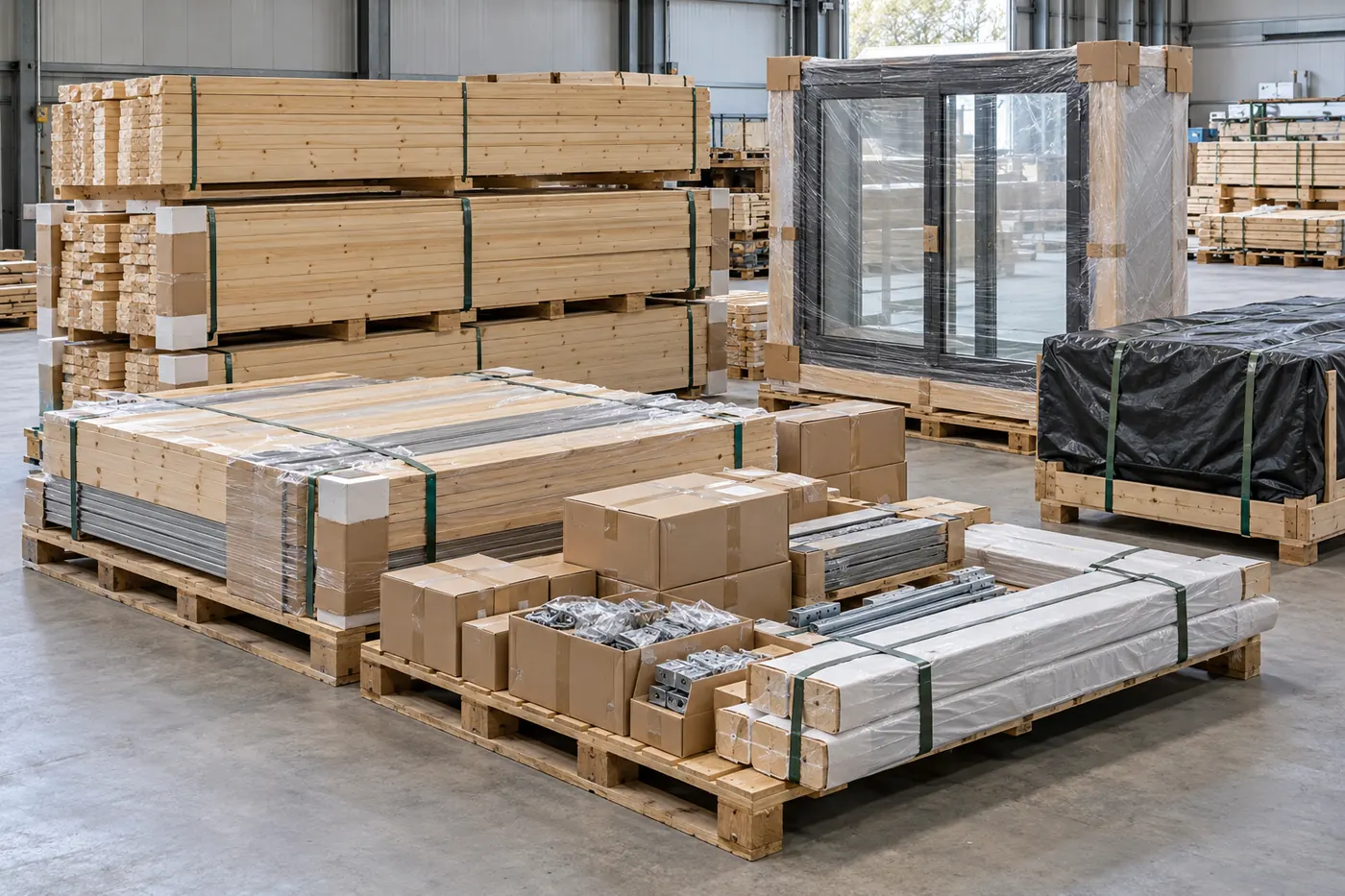
Source a cabin kit by freezing the exact model and completion level, then matching the bill of materials, drawings, components, packing and assembly information to that revision. Confirm timber and purchased-item specifications, local-supply boundaries, package identities, wood-packaging requirements, receiving checks, tools, skills and weather protection. The lowest kit price is not necessarily the lowest complete assembled cost.
Introduction: turn the search into a controlled purchase
A kit transfers work from factory completion to packing, logistics and site assembly. That can reduce transport volume and give the buyer local flexibility, but it also increases the importance of document control, component identification and installation preparation. The package should be evaluated as a system, not as a pile of timber with an attractive completed-cabin image.
The sourcing task is to define what is pre-cut, pre-drilled, panelized or supplied loose; what the buyer purchases locally; and what skill, equipment and design coordination remain at site. A bill of materials is useful only when it matches the current model, specification and quantity. Packing and receiving records must preserve that identity.
This guide gives procurement controls, not assembly instructions or structural advice. It does not report a CabinWild shipment, test or customer experience. All scenarios are hypothetical. Qualified professionals must review the actual design and site, while competent contractors should plan lifting, work at height, temporary stability and other installation risks.
A search can hide several completion levels. Wood cabin kits for sale may be pre-cut boards or panelized packages; timber log home kits may use a different wall system. Cabin kits and cabin kits for sale can exclude foundations, roof finish or openings, while a cabin kit for sale may be displayed with items that are optional. The written inclusion schedule must control the purchase.
1. Name the kit completion level
Ask the supplier to state which items are cut, machined, assembled or finished. Identify floor, wall and roof elements, openings, membranes, cladding, internal lining, fasteners and trim. Photographs should be linked to the offered configuration; a completed display cabin may contain locally sourced or optional work not present in the package.
Clarify the completion milestone the kit is designed to reach. A structural shell, weather-tight enclosure and finished interior require different material and labor. Record who supplies foundations, roof covering, sealants, equipment and consumables. A product can be a valid kit while intentionally leaving substantial work to others.
Request a system description and inclusion-exclusion schedule tied to one model revision. Ask: "Which transformations have been completed before packing?" Record the answer, owner and due date; do not let assuming that kit means every component needed for a weather-tight cabin become an assumed inclusion or approval.
A question to put in the buyer brief
Which transformations have been completed before packing?
2. Control the bill of materials and drawings
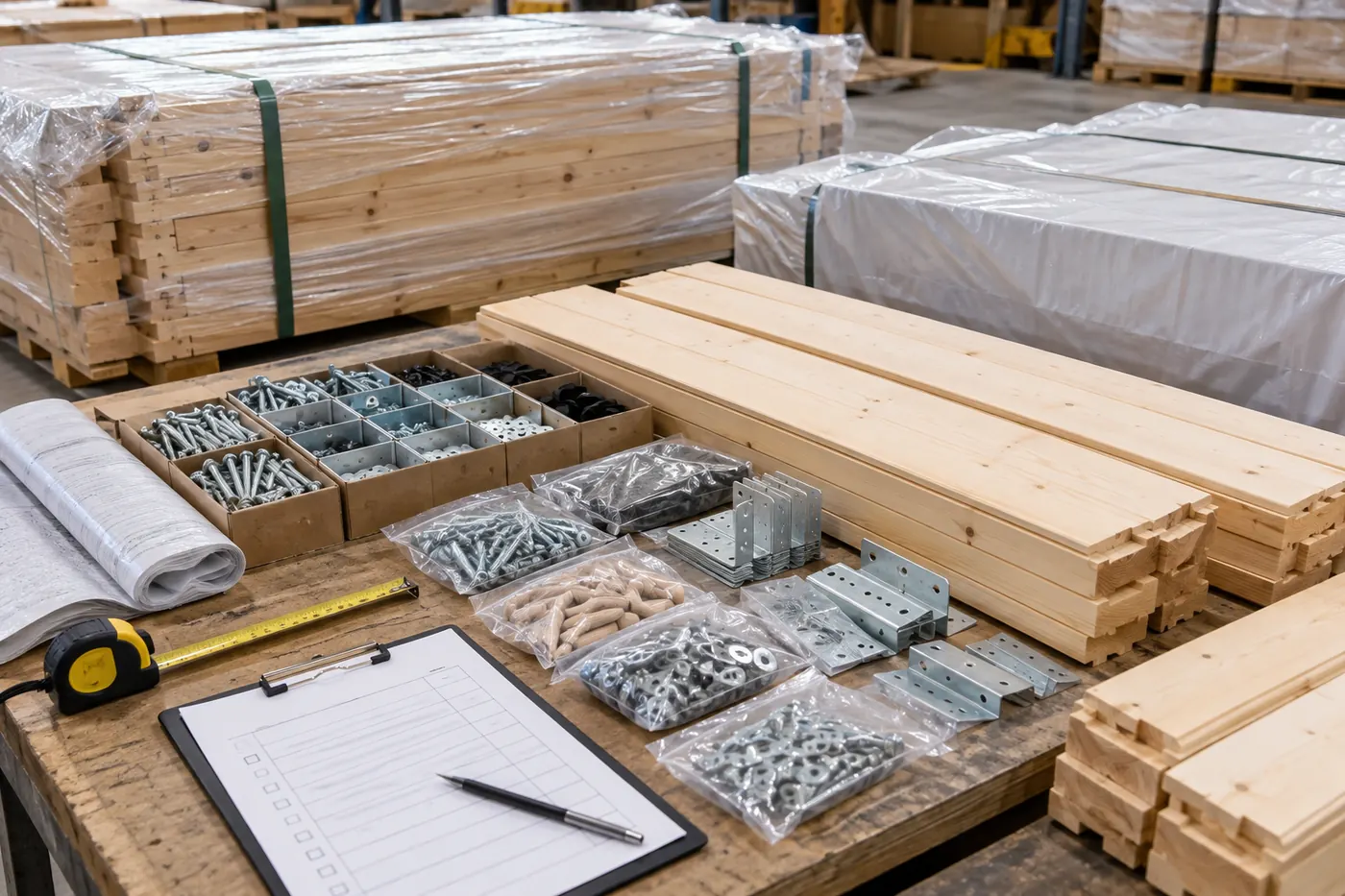
Request a sample bill of materials early and the controlled final issue before packing. It should distinguish supplied quantities, allowances, spares and locally purchased items. Part names should connect with drawings and assembly information. Generic categories such as hardware set or timber pack may be insufficient for receiving and claim evidence.
Check units, lengths and handed components carefully, particularly when buyer and supplier work in different measurement systems. Record approved substitutions with affected drawings and instructions. The buyer should not make field changes to compensate for an apparent mismatch until the responsible technical parties identify the cause and acceptable disposition.
Request a BOM-to-drawing cross-check with units, tolerances and substitution status. Ask: "Can every package and critical part be linked to the accepted design?" Record the answer, owner and due date; do not let pricing from one revision while packing from another become an assumed inclusion or approval.
A question to put in the buyer brief
Can every package and critical part be linked to the accepted design?
3. Specify timber as an engineering material
The USDA Wood Handbook describes wood's variability, moisture relationships and engineering use. Translate the project design into material requirements prepared by competent parties. State the relevant product, grade, dimensions, condition and finish without inventing a universal moisture target or substitution rule for all destinations.
Ask how timber is stored, identified, checked and protected before packing. Machined components should remain traceable to the accepted part list. Visible checking or color variation must be assessed against the agreed material and workmanship criteria rather than judged only from a small photo. Preserve representative records for disputed lots.
Request accepted material schedule plus incoming and pre-pack records. Ask: "Which measurable timber requirements support the design and assembly method?" Record the answer, owner and due date; do not let buying by species name, color or nominal thickness alone become an assumed inclusion or approval.
Further reading: USDA Forest Products Laboratory: Wood Handbook—Wood as an Engineering Material.
A question to put in the buyer brief
Which measurable timber requirements support the design and assembly method?
4. Map purchased components and local supplies
List proprietary and commodity components separately. Obtain available product information and handling requirements for openings, membranes, tapes, fixings and finishes. Do not infer whole-building compliance from one component document. The destination team should determine whether proposed products and combinations suit the design and applicable requirements.
For local-supply items, define the specification and procurement timing before shipping. An instruction that says source locally is incomplete if the installer cannot identify a compatible product. Where alternatives are allowed, state who reviews them and how changes are recorded. Consider future replacement and consumable availability as part of the decision.
Request a component schedule with manufacturer references, quantities and local alternatives. Ask: "Which components are compatible with the supplied kit and available for future replacement?" Record the answer, owner and due date; do not let discovering after delivery that a critical opening or fastener was display-only or locally assumed become an assumed inclusion or approval.
Further reading: European Commission: Construction Products Regulation.
A question to put in the buyer brief
Which components are compatible with the supplied kit and available for future replacement?
Turn these questions into a project brief
Send the destination, model brief, quantity, expected completion level and local assembly plan. Ask CabinWild for available kit inclusions, packing assumptions and technical documents.
5. Design packing around receiving and assembly
Group components by protection need and assembly sequence. Keep small hardware and critical documents identifiable. State lifting points, support requirements and package masses from actual packing information. A tight container plan can still be inefficient if first-use parts are inaccessible or weather-sensitive boards must be unpacked before protected storage is ready.
IPPC resources explain ISPM 15 controls for regulated wood packaging material such as pallets, crates and dunnage in international trade. Confirm current destination and transit requirements with competent logistics and plant-health parties. Do not assume that treatment of packaging establishes anything about the cabin timber itself, or vice versa.
Request a packing plan with package IDs, contents, mass, dimensions and opening sequence. Ask: "Can the receiving team protect and retrieve parts without dismantling the whole shipment?" Record the answer, owner and due date; do not let optimizing container fill while ignoring site storage and assembly order become an assumed inclusion or approval.
Further reading: IPPC: ISPM 15 implementation resources for wood packaging.
A question to put in the buyer brief
Can the receiving team protect and retrieve parts without dismantling the whole shipment?
6. Prepare the assembly organization before dispatch
Review current drawings and instructions with the actual assembly team. Identify lifting equipment, access, work platforms, storage, weather protection, temporary stability, consumables and inspection points. HSE manual-handling guidance emphasizes avoiding, assessing and reducing risk; a package weight alone does not decide a safe handling method.
Agree how technical questions and apparent shortages will be raised. Preserve part and package identities, stop affected work when necessary and obtain written disposition from the responsible party. Site teams should not improvise structural connections or cut unfamiliar components merely to maintain schedule. Plan spares and replacement routes proportionately.
Request an installation-readiness plan reviewed by the responsible site team. Ask: "Who will safely assemble, check and protect the kit using the supplied information?" Record the answer, owner and due date; do not let treating DIY marketing language as a risk assessment or proof of competence become an assumed inclusion or approval.
Further reading: HSE: manual handling at work.
A question to put in the buyer brief
Who will safely assemble, check and protect the kit using the supplied information?
Use an evidence matrix to compare complete proposals
Build a comparison sheet for cabin kit scope, packing and assembly information. Keep each original customer requirement beside the supplier response, responsible party and evidence status. Compare like-for-like scope before ranking price. A blank cell is not a free inclusion; it is an unresolved assumption that may create design, site, logistics or operating work later.
For wood cabin kits for sale, use three statuses: accepted with relevant evidence, accepted subject to a named condition, and unresolved. Conditional acceptance needs an owner and deadline before affected work proceeds. Keep provisional answers visible across the drawings, quotations and records used for this purchase.
Further reading: Related CabinWild buyer guide; Related CabinWild buyer guide; Related CabinWild buyer guide; Browse cabin options; Discuss a project.
| Review item | Evidence to compare | Closing question |
|---|---|---|
| Name the kit completion level | a system description and inclusion-exclusion schedule tied to one model revision | Which transformations have been completed before packing? |
| Control the bill of materials and drawings | a BOM-to-drawing cross-check with units, tolerances and substitution status | Can every package and critical part be linked to the accepted design? |
| Specify timber as an engineering material | accepted material schedule plus incoming and pre-pack records | Which measurable timber requirements support the design and assembly method? |
| Map purchased components and local supplies | a component schedule with manufacturer references, quantities and local alternatives | Which components are compatible with the supplied kit and available for future replacement? |
| Design packing around receiving and assembly | a packing plan with package IDs, contents, mass, dimensions and opening sequence | Can the receiving team protect and retrieve parts without dismantling the whole shipment? |
| Prepare the assembly organization before dispatch | an installation-readiness plan reviewed by the responsible site team | Who will safely assemble, check and protect the kit using the supplied information? |
Run the procurement workflow in four controlled stages
Issue an RFQ with intended use, destination, model, completion target, quantity, local procurement capabilities and assembly route. Ask suppliers to return a marked inclusion schedule and sample document index rather than a single kit total.
Compare the BOM, drawings and component schedule as one controlled package. Request clarification for generic groups, optional display items and local-supply assumptions. Check that the proposed revision is consistent across technical and commercial documents.
Agree inspection and packing evidence before manufacture. Define any dimensional or material checks, accessible workmanship review, package identification, packing-list format and photo requirements. State limitations; shipment photos cannot prove concealed work or destination approval.
Complete receiving and installation preparation before dispatch. Confirm access, unloading, secure dry storage, package opening sequence, tools, competent labor, weather windows and query escalation. Keep a quarantine area for damaged or unidentified parts.
Worked buyer scenario: an illustrative decision sequence
A hypothetical distributor orders six pre-cut cabin kits for local assembly. The first quotation includes timber walls and roof boards but excludes roof covering, windows and membranes. A second offer includes more components but uses package groupings that do not match the proposed installation sequence.
The distributor issues a normalized scope schedule, obtains compatible local-product specifications and asks both suppliers for sample packing plans. The selected route uses numbered packages, a controlled BOM and a receiving checklist. Local professionals review design and foundation interfaces before production release.
The example is not a CabinWild order, price or assembly result. It shows how kit sourcing can move risk into documents and logistics unless those tasks are planned explicitly.
Connect factory testing, shipment inspection and installation preparation
Factory testing for cabin kit scope, packing and assembly information should answer a defined question about the accepted configuration. Agree the method, conditions, acceptance basis and record before the test. Ask what the supplier can genuinely perform and identify features that cannot be verified until site work or services are complete. A demonstration or photograph should not be expanded into structural, regulatory or long-term performance proof.
Shipment inspection for cabin kit scope, packing and assembly information should compare the dispatched scope with the accepted revision, especially component list, quantities, identifiers and revision alignment. Check accessible quantity, visible condition, required documents and agreed markings. Preserve discrepancies before unnecessary unpacking. The inspection cannot establish a characteristic that was never specified, measured or accessible.
Installation preparation should give the site team current drawings, instructions, component information and the interface decisions behind loose material, pre-cut, panelized or hybrid scope. Confirm access, storage, tools, competent labor, weather protection and technical-query routes. Return proposed deviations to the responsible reviewer rather than improvising changes that break the controlled configuration.
At handover for wood cabin kits for sale, record locally completed work, commissioning, outstanding authority checks and maintenance information. Revisit package sequence, weather protection and wood-packaging controls and competence, tools, temporary works, sequence and technical support. Keep customer requirements, product application and responsibility traceable; a checklist describes only the work and observations within its stated scope.
Frequently asked questions
What is normally included in a cabin kit?
There is no universal package. It may contain pre-cut timber, panels, hardware, openings or finishes, but foundations, roof covering, services and installation are often separate. Use the seller's itemized inclusion and exclusion schedule for the exact model.
Should every kit have a bill of materials?
A controlled component list is important for pricing, packing, receiving and claims. Its detail and format vary, but it should identify the accepted configuration, quantities, units, exclusions and relevant part links clearly enough for the planned workflow.
Does ISPM 15 apply to the cabin timber?
ISPM 15 addresses regulated wood packaging material such as pallets, crates and dunnage. The cabin product can have separate plant-health or import requirements. Confirm both with the relevant destination authorities and logistics specialists.
Can an unskilled owner assemble a cabin kit?
Do not infer competence from a DIY label. Review the actual design, instructions, weights, tools, temporary stability, work at height and local requirements. Arrange competent contractors and professional input for tasks beyond the team's capability.
What should I do if parts are damaged on arrival?
Preserve package and part identity, photograph condition before unnecessary movement, note the transport record, protect items from further damage and notify the responsible parties promptly. Do not install a questionable component until an authorized disposition is provided.
Conclusion: buy the defined project, not the label
A good kit purchase is a controlled system of components, information, packing and site responsibility. Define the completion level, keep revision identity intact and plan assembly resources before the container or truck leaves the supplier.
Send CabinWild the destination, desired model, quantity and assembly route. Ask for available inclusion, document and packing information for the proposed kit, then have the local team review design and installation requirements before release.
Request a cabin kit scope schedule
Send the destination, model brief, quantity, expected completion level and local assembly plan. Ask CabinWild for available kit inclusions, packing assumptions and technical documents.
Prepared with AI assistance for CabinWild Editorial using the linked public sources. Examples are illustrative, not customer results or verified CabinWild test data. Project-specific design and local requirements need review by the appropriate professionals.