
A flat-pack cabin is import-ready only when the buyer can connect the quoted design to the packing list, package marks, export documents, unloading plan, protected storage, assembly sequence and local completion work. Confirm the importer and destination obligations before shipment. Compact packing does not by itself establish easy assembly, compliance or a completed project price.
Introduction: compare the complete purchasing decision
A flat-pack cabin is import-ready only when the buyer can connect the quoted design to the packing list, package marks, export documents, unloading plan, protected storage, assembly sequence and local completion work. Confirm the importer and destination obligations before shipment. Compact packing does not by itself establish easy assembly, compliance or a completed project price. This article is a procurement framework for overseas buyers. It is not a product quotation, code opinion, engineering design or customs ruling.
For flat pack cabins for sale, introduction: compare the complete purchasing decision, checkpoint 1: search results and catalogues can help create a shortlist, but they rarely contain the site, contract and operating detail needed for approval. Use the exact configuration, current supplier documents and advice from the responsible destination professionals before committing funds.
For flat pack cabins for sale, introduction: compare the complete purchasing decision, checkpoint 2: examples below are hypothetical decision exercises. They do not describe a CabinWild factory test, customer delivery or verified project result. The aim is to show the questions, evidence and responsibility boundaries a buyer can record.
Further reading: Compare flat-pack and panelized supply.
1. Confirm what flat pack means in the offer
Search results for flat pack cabins for sale can contain numbered timber profiles, preassembled wall frames or mixed packages of structure, windows, membranes and finishes. Ask for a component hierarchy and images tied to the offered revision. A flat pack cabin for sale is not one universal level of completion.
Flat pack log cabins for sale may be practical for experienced installers but unsuitable for buyers expecting furniture-style assembly. Check whether the design depends on site cutting, drilling, sealing or specialist equipment. A flat pack log cabin for sale should state the required competence and which operations remain outside the instructions.
For the comparison record, capture design revision, component groups and site fabrication tasks. Link every answer to a dated drawing, quotation, inspection note or professional response. If the evidence is unavailable, mark the issue unresolved and assign an owner rather than replacing it with a sales assumption.
2. Resolve importer and destination requirements
Identify the importer of record and the adviser responsible for tariff classification, valuation, permits and other agency requirements. Customs outcomes depend on the actual goods, origin, destination and transaction. A seller's previous shipment to the same country is useful context but not a ruling for the buyer's order.
CBP advises U.S. importers to provide a complete description, origin, composition, intended use and payment information when seeking assistance. Apply the same discipline in other markets through the relevant authority and broker. Do not let the phrase flat pack cabins China substitute for an accurate product description.
For the comparison record, capture importer, goods description, origin and destination advice. Link every answer to a dated drawing, quotation, inspection note or professional response. If the evidence is unavailable, mark the issue unresolved and assign an owner rather than replacing it with a sales assumption.
3. Build a document matrix before payment milestones
List the pro forma invoice, final commercial invoice, packing list, transport document, origin evidence and any destination-specific certificates or inspection records. Assign who prepares, checks and receives each item, with a deadline linked to the commercial schedule.
The U.S. International Trade Administration explains that an export packing list is more detailed than a domestic list and is not a substitute for the commercial invoice. Reconcile descriptions, quantities, weights and marks across the documents. A mismatch found after arrival can delay identification and customs work.
For the comparison record, capture document, responsible party, due date and cross-check. Link every answer to a dated drawing, quotation, inspection note or professional response. If the evidence is unavailable, mark the issue unresolved and assign an owner rather than replacing it with a sales assumption.
| Import stage | Minimum evidence | Buyer decision |
|---|---|---|
| Before order | Scope, drawings, package concept | Is the supply practical to complete? |
| Before dispatch | Final packing list, dimensions, marks, documents | Can customs and receiving proceed? |
| At arrival | Seal/package condition and count record | What needs notice or isolation? |
| Before assembly | Dry storage, current instructions, component check | Is the installer ready to start? |
| At handover | As-built changes, tests and maintenance data | Is the completed building ready for use? |
4. Design package marks around assembly logic
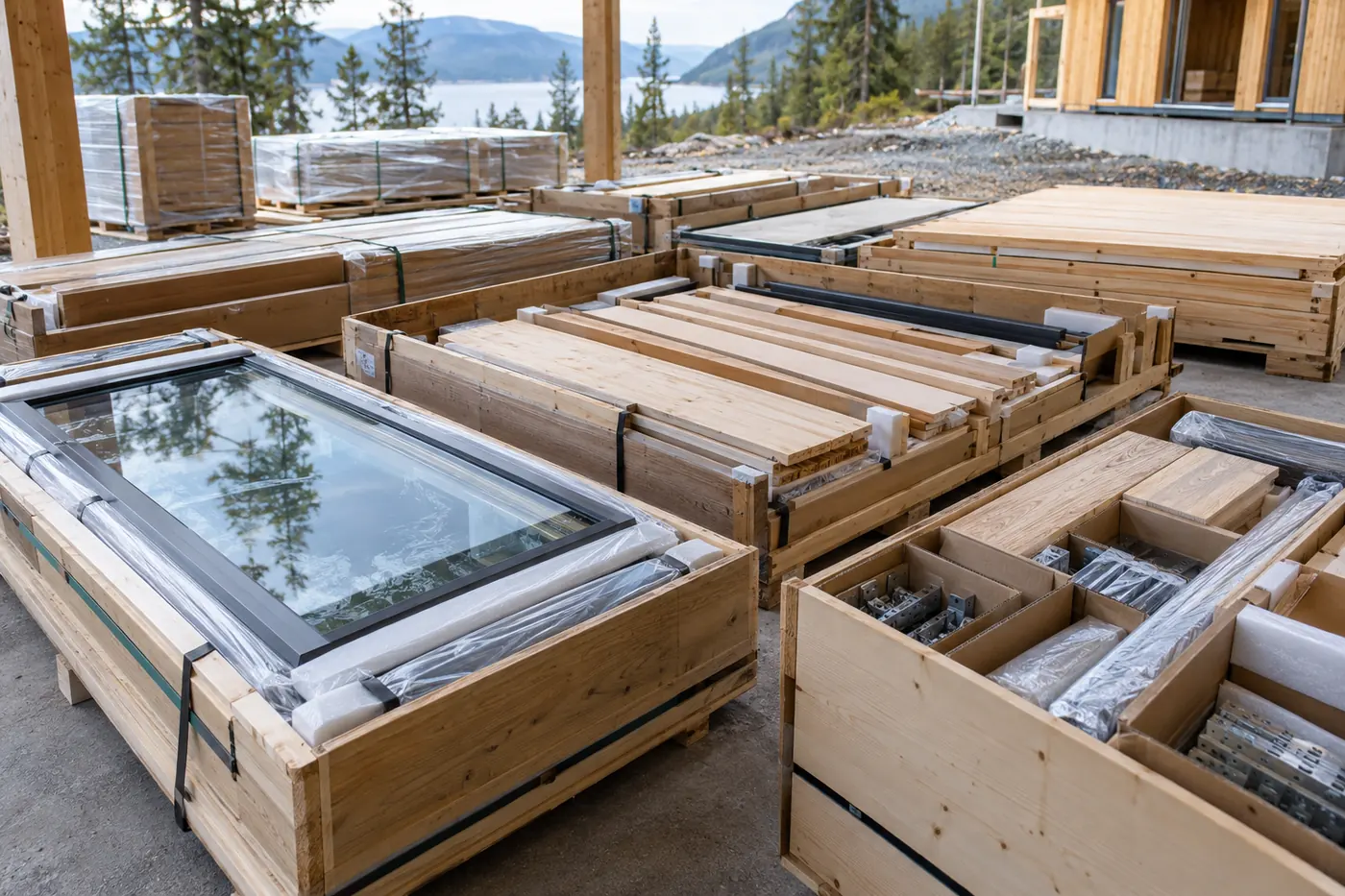
Ask the packing plan to connect every crate or bundle with the bill of materials and assembly sequence. Marks should survive expected handling and remain readable without opening every package. Fragile glazing, membranes, fixings and finish materials need identities that help the receiving team place them in protected storage.
Package optimization should not make inspection impossible. Agree which packages may be opened before shipment and at arrival, how resealing is handled and how photographs show identity. A dense container load is not automatically a good project outcome if the first required component is inaccessible or package groups cannot be verified.
For the comparison record, capture package mark, contents, sequence, protection and inspection access. Link every answer to a dated drawing, quotation, inspection note or professional response. If the evidence is unavailable, mark the issue unresolved and assign an owner rather than replacing it with a sales assumption.
5. Specify transport responsibilities precisely
Choose the Incoterms 2020 rule and named place with qualified commercial advice. State the exact point, not only a city or port where several terminals exist. Confirm who books each carriage stage, clears the goods, arranges insurance where required and handles charges not visible in the supplier's product price.
Incoterms does not decide assembly quality, payment security, ownership transfer or final cabin acceptance. Address those matters elsewhere in the contract. Maintain a route-specific logistics sheet with carrier limits, transshipment, destination handling, final delivery and unloading assumptions.
For the comparison record, capture trade term, named place, carriage stages and risk boundary. Link every answer to a dated drawing, quotation, inspection note or professional response. If the evidence is unavailable, mark the issue unresolved and assign an owner rather than replacing it with a sales assumption.
Further reading: Plan export packaging for a cabin kit.
Turn these questions into a project brief
Send your destination, intended use, site access and installer plan. Ask for package data, document deliverables, assembly information and exclusions before shipment.
6. Prepare unloading and protected storage
Use confirmed package dimensions and masses to let a competent local team plan equipment, access and storage. Avoid treating a total shipment weight as enough information; individual bundles may drive the handling choice. Check ground, overhead restrictions, turning space and the sequence from vehicle to protected laydown area.
Keep timber and moisture-sensitive materials off unsuitable ground and protected according to the supplier's instructions and local plan. Ventilation, rain protection and inspection access can conflict if improvised. OSHA material-handling rules provide U.S. construction context, but the actual site requires its own competent safe-work plan.
For the comparison record, capture package mass, equipment, access, supports and protection. Link every answer to a dated drawing, quotation, inspection note or professional response. If the evidence is unavailable, mark the issue unresolved and assign an owner rather than replacing it with a sales assumption.
7. Review assembly information before dispatch
Provide the installer with drawings, component lists, connection details, tolerances and the proposed sequence early enough to raise questions. Translate instructions where necessary and control the final language version. A picture-only manual may be helpful but cannot resolve every dimensional or service interface.
Ask how missing, damaged or out-of-tolerance components are reported and replaced. Clarify whether local alternatives are permitted and who approves them. Unrecorded substitutions can create later weathering, finish or warranty disputes even when assembly appears to continue successfully.
For the comparison record, capture installer review, controlled instructions and substitution process. Link every answer to a dated drawing, quotation, inspection note or professional response. If the evidence is unavailable, mark the issue unresolved and assign an owner rather than replacing it with a sales assumption.
Further reading: International Trade Administration: Common Export Documents; ICC: Incoterms 2020.
8. Plan factory and shipment inspection in stages
A pre-shipment check can compare package identity, count, visible protection and accessible components with the approved documents. Define sampling and limitations. It cannot inspect every concealed face or guarantee what will occur during transport and storage.
At arrival, preserve container or vehicle condition, seal information where relevant, package marks and visible damage before moving the load. Follow the contract, carrier and insurer notice requirements. Do not assume signing a delivery document either removes all rights or proves the shipment was complete; obtain appropriate commercial advice.
For the comparison record, capture inspection scope, accessible evidence, notice route and custody. Link every answer to a dated drawing, quotation, inspection note or professional response. If the evidence is unavailable, mark the issue unresolved and assign an owner rather than replacing it with a sales assumption.
For flat pack cabins for sale, plan factory and shipment inspection in stages, checkpoint 3: review this point against the actual customer requirements and product application. The same answer may change with climate, occupancy, route, local rules or installer capability. Preserve those conditions so a later reviewer can understand why the decision was made and when it needs to be reopened.
9. Separate assembly from completed-building handover
The flat-pack contract may end with supplied materials while the buyer still needs foundations, assembly labor, roof completion, services, finishes and local inspections. Create a destination responsibility map. Link every excluded task to a contractor or adviser instead of leaving it implicit.
Commission relevant services and inspect the completed envelope through the responsible teams. Retain as-built changes, product information and maintenance instructions. A cabin that stands upright is not necessarily ready for its intended occupancy, and a supplier's material warranty is not a substitute for complete site acceptance.
For the comparison record, capture site tasks, commissioning, approval and handover documents. Link every answer to a dated drawing, quotation, inspection note or professional response. If the evidence is unavailable, mark the issue unresolved and assign an owner rather than replacing it with a sales assumption.
Review this point against the actual customer requirements and product application.
Further reading: U.S. Customs and Border Protection: Tips for New Importers and Exporters; OSHA: Construction materials handling and storage; Prepare the cabin arrival inspection.
10. Run an import-readiness gate
Before authorizing shipment, confirm that the site can receive and protect the packages, the importer has reviewed documents, the installer has accepted the information, and unresolved design matters have owners. Hold the shipment if a critical dependency is still based on an assumption.
For a hypothetical small-resort order, the gate might reveal that the cabin materials are ready but the final delivery vehicle cannot reach the storage area. Resolving that route before dispatch is better than presenting the factory completion date as overall readiness. The example illustrates process, not a CabinWild shipment history.
For the comparison record, capture shipment release status, blockers, owners and evidence. Link every answer to a dated drawing, quotation, inspection note or professional response. If the evidence is unavailable, mark the issue unresolved and assign an owner rather than replacing it with a sales assumption.
For flat pack cabins for sale, run an import-readiness gate, checkpoint 4: review this point against the actual customer requirements and product application. The same answer may change with climate, occupancy, route, local rules or installer capability. Preserve those conditions so a later reviewer can understand why the decision was made and when it needs to be reopened.
Practical procurement workshop
Prepare a one-page decision sheet
For flat pack cabins for sale, practical procurement workshop, checkpoint 5: put the intended use, destination, site constraints, selected configuration and required operating date at the top. Below them, list the package boundary, local work, evidence, quotation validity and open decisions. This sheet should point to controlled source documents rather than trying to reproduce every technical detail.
For flat pack cabins for sale, practical procurement workshop, checkpoint 6: use a simple status of confirmed, conditional, unresolved or not applicable. A conditional answer must state the condition. A hypothetical option can remain under review without being presented as a supplier commitment. The discipline is especially useful when several people join the buying process at different times.
Run the installation-preparation review
For flat pack cabins for sale, practical procurement workshop, checkpoint 7: before shipment or site mobilization, bring together the current drawings, package data, access plan, foundation readiness, service interfaces, protection method and installer questions. Confirm which revisions everyone is using. Installation preparation should close coordination gaps while changes are still controllable.
For flat pack cabins for sale, practical procurement workshop, checkpoint 8: record the scope of factory testing and shipment inspection separately. Factory testing can verify stated criteria at the manufacturing stage; shipment inspection can record identity, count and accessible condition. Neither automatically establishes final site performance, local approval or suitability for an unreviewed use.
Use a stop rule for missing evidence
For flat pack cabins for sale, practical procurement workshop, checkpoint 9: agree which unanswered questions prevent design release, payment, production, dispatch or occupation. The stop rule should be proportionate and assigned to the party able to close it. It protects the buyer from turning an acknowledged gap into an accidental acceptance merely because the schedule becomes urgent.
For flat pack cabins for sale, practical procurement workshop, checkpoint 10: if information changes, update the decision sheet and the relevant contract or drawing record. Do not leave a critical instruction only in an email thread or meeting memory. Traceability supports fair clarification with the supplier and helps local teams distinguish accepted information from earlier options.
FAQ: Flat-Pack Cabins for Sale: An Import and Assembly Readiness Guide
Are flat-pack cabins always shipped in one container?
No. The number and type of transport units depend on the design, quantity, packaging, route and carrier restrictions. Obtain final package dimensions and masses before planning freight, unloading or storage. Do not infer capacity from a marketing image or a different model's shipment.
What documents should accompany a flat-pack cabin import?
Requirements vary by destination and goods. Common documents can include commercial invoice, packing list, transport document and origin evidence, with additional certificates or permits where required. Ask the importer, broker and destination authorities to confirm the actual list before shipment.
Does compact packaging mean easy DIY assembly?
No. Packing density says little about required skills, tools, lifting, tolerances, weather protection or service work. Ask an intended installer to review the controlled assembly information and component data. A package can be efficient to transport while still requiring professional site work.
When should shipment inspection occur?
Define checks before dispatch and again at receipt. Factory inspection can verify accessible package identity and protection; arrival inspection records transport condition and package status. Each stage has limits. Link the process to contract, carrier and insurer notice requirements instead of relying on one inspection.
How should missing parts be handled?
Agree the reporting route, evidence, response time, replacement responsibility and approval of any local alternative before ordering. Keep package and component identities traceable. Do not substitute structural, weathering or service items without the responsible technical review simply to keep assembly moving.
Conclusion: make the package boundary visible
A flat-pack cabin is import-ready only when the buyer can connect the quoted design to the packing list, package marks, export documents, unloading plan, protected storage, assembly sequence and local completion work. Confirm the importer and destination obligations before shipment. Compact packing does not by itself establish easy assembly, compliance or a completed project price. The useful output is a dated decision supported by drawings, scope, quotations and responsible reviews, not a label or headline figure.
For flat pack cabins for sale, conclusion: make the package boundary visible, checkpoint 11: send CabinWild the destination, intended use, layout priorities, access information and expected supply boundary. Ask for a configuration-specific response, then coordinate it with qualified destination advisers, logistics providers and installers before ordering.
Request an import-ready flat-pack scope
Send your destination, intended use, site access and installer plan. Ask for package data, document deliverables, assembly information and exclusions before shipment.
Prepared with AI assistance for CabinWild Editorial using the linked public sources. Examples are illustrative, not customer results or verified CabinWild test data. Project-specific design and local requirements need review by the appropriate professionals.