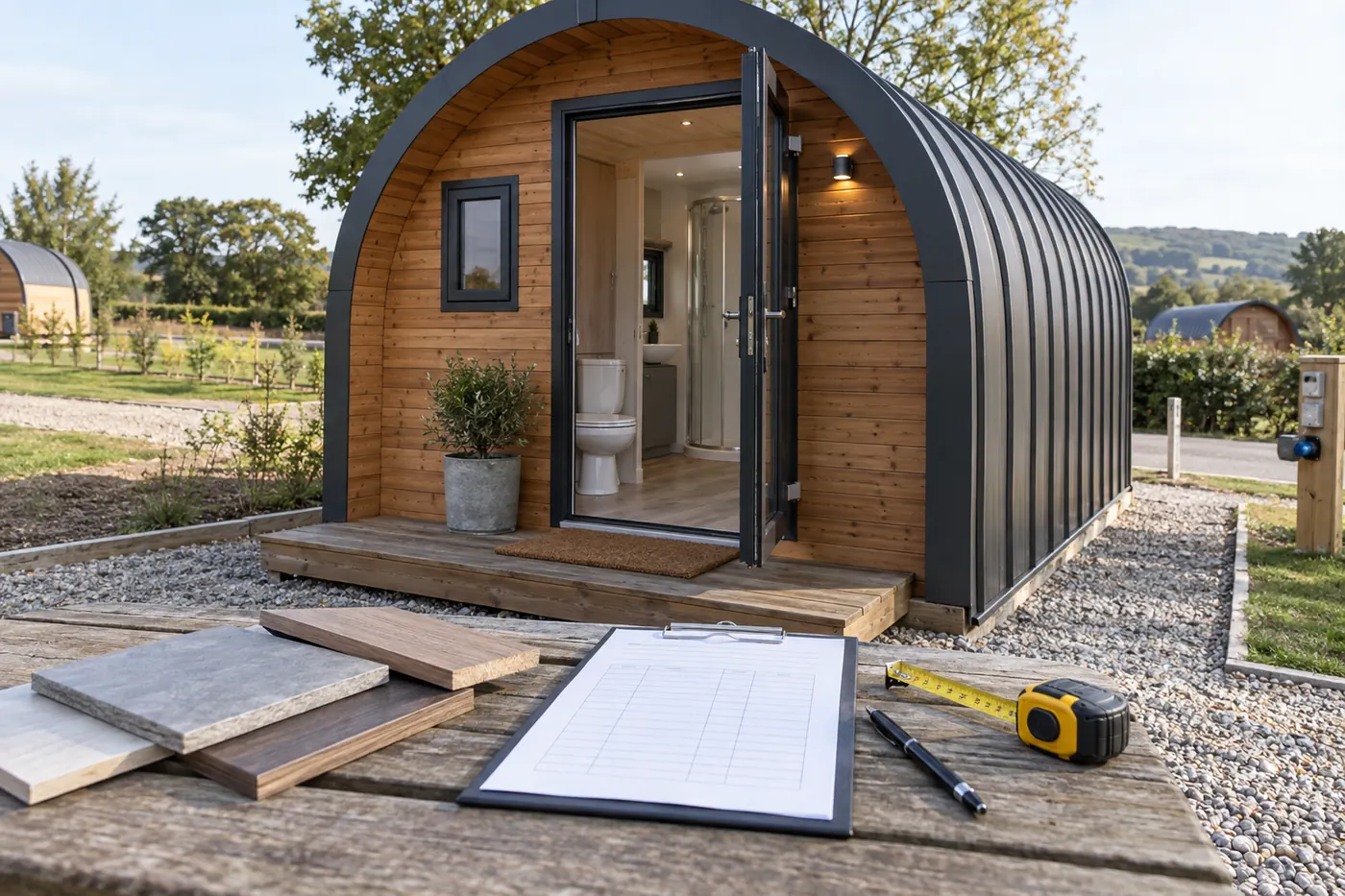
Glamping cabin cost is the sum of the specified unit, logistics, destination works, services, approvals and opening preparation at one defined completion stage. A pod with a bathroom is not directly comparable with a camping shell that uses shared facilities. Use actual quotations, keep unknowns visible and evaluate maintenance and replacement duties as well as first cost.
Introduction: define the product before comparing its cost
What is a glamping cabin? In procurement terms, it is an accommodation product whose construction, fitout and service scope must be described rather than assumed from the label. Pod, hut, cabin and lodge are used differently by sellers and markets. The name does not establish dimensions, mobility, code classification, seasonal suitability or whether guests can occupy it after delivery.
A useful cost comparison therefore starts with one completion statement. Decide whether the budget ends at a component package, an enclosed shell, a fitted unit on a prepared base or accommodation accepted for operation. Every proposal should be reconciled to that same point. Otherwise, the apparent price difference may simply be work transferred to the buyer.
This guide does not publish market averages, describe a completed CabinWild project or predict revenue. It offers a transparent method for camping and glamping buyers to compare actual quotations. Taxes, approval routes, labour, transport and site services vary by destination and must be checked by the responsible local parties.
1. Separate the product label from the technical scope
Ask every seller to describe the structural system, envelope, floor area, openings, internal finish, furniture and services. Confirm whether the unit is mobile, modular, panelized or assembled from prepared members, because those terms affect transport and site work. Record the intended product application and occupancy without assuming that a marketing category establishes legal status.
For camping cabins for sale, the bathroom may sit in a shared facility and the cabin may contain only sleeping space. Glamping pods for sale with bathroom move water, drainage, ventilation and maintenance access into each unit. That changes both supply scope and site infrastructure. Compare the complete guest offer, not a shell and an ensuite unit as if they were equivalents.
2. Build a quote-based cost model
Use separate rows for design and review, supplied package, selected options, freight, import treatment, unloading, groundworks, assembly, utilities, fitout, commissioning and an explicit risk allowance. Enter the source and date beside every amount. Leave a line unknown until it has a defensible quotation or allowance; entering zero creates a false sense of completeness.
Record whether each amount applies per unit, per shipment, per plot or to the whole site. A shared wastewater upgrade cannot be divided mechanically unless capacity and phasing support that allocation. Similarly, a supplier's package total should not be multiplied again if it already covers the stated batch. Review quantity assumptions with the estimator before comparing unit rates.
Further reading: Use the broader prefab cabin budget method.
3. Price the bathroom as a coordinated system
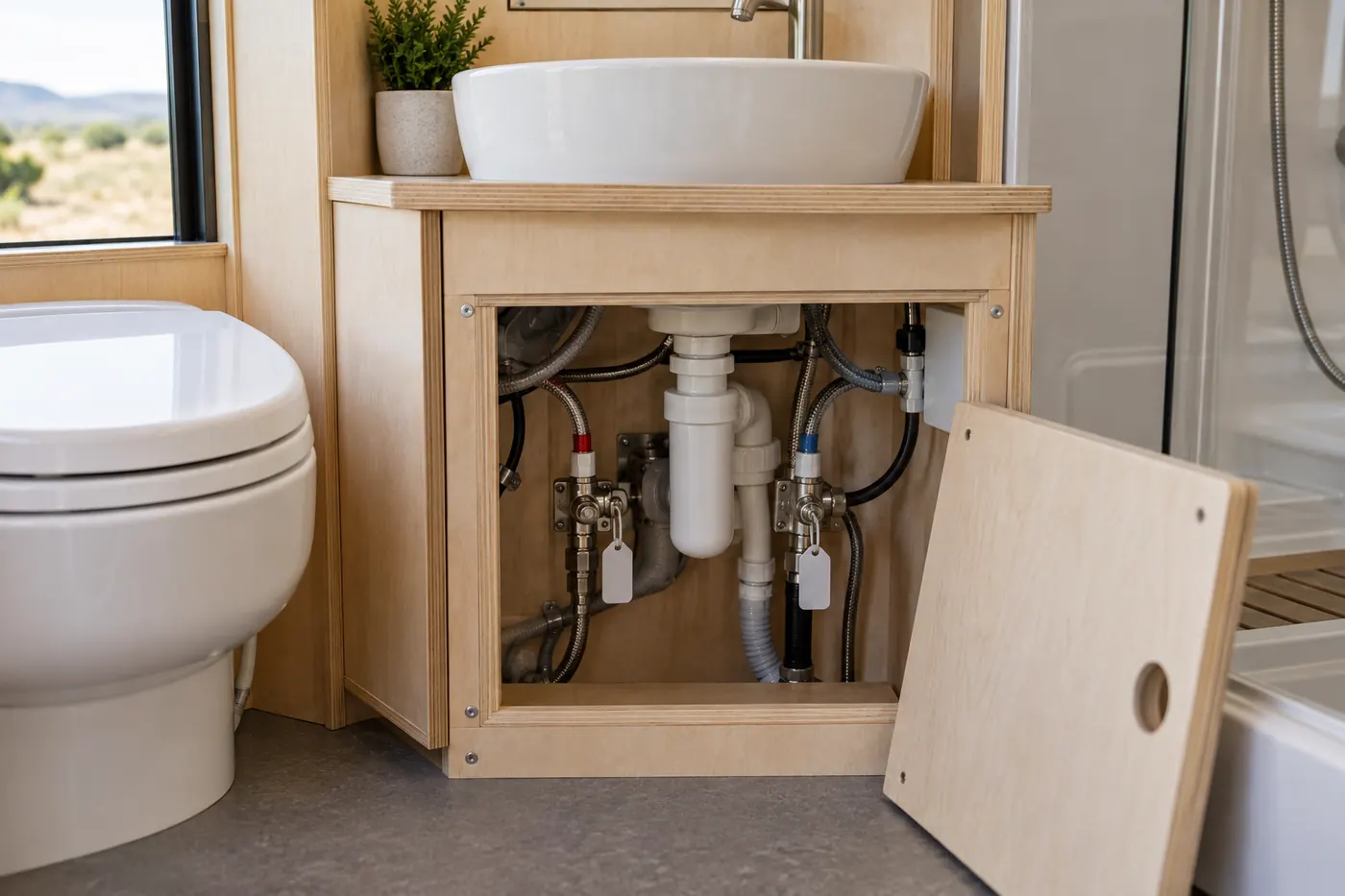
An ensuite quotation should identify fixtures, waterproofing boundary, ventilation, hot-water equipment, pipework extent, access panels and connection points. Ask which parts are installed and which are merely shown. The room may look complete while its external water, waste and electrical interfaces remain entirely within the destination contractor's scope.
Review maintenance access before approving compact cabinetry. Shutoff valves, traps, pumps and connections should be reachable without destructive removal of unrelated finishes. EPA WaterSense resources illustrate how leak checks, fixture selection and hot-water delivery are considered as connected household water topics in the United States. Use the destination's own requirements; WaterSense is not a global compliance certificate.
Further reading: US EPA: WaterSense homes technical reference manual; Review cabin bathroom and kitchen specifications.
6. Check the evidence behind each cost line
A useful supplier response should connect every important statement to a named document. For glamping cabin or pod cost comparison, that means drawings with revision identifiers, a written component or room schedule, declared exclusions and the evidence needed for included fitout, service readiness and quoted completion stage. Marketing photographs can help explain appearance, but they cannot define dimensions, hidden layers, regulatory status or the work left for the destination team.
Further reading: WBDG: construction cost estimating guidance; Review glamping pod fitout budgets.
| Decision record | Minimum content | Release question |
|---|---|---|
| Buyer brief | Use, destination, quantity and completion stage | Has the supplier answered the current brief? |
| Drawing set | Revision, dimensions, openings and service zones | Has the destination reviewer accepted this revision? |
| Supply schedule | Included, optional and excluded items | Can each quotation line be traced to scope? |
| Evidence register | Records relevant to included fitout, service readiness and quoted completion stage | Does the evidence cover the offered configuration? |
| Open-item log | Owner, due date and effect if unresolved | Is the remaining uncertainty acceptable before release? |
Maintain a controlled clarification log
For glamping cabin cost, check the evidence behind each cost line, checkpoint 1: create a clarification log with one row for the question, supplier response, supporting file, responsible reviewer and closure date. Separate confirmed facts from assumptions and optional proposals. When a drawing changes, reopen any decision affected by the revision. This simple discipline prevents an old email or a visually similar product photo from quietly becoming the specification for the current order.
Check whether evidence applies to the offered configuration
For glamping cabin cost, check the evidence behind each cost line, checkpoint 2: where performance matters, ask which document applies to the offered configuration and who is qualified to interpret it in the destination. A generic certificate, test report or calculation may describe another size, material or assembly. This article does not confirm regulatory compliance, structural adequacy, thermal performance or product approval; those conclusions belong to the relevant local authorities and competent professionals.
Turn these questions into a project brief
Send the destination, unit quantity, room functions, bathroom boundary, preferred supply format and delivery point. Ask for inclusions, exclusions and work remaining after arrival.
4. Compare prefab transport and local assembly
Camping cabin prefab formats may arrive as volumetric units, panels or prepared component sets. A completed pod uses transport space differently from a flat pack and may require lifting equipment, turning space and delivery-route surveys. A component package may be easier to move but needs protected storage, sequencing and a capable assembly team.
Ask for package dimensions, weights, lifting or handling points, unloading boundary and moisture protection. Then obtain a destination plan and quotations. Do not infer that a lower freight line produces a lower completed cost; it may coincide with more labour, temporary works or repeat travel at the site.
5. Compare ownership duties, not only purchase price
A total-cost discussion should include planned inspection, cleaning access, consumables, service visits, replacement components and eventual refurbishment. The Whole Building Design Guide describes life-cycle cost analysis as comparing alternatives that meet the same performance requirements while considering acquisition, operation, maintenance, replacement and disposal. That is a decision principle, not a ready-made cabin cost model.
Choose a common study period and write down operating assumptions. Do not claim energy or maintenance savings without project evidence. For a first decision, identify cost categories and critical differences rather than inventing precise future values. A maintainable service panel or standardized fitting can matter operationally even when it adds a modest amount to the first quotation.
Further reading: WBDG: life-cycle cost analysis.
8. Run a staged buyer review for glamping cabin or pod cost comparison
For glamping cabin cost, run a staged buyer review for glamping cabin or pod cost comparison, checkpoint 3: hold a short review at three points: before requesting prices, before approving drawings and before releasing shipment. At the first meeting, read the buyer brief aloud and ask each discipline to identify missing inputs. At the second, trace the current drawings to the supplier schedule. At the third, confirm that agreed evidence, packaging information and destination readiness belong to the same revision.
Use a hypothetical decision worksheet rather than an invented customer story. Put the options for “glamping cabin cost” and “what is a glamping cabin” in adjacent columns, then compare required functions, included scope, local work, open evidence and consequence of delay. This scenario is a review method only; it does not represent a CabinWild order, tested result or typical price.
Assign one owner to every unresolved interface.
For glamping cabin cost, run a staged buyer review for glamping cabin or pod cost comparison, checkpoint 4: add a “do not release until” column. Examples include an accepted drawing, confirmed access route, local utility design, selected fixture, verified opening size or agreed packing plan. Use release criteria that can be evidenced. Phrases such as “generally acceptable” or “similar to the photo” are not useful gates because different reviewers can interpret them differently.
For glamping cabin cost, run a staged buyer review for glamping cabin or pod cost comparison, checkpoint 5: when a requirement changes, record the request, reason, affected documents, cost and programme response before accepting it. Ask whether the change alters packaging, structural review, service capacity, maintenance access or destination work. A small visible change can have several hidden consequences. Keep the previous baseline so the purchasing team can explain the commercial movement.
For glamping cabin cost, run a staged buyer review for glamping cabin or pod cost comparison, checkpoint 6: close the workshop with a one-page decision note: selected option, rejected alternatives, key assumptions, open items, responsible reviewers and next authorization. Attach rather than summarize the supporting files. This creates experience-based discipline without pretending that generic guidance can replace project evidence, professional judgment or the buyer's final commercial approval.
- Confirm the article's first buyer question: What is a glamping cabin?
- Confirm the second buyer question: What changes the cost of a bathroom pod?
- Confirm the third buyer question: How can buyers compare complete project scope?
- Name every unresolved interface and its owner.
- Issue a dated decision note linked to controlled documents.
Coordinate factory review, shipment inspection and installation preparation
For glamping cabin cost, coordinate factory review, shipment inspection and installation preparation, checkpoint 7: define factory testing and workshop checks from the contracted supply scope. Depending on the product, these may include dimensional checks, trial fitting, finish samples, hardware operation or service-component identification. Agree the procedure, acceptance criteria, sampling basis and record format before production release. CabinWild does not claim here that any named test has been completed for a particular order.
For glamping cabin cost, coordinate factory review, shipment inspection and installation preparation, checkpoint 8: shipment inspection serves a different purpose. Reconcile packages with the packing list, photograph accessible condition, record protection and identify the documents travelling with the goods. The inspection cannot prove that concealed work complies or that the destination site is ready. Damage, shortage and document exceptions need a dated route for notice and resolution under the actual contract and transport arrangements.
Installation preparation should cover foundation interfaces, utility capacity, drainage, unloading and commissioning. Confirm who checks the base, access, lifting or manual-handling plan, weather protection, temporary storage, utilities and local inspections. A delivery date is not an occupancy or operating date. Keep commissioning and final acceptance separate, with named people responsible for closing outstanding work and retaining the handover information.
Further reading: Plan flat-pack delivery and receiving evidence.
- Approve the current buyer brief and drawing revision.
- Match factory checks to the actual contracted supply scope.
- Inspect shipment identity, quantity, protection and visible condition.
- Confirm destination readiness for foundation interfaces, utility capacity, drainage, unloading and commissioning.
- Record installation, commissioning and handover responsibilities separately.
9. Compare quotations without hiding unknown work
For glamping cabin cost, compare quotations without hiding unknown work, checkpoint 9: normalize proposals before judging them. Put the same destination, quantity, layout revision, material requirements, delivery point and completion stage at the top of every comparison. Then identify the work remaining after each offer. A lower figure can be commercially sound, but it may also stop at a different boundary. Price differences become useful only when the scope difference is visible.
For glamping cabin cost, compare quotations without hiding unknown work, checkpoint 10: ask for optional items as explicit additions or substitutions rather than informal promises. If one option changes geometry, weight, service demand, packaging or installation sequence, request a coordinated quotation update. Do not change a visible finish price while assuming that related interfaces and labour remain unaffected. Preserve the earlier revision so the purchasing team can explain why the selected total changed.
For glamping cabin cost, compare quotations without hiding unknown work, checkpoint 11: use a weighted decision record only after mandatory requirements are satisfied. Suitable headings may include usability, documentation, local work, logistics, maintainability and commercial clarity.
| Comparison line | What to normalize | Common hidden difference |
|---|---|---|
| Design | Same approved layout and dimensions | Older drawing or smaller usable area |
| Envelope | Named wall, roof, floor and opening build-ups | Finish described without the complete assembly |
| Fitout | Same fixtures, furniture and service boundary | Room shown but equipment excluded |
| Logistics | Named destination and unloading boundary | Freight, access or storage left to buyer |
| Handover | Same records, checks and completion state | Delivery described as ready for use |
Frequently asked questions
What is a glamping cabin for purchasing purposes?
It is an accommodation unit defined by its actual design, construction, fitout, services and delivery format, not by the marketing label alone. State occupancy, operating season, room functions and completion stage. A pod, hut or cabin may suit the same guest concept while leaving very different transport and site responsibilities.
What usually changes glamping cabin cost?
Major drivers include size and geometry, envelope and openings, internal finish, bathroom and kitchen scope, factory completion, order quantity, transport, destination access, foundations, utilities, local labour, approvals and commissioning. Their effect must come from actual quotations and design review; a universal percentage would be unreliable.
Does a pod with a bathroom include site connections?
Only if the quotation and contract say so. A unit can include internal fixtures and pipework while leaving external water, drainage, power, testing and approvals to the buyer. Request an interface schedule that names connection points, design conditions, responsible parties and the records required at commissioning.
Can buyers compare products using price per square metre?
Only after aligning area definitions and supplied scope. Keep total project amounts visible and state whether decks, lofts, bathrooms and low-headroom zones are included in the denominator. A shell unit rate should not be compared directly with an opening-ready accommodation rate.
How should an unknown local cost be handled?
Keep it explicitly unknown or obtain a dated allowance from the responsible professional or contractor. Do not enter zero unless the work is genuinely unnecessary or included in another identified line. Track the owner and due date so the purchasing decision shows which uncertainties remain.
Conclusion: cost follows scope
A credible glamping cabin cost comparison explains exactly what the buyer receives and what remains. Define the product, normalize the completion stage, separate shared site work from unit work and preserve unknown items until they are priced. This method supports a commercial decision without pretending that one online figure can describe every destination.
Send CabinWild the cabin quantity, destination, guest capacity, bathroom and kitchen needs, preferred delivery format and expected completion stage. Ask for a structured inclusion and exclusion schedule that your destination team can review beside local quotations.
Further reading: Contact CabinWild about a project brief.
Request a scope-based pod or cabin quotation
Send the destination, unit quantity, room functions, bathroom boundary, preferred supply format and delivery point. Ask for inclusions, exclusions and work remaining after arrival.
Prepared with AI assistance for CabinWild Editorial using the linked public sources. Examples are illustrative, not customer results or verified CabinWild test data. Project-specific design and local requirements need review by the appropriate professionals.