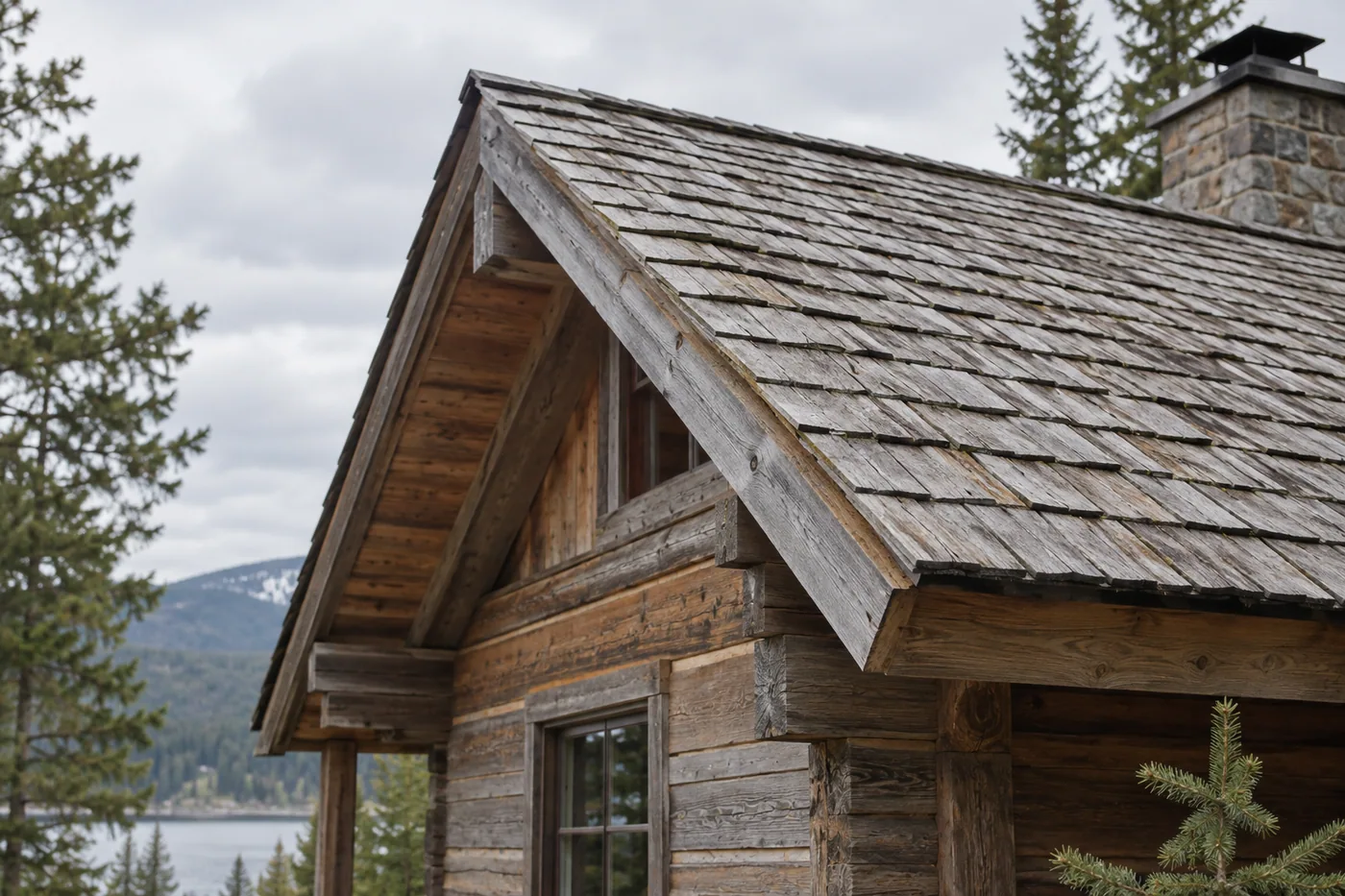
A cabin reroofing scope should identify the existing roof, the proposed replacement and what remains uncertain beneath the covering. Agree investigation, temporary weather protection, interface work, hold points and responsibility for unexpected conditions before ordering materials. The choice of covering is only one part of the decision. Structural suitability, safe access and applicable local requirements need competent assessment.
Introduction: replacing a covering is not always the whole job
A search for log cabin roofing ideas can begin with colours and materials. For an existing building, the first useful comparison is between complete work scopes. The visible covering may be only one part of the required work, and a quotation can look inexpensive because it assumes that every concealed part remains suitable.
This guide helps a buyer prepare an evidence-led reroofing brief. It does not provide roof-access instructions, structural calculations or a method for removing materials. Roof work involves serious hazards and should be planned and performed by competent professionals using appropriate controls. Do not climb onto a roof to gather information for this checklist.
The procurement objective is to separate known work, investigated conditions and unresolved risks. That gives the owner and contractor a shared basis for decisions when the roof is opened. It also avoids interpreting a material-only price as the total cost of making the building weather-ready again.
Identify the roof that actually exists
Gather original roof drawings, component schedules, previous repair records and any known alterations. Note which information matches the building and which remains uncertain. A current catalogue illustration may differ from an older delivered cabin, and a former owner's repair may have changed the assembly without updating the original documents.
Ask a competent roofing professional to define the initial assessment and any further investigation needed. The owner can supply accessible photographs and records, but should not be expected to assess hidden structure or walk on a roof. Keep observations separate from conclusions: staining or a reported leak may justify investigation without establishing its source.
Record the intended future use and any changes in equipment or roof features. A replacement proposal should not assume that a roof designed for one arrangement automatically supports a different covering or added equipment. Appropriate designers must assess the actual proposal, with local requirements and the existing building considered together.
Further reading: UK government: building regulations approval overview.
Divide the work into known, conditional and excluded items
Ask each quotation to identify what is included in the defined replacement, what is allowed for pending investigation and what is excluded. Use the same headings across bidders. If one proposal includes investigation and making good while another prices only a new covering, the totals do not describe equivalent work.
Conditional items should have a decision process, not merely a phrase such as extras if needed. State who assesses the exposed condition, who authorizes additional work and how the cost and programme will be agreed. The contractor should not have to guess the owner's intent while the building is temporarily exposed.
Exclusions also need an owner. If wall junctions, drainage components or internal repairs are excluded, identify who investigates and prices them. Leaving a task outside the roofer's scope does not remove it from the project. The final decision should account for the whole building interface, including any necessary coordination between trades.
| Workstream | Define before ordering | Evidence or decision needed |
|---|---|---|
| Existing-condition assessment | Accessible review and proposed investigation | Dated findings and remaining unknowns |
| Removal and protection | Scope, responsible contractor and protection plan | Reviewed sequence and site arrangements |
| Supporting assembly | What is retained and what is conditional | Competent assessment when relevant work is exposed |
| New covering | Actual product and complete specified system | Relevant product and design information |
| Edges and junctions | Included interfaces and trade boundaries | Coordinated details and acceptance responsibility |
| Completion | Checks, records and reinstatement scope | Handover evidence and outstanding issue list |
Compare log cabin roofing options as complete systems
Different coverings can have different installation, support, maintenance and detailing requirements. A buyer should request the complete proposed system and the basis for its suitability, not select solely from a photograph. Appearance matters, but it does not establish compatibility with the existing cabin or the local conditions.
When a quote refers to log cabin roofing felt, ask which actual product and arrangement is proposed. A broad category name is insufficient to establish the complete specification. Likewise, a more expensive-looking covering is not automatically a performance upgrade when the supporting assembly and interfaces have not been assessed.
Avoid turning an illustrative lifespan into a guarantee. Request the applicable product information, installation requirements and warranty terms, and distinguish them from the contractor's workmanship obligations. Any claim should match the actual proposed system and conditions. This guide provides no universal roof life, cost range or maintenance interval.
Keep visual selection after the feasibility review
Create a shortlist of technically reviewed options before choosing the final appearance. Record the accepted product and finish so ordering does not substitute a similar-looking item without review. If the visual choice changes the specified system, return it to the relevant professionals before release rather than treating colour approval as approval of every technical consequence.
Plan for concealed conditions without assuming every roof is defective
Existing buildings introduce uncertainty because not everything is visible before work begins. That uncertainty should be described proportionately. Do not assume hidden damage, but do not promise that supporting components are sound merely because the exterior looks tidy. The competent assessment should identify what is known and what can only be confirmed later.
A useful conditional-work procedure names the observation that triggers review, the person authorized to assess it and the evidence required. It also defines how the building will remain protected while a decision is pending. The owner should know whether a delay could affect occupation, equipment or other work inside.
Keep the original scope and later approved changes distinguishable. A photograph of exposed work, a professional finding and an authorized response can form part of the record. A casual conversation with no agreed instruction is a weak basis for both technical and commercial accountability. Do not retrospectively invent an inspection that did not occur.
Turn these questions into a project brief
Send the cabin identity, available roof records and your local roofer's information requests. Ask which original component details are available.
Make temporary weather protection an explicit responsibility
Roof replacement creates a period when the building's normal protection may be interrupted. Ask the contractor to explain how temporary protection is included in its reviewed method and what conditions affect the sequence. This article does not prescribe tarpaulin arrangements, weather limits or work-at-height techniques; those belong to competent project planning.
Coordinate the work with the operator. Decide whether the cabin will be occupied, what contents need protection or removal and how access will be controlled. Do not assume a rental unit can remain available simply because the roof work is described as minor. The responsible parties must assess the actual operation and its constraints.
Define communications for changing conditions. The owner should know who can pause work, who receives an update and how a revised programme is accepted. Price and document any agreed alternative arrangements before they become urgent. A weather contingency with no responsible party is only a note, not a plan.
Further reading: HSE: fragile surfaces and roof-work risks.
Check eaves, wall junctions and exterior cladding boundaries
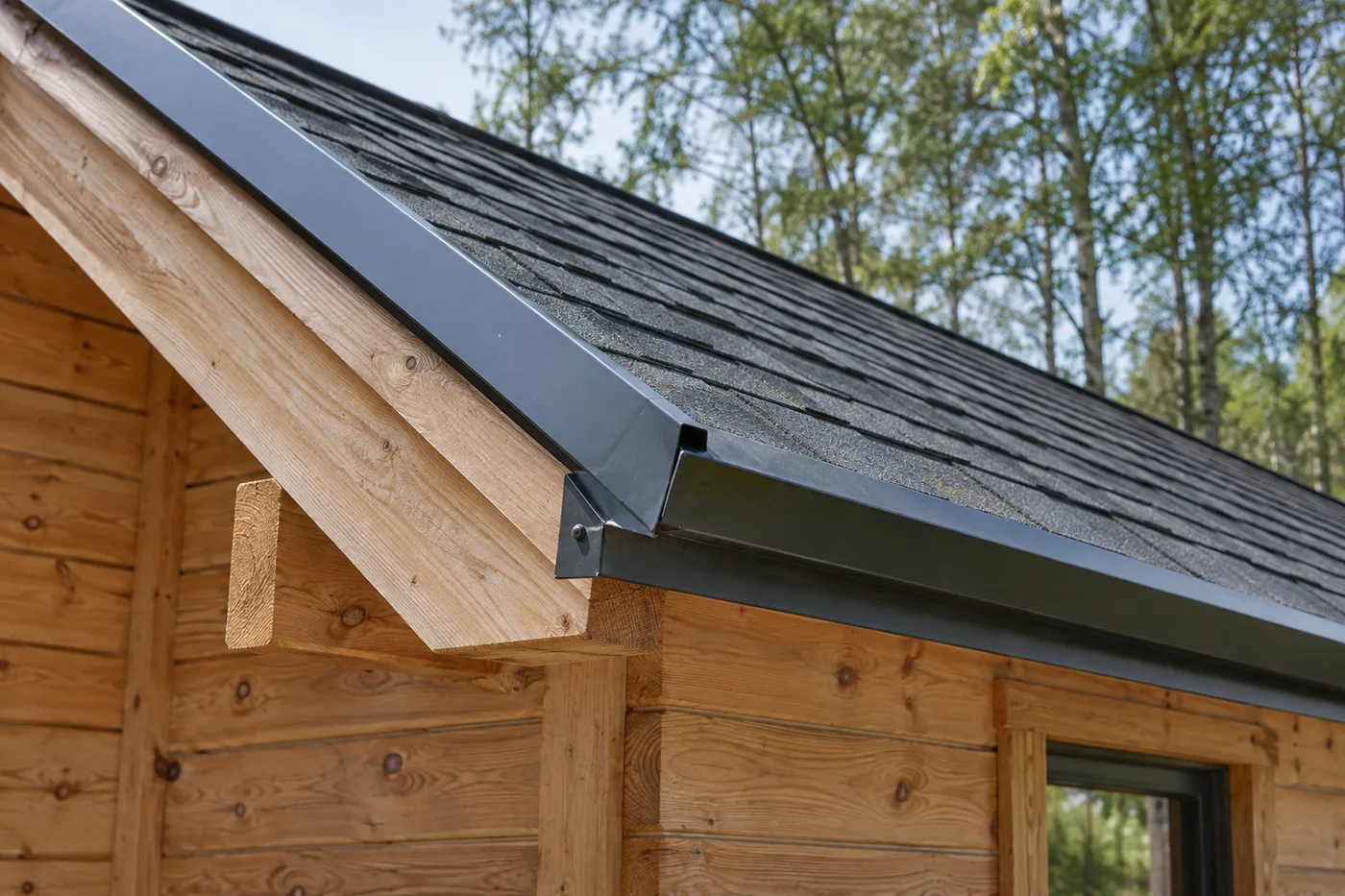
A replacement covering meets other parts of the building. Identify relevant eaves, wall junctions, roof features and drainage interfaces in the scope. The roofer and other responsible professionals should agree which details are retained, revised or investigated. A neat central roof surface cannot compensate for an unresolved edge condition.
Log cabin cladding exterior details may be affected where roof work meets the wall, but that does not make all cladding renewal part of the roofing contract. Record the exact boundary and any making-good responsibility. If work exposes an unexpected condition, use the agreed review process rather than allowing each trade to assume the other will resolve it.
Where roof penetrations or rainwater components are involved, refer to their specific design and maintenance requirements. Keep this article's scope focused on replacement procurement. Detailed choices about a skylight or drainage arrangement need their own coordinated assessment, and should not be improvised as minor accessories added at the end.
Further reading: Coordinate cabin roof penetrations and skylights; Review gutters and rainwater drainage separately.
Order only after scope and decision responsibilities are clear
Before ordering materials, confirm the accepted proposal, relevant product identity, quantities determined by the responsible contractor and the work sequence. This guide does not calculate quantities or wastage factors. The people responsible for installation should verify that the ordered system matches their accepted design and method.
Record delivery, storage and inspection responsibilities. Shipment inspection can establish visible condition and identity within its scope, but cannot prove that the roof will be correctly installed. Factory testing or product certification, where genuine and relevant, should be checked for applicability to the proposed system rather than used as a blanket assurance.
Keep the purchasing file organized around decisions: accepted scope, unresolved conditions, approved substitutions and required completion evidence. A folder full of unrelated brochures is less useful than a short register showing which information actually governs the work. The operator should be able to find that register after the contractor leaves.
- Identify the existing roof and available records.
- Obtain a competent assessment and investigation scope.
- Compare complete replacement proposals on common headings.
- Define conditional work and authorization routes.
- Assign temporary protection and interface responsibilities.
- Confirm ordering information and required handover evidence.
Hypothetical example: the cheapest covering quote omits the junctions
Consider a hypothetical owner comparing two cabin reroofing offers. One lists only the new covering and its installation. The other includes assessment, defined edge work, temporary protection and a process for concealed conditions. The first total is lower, but the buyer cannot yet conclude that it offers better value because the scopes differ.
The owner sends both contractors the same interface schedule and asks them to identify inclusions, exclusions and assumptions. The revised comparison shows which work each party actually proposes and which decisions remain unresolved. No fictional market price is needed to demonstrate the issue: the critical comparison is the purchased outcome.
The owner then chooses a reviewed scope and keeps a separate allowance for identified uncertainty according to appropriate advice. That does not eliminate the possibility of additional work. It creates a transparent way to assess and authorize it, while protecting the building and preserving evidence of the final installation.
Agree what completion means before the roof work begins
Completion can mean different things to the roofer, the cabin operator and another trade. The covering may be installed while internal making good, drainage connections or document handover remain incomplete. Define the milestones and their owners before work begins. A single word such as finished should not hide the distinction between a completed trade scope and a cabin ready to return to normal use.
Ask the responsible professionals to specify the relevant inspections and acceptance evidence for the proposed system. Do not invent a generic water test or inspection method from this article. The evidence should match the design and product requirements, with limitations recorded honestly. A photograph taken from the ground can document appearance but may not demonstrate the condition of concealed interfaces.
Create an outstanding-items list that distinguishes restrictions on use from minor agreed follow-up work. Each item needs an owner and a closure route. The operator should understand whether any temporary protection or restriction remains and who is responsible for checking it. A booked guest arrival is not a reason to erase an unresolved condition from the handover.
Include information for the next maintenance visit. Identify the installed system, relevant access restrictions, warranty contacts and care instructions. Keep original documentation and approved substitutions together. Future contractors should not have to guess whether a visible material matches the product named in an old quotation.
Where the new work meets retained older components, make that boundary explicit in the completion record. It helps avoid later assumptions that every part of the roof was replaced. The boundary can also be relevant to maintenance and commercial responsibilities, which should be interpreted under the actual agreements rather than inferred from the date of the latest invoice.
Finally, compare the completed scope with the original proposal and approved changes. Explain what was retained, replaced and left outside the work. This close-out review gives the owner a useful building record and a better basis for future budgeting, without turning one successful replacement into a universal claim about roof lifespan or performance.
Frequently asked questions
Can I replace cabin roofing with a different material?
A different covering may be possible, but the actual building, supporting assembly, interfaces and local requirements need competent assessment. Do not assume that a visually similar or apparently lighter product is automatically suitable. Obtain a complete reviewed proposal before ordering.
What should a log cabin roofing quote include?
Ask for the defined replacement system, assessment and removal scope, temporary protection, interface work, relevant making good and completion records. Identify conditional work and exclusions explicitly. The appropriate scope depends on the existing roof and the findings of competent professionals.
Does a new covering solve every roof leak?
No such conclusion should be made without assessment. Water entry can involve different parts of the assembly or adjacent interfaces. Record observations and obtain an appropriate investigation. Replacing one visible component does not prove that the underlying cause has been identified or resolved.
Should I inspect the roof myself before requesting a quote?
Provide existing records and safely obtainable information, but do not climb onto a roof to follow this guide. Ask a competent contractor to plan necessary inspection and access. Roof work and fragile surfaces can present serious hazards that require appropriate controls.
What belongs in the reroofing handover file?
Keep the accepted scope, actual product information, approved changes, relevant inspection and installation records, warranty information and maintenance requirements. Include unresolved issues and their owners. The file should describe the completed work, not merely the materials originally proposed.
Conclusion: buy a reviewed replacement outcome
A useful reroofing brief starts with the existing building and ends with a documented completed scope. Compare complete systems, make hidden-condition decisions explicit and assign temporary protection and interface work. Material appearance is one choice within that larger process.
Contact CabinWild with the cabin identity and your local roofing professional's information requests. Original package records can support the review where available, while suitability and execution of the replacement remain matters for the appropriate project professionals.
Clarify your existing roof package
Send the cabin identity, available roof records and your local roofer's information requests. Ask which original component details are available.
Prepared with AI assistance for CabinWild Editorial using the linked public sources. Examples are illustrative, not customer results or verified CabinWild test data. Project-specific design and local requirements need review by the appropriate professionals.