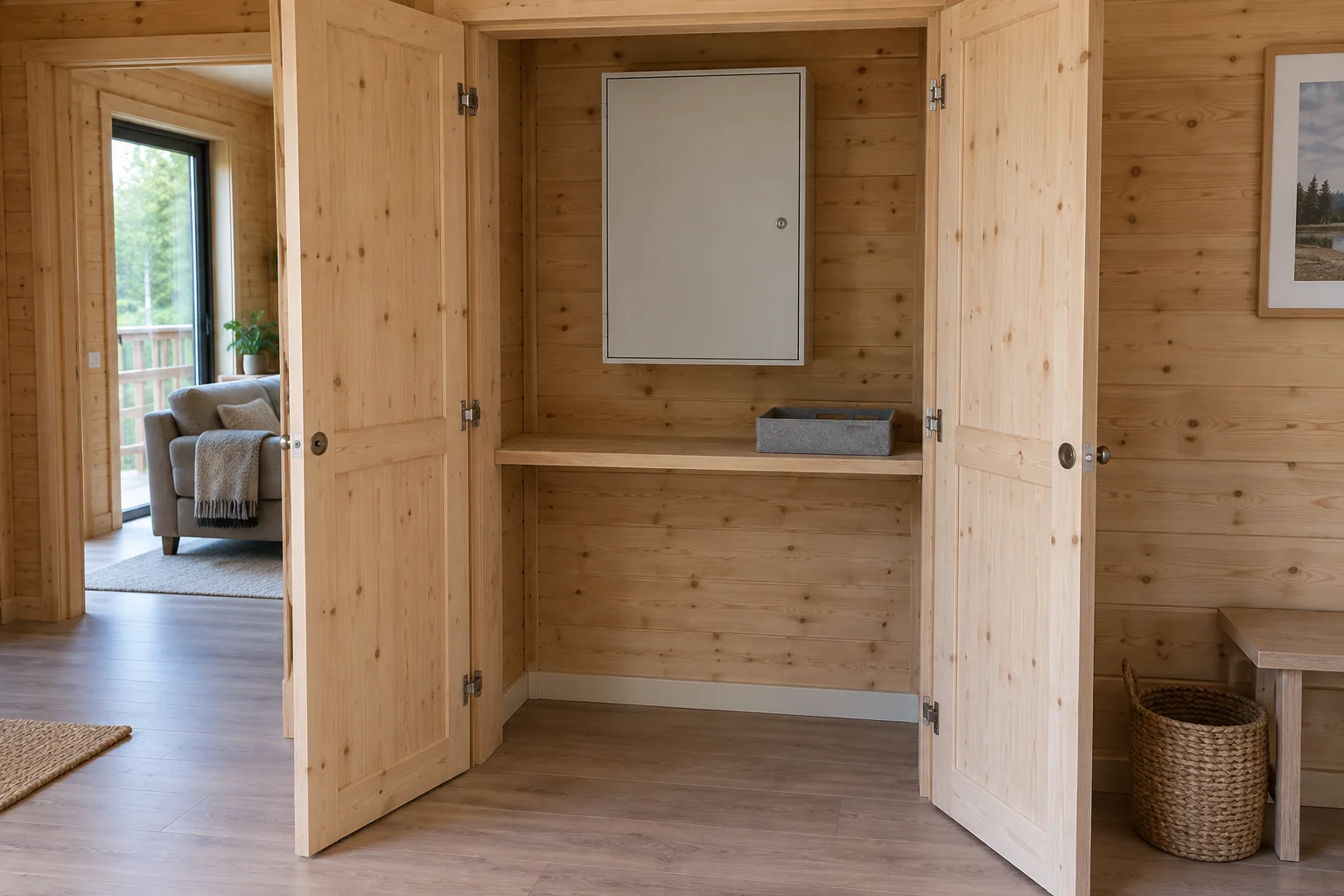
A winter shutdown plan should identify every installed system, its manufacturer instructions, freeze and moisture risks, inspection access and reopening checks. Coordinate plumbing, equipment, ventilation and monitoring with competent service providers. Simply switching off the heating is not a complete plan, and no universal drain-down procedure suits every cabin system.
Introduction: inventory the installed systems and responsibilities
Seasonal operators can purchase a cabin for summer use and discover that nobody has defined how its fitted services will be protected through winter. A closure plan belongs in the procurement brief because valves, access panels and monitoring choices are easier to coordinate before fit-out. Reopening also needs a deliberate review rather than an assumption that unused systems remain ready.
A winter shutdown plan should identify every installed system, its manufacturer instructions, freeze and moisture risks, inspection access and reopening checks. Coordinate plumbing, equipment, ventilation and monitoring with competent service providers. Simply switching off the heating is not a complete plan, and no universal drain-down procedure suits every cabin system.
This guide is written for seasonal hospitality operators coordinating building closure and return to service. Its examples are hypothetical purchasing and operating situations. Use the checks to prepare a precise brief for the cabin supplier and destination team; they do not establish that an unspecified cabin meets a particular performance level or local approval route.
Further reading: CDC: reopening buildings after reduced operation.
1. Inventory the installed systems and responsibilities
List water supply, waste, heating, cooling, ventilation, appliances and any monitoring or backup equipment. Identify the owner of shutdown instructions for each system. An imported fitted cabin may contain equipment selected by several parties, so one generic cabin manual may not cover everything. Ask the service providers to coordinate their requirements and identify conflicting instructions before the operating season ends.
A useful starting record is a system inventory with identified equipment and named shutdown and reopening responsibilities. Ask the person producing it to identify the cabin model, affected component and drawing revision. A document describing a different construction system may explain a principle, but it cannot establish acceptance of this package. Keep the answer with the quotation so that purchasing and technical reviewers are working from the same basis.
The error to avoid is assuming the cabin supplier manual covers every destination-installed appliance. Resolve the gap before the adjoining work is purchased or concealed. Where two options look similar in the catalogue, compare the evidence, access for correction and effect on the rest of the package rather than treating the photograph as the specification.
A question to put in the buyer brief
Who provides and verifies the closure instructions for each installed system?
2. Define the winter operating condition
Decide whether the cabin is unheated, maintained at a controlled condition or periodically occupied. Assess local freezing, moisture and access conditions with competent advisers. The choice affects services and monitoring, not just energy cost. Do not infer that a climate label or insulated wall protects every pipe. Record what happens if power fails or weather prevents staff access so the plan remains credible during the actual closure period.
Compare the proposed approach using an agreed closure condition and contingency assessment for loss of power or site access. The important question is not whether a supplier can send more photographs; it is whether the information resolves this decision. Identify what can be checked before an order and what requires a site observation. If there is a limitation, record it alongside the proposal rather than hiding it in a later email.
The error to avoid is treating insulation as a substitute for a reviewed freeze-protection strategy. Resolve the gap before the adjoining work is purchased or concealed. Where two options look similar in the catalogue, compare the evidence, access for correction and effect on the rest of the package rather than treating the photograph as the specification.
Further reading: EPA: moisture control guidance.
A question to put in the buyer brief
What condition will be maintained, and what happens if the intended protection is interrupted?
3. Coordinate water and equipment instructions
Have the relevant plumber and equipment providers define isolation, draining or other protection appropriate to the actual system. Hidden low points, pumps and water heaters may require particular treatment. Do not apply improvised chemicals or compressed-air procedures from an unrelated online checklist. Record valve locations and access so staff can follow the approved instructions without dismantling the cabin. Technical procedures should be performed by suitable personnel.
Before approving this detail, request system-specific plumbing and equipment instructions with accessible isolation and service locations. Evidence should have a clear scope and a named reviewer, especially when the manufacturer and local installer perform different parts of the work. Record the accepted outcome and keep any conditional items open. This prevents a preliminary assumption from becoming a repeated production instruction without a deliberate decision.
The error to avoid is using one generic drain-down procedure for unidentified installed equipment. Resolve the gap before the adjoining work is purchased or concealed. Where two options look similar in the catalogue, compare the evidence, access for correction and effect on the rest of the package rather than treating the photograph as the specification.
A question to put in the buyer brief
Which equipment needs specialist action, and where are the required valves and access points?
4. Manage moisture without creating new hazards
Closure changes occupancy moisture and the way ventilation operates. Review the enclosure, retained wet materials and planned airflow or humidity management. Turning off all equipment indiscriminately can defeat an agreed moisture strategy; leaving unrelated equipment running can create other risks. The appropriate arrangement depends on climate and system design. Record what observations trigger investigation rather than prescribing a universal thermostat or humidity setting.
A useful starting record is a coordinated unoccupied-building moisture plan with inspection and escalation triggers. Ask the person producing it to identify the cabin model, affected component and drawing revision. A document describing a different construction system may explain a principle, but it cannot establish acceptance of this package. Keep the answer with the quotation so that purchasing and technical reviewers are working from the same basis.
The error to avoid is assuming an empty cabin cannot develop a moisture problem. Resolve the gap before the adjoining work is purchased or concealed. Where two options look similar in the catalogue, compare the evidence, access for correction and effect on the rest of the package rather than treating the photograph as the specification.
A question to put in the buyer brief
How will the closed cabin manage moisture under the specified winter condition?
Turn these questions into a project brief
Send your destination, quantity, intended use and this specification question. Ask for a clearly bounded quotation and document list.
5. Make inspections and monitoring actionable
Agree who checks the cabin, what can be observed safely and how alerts are handled. A sensor is useful only if someone can respond and its power or communications are available. Include roof drainage, visible wetting and access to service zones in the appropriate plan. Avoid a monitoring claim that implies guaranteed protection. Keep dated observations and route equipment or structural concerns to the responsible specialist.
Compare the proposed approach using an inspection and alert-response plan with communication and access contingencies. The important question is not whether a supplier can send more photographs; it is whether the information resolves this decision. Identify what can be checked before an order and what requires a site observation. If there is a limitation, record it alongside the proposal rather than hiding it in a later email.
The error to avoid is installing sensors without assigning someone able to respond to an alert. Resolve the gap before the adjoining work is purchased or concealed. Where two options look similar in the catalogue, compare the evidence, access for correction and effect on the rest of the package rather than treating the photograph as the specification.
Further reading: EPA: moisture control guidance.
A question to put in the buyer brief
Who receives an alert, and what practical response is possible during closure?

6. Plan reopening as a separate gate
The return to service should follow the equipment instructions and appropriate checks of water, ventilation and building condition. CDC guidance identifies hazards associated with prolonged shutdown or reduced water use; applicability and required measures need competent local review. Do not assume a brief run of a tap resolves every issue. Record completed checks and outstanding concerns before admitting guests, with specialist assessment where the condition is uncertain.
Before approving this detail, request a coordinated reopening record covering equipment, water-system review and observed building condition. Evidence should have a clear scope and a named reviewer, especially when the manufacturer and local installer perform different parts of the work. Record the accepted outcome and keep any conditional items open. This prevents a preliminary assumption from becoming a repeated production instruction without a deliberate decision.
The error to avoid is treating reopening as simply restoring power and accepting the next booking. Resolve the gap before the adjoining work is purchased or concealed. Where two options look similar in the catalogue, compare the evidence, access for correction and effect on the rest of the package rather than treating the photograph as the specification.
A question to put in the buyer brief
Which checks and responsible specialists must release the cabin back into occupied service?
Use a decision matrix to compare the complete proposal
A buyer can turn the questions above into a comparison sheet for seasonal cabin winter shutdown. Keep the original requirement in one column and each supplier's proposed answer in another. Compare like-for-like scope first; then assess how convincing the supporting evidence is. A missing answer should appear as pending, not as a zero-cost inclusion or an assumed pass.
Use three practical statuses: accepted with evidence, accepted subject to a named condition, and unresolved. Conditional acceptance needs an owner and a deadline before the affected work begins. It may be sensible to proceed with unrelated work while a detail is developed, but the team should explicitly identify the boundary. That is different from letting an unresolved detail silently spread across a multi-unit order.
Further reading: Related CabinWild buyer guide; Related CabinWild buyer guide; Browse cabin options; Discuss a project.
| Review item | Evidence to compare | Question that closes the gap |
|---|---|---|
| Inventory the installed systems and responsibilities | A system inventory with identified equipment and named shutdown and reopening responsibilities | Who provides and verifies the closure instructions for each installed system? |
| Define the winter operating condition | An agreed closure condition and contingency assessment for loss of power or site access | What condition will be maintained, and what happens if the intended protection is interrupted? |
| Coordinate water and equipment instructions | System-specific plumbing and equipment instructions with accessible isolation and service locations | Which equipment needs specialist action, and where are the required valves and access points? |
| Manage moisture without creating new hazards | A coordinated unoccupied-building moisture plan with inspection and escalation triggers | How will the closed cabin manage moisture under the specified winter condition? |
| Make inspections and monitoring actionable | An inspection and alert-response plan with communication and access contingencies | Who receives an alert, and what practical response is possible during closure? |
| Plan reopening as a separate gate | A coordinated reopening record covering equipment, water-system review and observed building condition | Which checks and responsible specialists must release the cabin back into occupied service? |
Worked buyer scenario: an illustrative decision sequence
A fictional lakeside operator closes several cabins for winter. The initial plan is to switch off power and lock the doors. A system inventory identifies equipment with different isolation and protection needs, and the plumbing provider prepares instructions for the actual installed arrangement. Access to a concealed valve is improved before the next season.
The operator then agrees the unoccupied moisture condition and a response plan for monitoring alerts. Staff inspections have a clear escalation route rather than asking housekeepers to diagnose equipment failures. The design makes no assumption that insulation alone protects water services during a power interruption.
Before reopening, the operator follows the coordinated water and equipment review with the relevant professionals. The example is hypothetical and is not a CabinWild winterization procedure or health assessment. It supplies no universal temperature, drain-down technique or guaranteed freeze protection.
Separate factory checks, delivery condition and the installed result
For this product application, identify which decisions can be confirmed from the accepted brief and which require physical evidence. Factory testing, if specified and actually performed, should have a defined method, sample and acceptance criterion. A supplier's demonstration is not automatically an independent test, and a component result does not prove the installed cabin's performance. Ask for the scope before putting any test wording in a purchase order.
At shipment inspection, compare the supplied items with the evidence list below. The purpose is to confirm the agreed package and condition at the stated stage, not to predict every destination outcome. Installation preparation should identify access, responsible trades and any hold point needed before an interface is covered. A gap found at that stage is often easier to correct than one found after a finished room has been furnished.
For repeated cabins, use an identified first unit or agreed representative sample before authorizing repetition of a new detail. Record what was checked, who checked it and what remains for site verification. Do not call the whole batch approved merely because one attractive unit has been photographed. Equally, do not impose unrelated checks that add delay without resolving the specific customer requirements.
- A system inventory with identified equipment and named shutdown and reopening responsibilities.
- An agreed closure condition and contingency assessment for loss of power or site access.
- System-specific plumbing and equipment instructions with accessible isolation and service locations.
- A coordinated unoccupied-building moisture plan with inspection and escalation triggers.
- An inspection and alert-response plan with communication and access contingencies.
- A coordinated reopening record covering equipment, water-system review and observed building condition.
Frequently asked questions
Can I just turn off heating for winter?
Only after reviewing the installed systems and intended winter condition. Freezing, moisture and equipment requirements may conflict with that choice. Obtain a coordinated plan from the relevant designers and service providers.
Should every cabin water system be drained?
The procedure depends on the actual plumbing and equipment. Have competent providers define appropriate isolation and protection. Do not apply a generic drain-down or chemical procedure to unidentified systems.
Does insulation prevent frozen pipes?
Insulation does not by itself establish protection under every condition. Pipe location, heat, duration and system design matter. Review the intended winter condition and interruption contingencies with the responsible professionals.
Why does reopening need water-system review?
Prolonged shutdown or reduced use can create water-system hazards. CDC guidance explains the general concern, but the appropriate response depends on the system and local requirements. Use competent assessment rather than assume one brief flush resolves everything.
Are monitoring sensors enough?
No. Define who receives alerts, communications and power availability, site access and the response procedure. Monitoring is a tool within a protection plan, not a guarantee against damage or equipment failure.
Conclusion: design closure and reopening before the season ends
A useful seasonal plan begins with the installed systems and ends with an explicit return-to-service gate. Coordinate freeze and moisture requirements, preserve access and assign response responsibilities. Procurement choices can support the plan, but specialist procedures must follow the actual equipment and destination conditions.
Send CabinWild your destination, intended use, quantity, drawing stage and the questions that remain open. Include the evidence you need in the quotation rather than asking only for a model price. Contact info@CabinWild.com to discuss the proposed cabin supply boundary and supporting documents. Local design, installation and approval responsibilities should be agreed with the destination professionals.
Discuss seasonal cabin winter shutdown
Send your destination, quantity, intended use and this specification question. Ask for a clearly bounded quotation and document list.
Prepared with AI assistance for CabinWild Editorial using the linked public sources. Examples are illustrative, not customer results or verified CabinWild test data. Project-specific design and local requirements need review by the appropriate professionals.