
Qualify a wooden-house supplier in layers: verify the legal counterparty, confirm the proposed production site, match demonstrated capability to the exact cabin system, test document and material traceability, and agree inspection plus corrective-action controls. A business licence, certificate, showroom or factory video can support one part of due diligence, but none alone proves product conformity, capacity or suitability for the destination.
Introduction: turn the search into a controlled purchase
Supplier qualification is not a search for the longest certificate list. It is a structured check that the contracting company can control the work promised in the quotation. The buyer needs to know who receives payment, who prepares technical information, where each major process occurs, who approves changes and which party remains responsible when production or installation is subcontracted.
Factory evidence should be product-specific. A workshop capable of joinery may not have experience with closed panels, fitted wet areas or large modules. Conversely, a modest factory can be suitable for a defined kit if it has controlled documents, competent staff, appropriate equipment and transparent limits. Capability must be matched to the proposed system and order volume.
This guide does not endorse or audit CabinWild or any other company. It makes no claim about a particular certificate, production line, customer, test or capacity. Registry, certification and audit findings must be verified directly, and qualified destination professionals must assess the actual product information and applicable requirements.
Company labels can conceal different roles. Wooden house manufacturers may own production, while wooden house suppliers may coordinate outsourced work. Timber cabin builders can be site contractors rather than exporters. Searches for cabin manufacturers china or a wooden house factory therefore need legal-entity, production-site and scope verification before the buyer assumes who designs, makes, exports or warrants the product.
1. Verify the legal counterparty and trading role
Obtain the company's legal name in its registration language, unified identifier where applicable, registered address and authorized contract details. Cross-check information using the relevant official registry; for a Chinese entity, the National Enterprise Credit Information Publicity System is an official starting point. Access, disclosed fields and interpretation may require local support.
Map the seller, manufacturer, exporter and payment beneficiary. They may legitimately differ, but the contract should explain the relationship and allocate responsibility. Ask who owns the production site, who can bind subcontractors, who issues invoices and who answers a defect claim. Do not send funds based only on email instructions that conflict with accepted counterparty information.
Request current registry records plus matching quotation, contract and bank-beneficiary details. Ask: "Which legal entity makes each promise and receives the buyer's money?" Record the answer, owner and due date; do not let treating a website brand, factory sign and beneficiary name as automatically the same company become an assumed inclusion or approval.
Further reading: China National Enterprise Credit Information Publicity System.
A question to put in the buyer brief
Which legal entity makes each promise and receives the buyer's money?
2. Match capability to the actual cabin system
Break the proposed cabin into process families: timber preparation, framing or machining, panel assembly, membranes, openings, finishing, wet-area work, electrical integration, packing and module handling. Ask which site performs each step and which work is purchased. A credible answer identifies interfaces rather than claiming everything happens under one roof.
Review capacity as a schedule, not a monthly marketing number. Ask about shifts, bottlenecks, curing or inspection time, subcontracted stages and other committed orders. Compare the requested ramp-up with demonstrated control. A buyer should not infer repeat-unit consistency from one attractive prototype or a line speed stated without product mix and quality activities.
Request a process map and recent anonymized records for comparable construction tasks. Ask: "Which critical processes are performed, controlled or subcontracted for this exact product?" Record the answer, owner and due date; do not let accepting a generic factory tour that never shows the proposed construction method become an assumed inclusion or approval.
A question to put in the buyer brief
Which critical processes are performed, controlled or subcontracted for this exact product?
3. Read management-system evidence within its limits
ISO describes ISO 9001 as a quality-management-system standard. It can support confidence that an organization uses controlled processes, but it does not by itself certify the structural, thermal, fire or regulatory performance of a cabin. Check the named organization, site and scope, and ask how the system controls this order.
ISO also explains that it does not perform certification. Confirm the certification body and, where relevant, its accreditation through authoritative directories. Then sample actual practice: drawing approval, purchasing, inspection, nonconformance and change records. A valid certificate with weak order-specific control still leaves the buyer with unresolved evidence.
Request certificate issuer, accredited status, scope, site and expiry checked against live records. Ask: "What does the certificate cover, and what product evidence is still required?" Record the answer, owner and due date; do not let treating an ISO 9001 certificate as product approval or proof of local code compliance become an assumed inclusion or approval.
Further reading: ISO: ISO 9001 quality management systems; ISO: certification and conformity assessment.
A question to put in the buyer brief
What does the certificate cover, and what product evidence is still required?
4. Trace timber and purchased components
Define timber species or product, grade where relevant, condition, finish and supporting documents with the competent design team. Review how incoming material is identified and separated, how damaged or nonconforming stock is handled and how substitutions require approval. Traceability should be proportionate to the risk and contractual claim.
If FSC claims matter, use the FSC certificate database and transaction documentation rather than a logo screenshot. FSC explains that chain of custody concerns identification, tracking and records through the supply chain. Confirm that the company, site, product group and claim fit the proposed sale; do not turn certification into a broader performance promise.
Request approved material schedules, purchase records, lot links and claim documentation. Ask: "Can the factory connect the supplied cabin to the accepted material requirement?" Record the answer, owner and due date; do not let accepting a logo or sample board as proof that every ordered component carries the stated claim become an assumed inclusion or approval.
Further reading: FSC: chain of custody certification; USDA Forest Products Laboratory: Wood Handbook—Wood as an Engineering Material.
A question to put in the buyer brief
Can the factory connect the supplied cabin to the accepted material requirement?
Turn these questions into a project brief
Send the project destination, cabin type, quantity and evidence checklist. Ask CabinWild which company, production, document and inspection information can be supplied for the proposed order.
5. Test document and change control with a sample order file
Select one comparable completed or mock order and follow its information path. The accepted drawing, bill of materials, purchase specification, work instruction, inspection record and packing list should identify a coherent configuration. Redaction may protect customer information while still showing the control method. Ask staff which source they use when documents disagree.
Introduce a hypothetical change, such as a window option or mirrored layout, and ask how it is reviewed, priced, released and verified. The purpose is not to trick the supplier; it is to see whether the system prevents partial updates. A change that reaches fabrication but not packing, foundation information or the buyer's drawing can still cause a serious mismatch.
Request a redacted job pack showing one configuration through purchasing, production and packing. Ask: "How does a released change reach every affected record and workstation?" Record the answer, owner and due date; do not let reviewing polished templates without checking whether records agree on the same revision become an assumed inclusion or approval.
A question to put in the buyer brief
How does a released change reach every affected record and workstation?
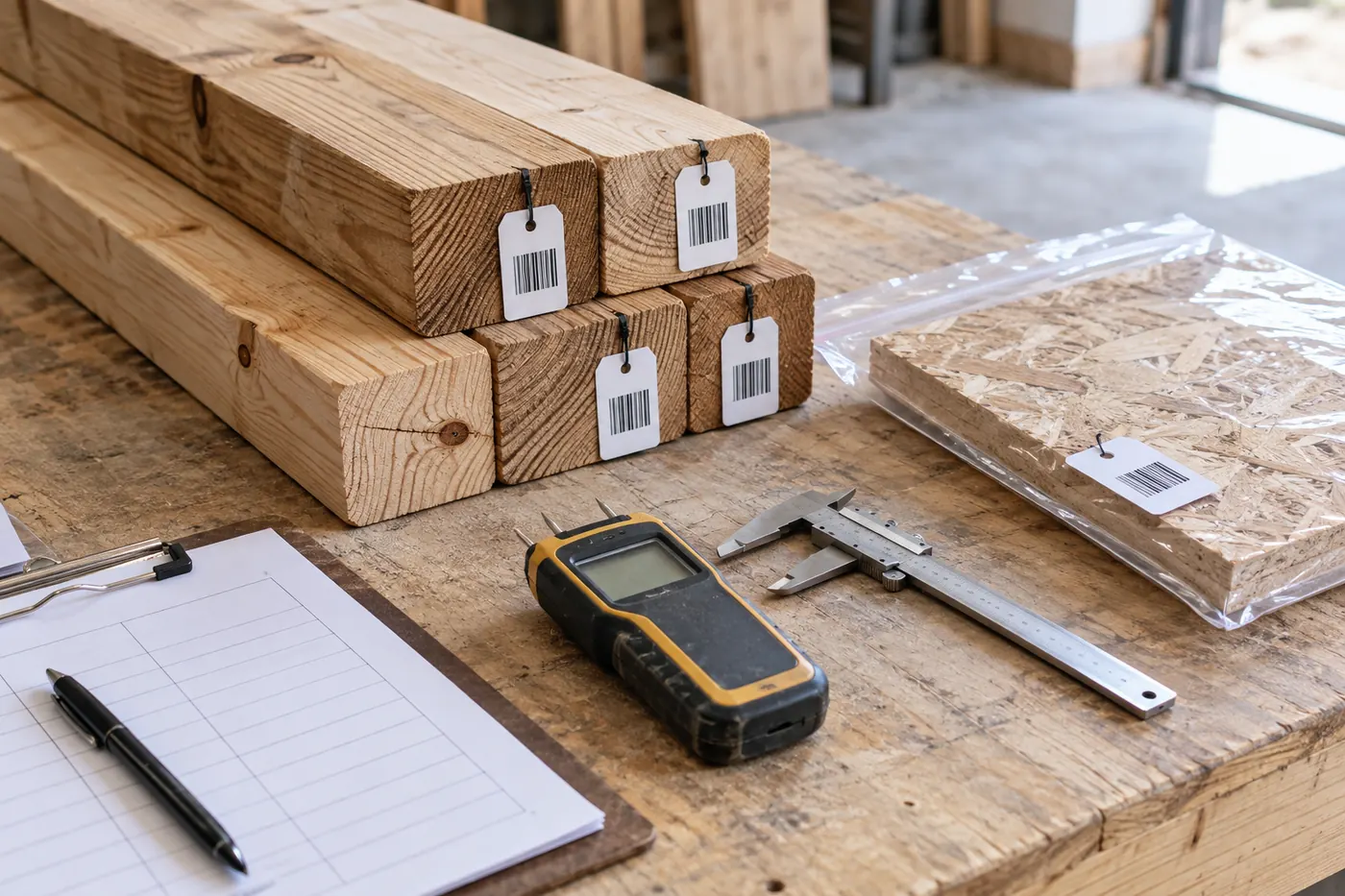
6. Agree audit, inspection and corrective-action boundaries
Decide whether review is remote, on-site, first-party or independent. Give the inspector the accepted configuration and criteria before the visit. Identify accessible and concealed features, safety rules, sampling limits and reporting format. A factory tour demonstrates access and context; an inspection evaluates defined items and should state what it did not verify.
Require findings to identify the affected unit or lot, evidence, disposition, owner and closure record. Rework photographs without identity or follow-up may be insufficient. Escalation and payment consequences belong in the contract. A buyer should avoid calling every observation a failure, but should also avoid accepting unexplained deviations as normal workmanship.
Request an inspection plan with hold points, sampling, records and corrective-action deadlines. Ask: "Who can stop release, and what evidence closes a finding?" Record the answer, owner and due date; do not let arranging an inspection with no accepted specification or authority to address defects become an assumed inclusion or approval.
A question to put in the buyer brief
Who can stop release, and what evidence closes a finding?
Use an evidence matrix to compare complete proposals
Build a comparison sheet for supplier qualification and cabin factory evidence requirements. Keep each original customer requirement beside the supplier response, responsible party and evidence status. Compare like-for-like scope before ranking price. A blank cell is not a free inclusion; it is an unresolved assumption that may create design, site, logistics or operating work later.
For wooden house manufacturers, use three statuses: accepted with relevant evidence, accepted subject to a named condition, and unresolved. Conditional acceptance needs an owner and deadline before affected work proceeds. Keep provisional answers visible across the drawings, quotations and records used for this purchase.
Further reading: Related CabinWild buyer guide; Related CabinWild buyer guide; Related CabinWild buyer guide; Browse cabin options; Discuss a project.
| Review item | Evidence to compare | Closing question |
|---|---|---|
| Verify the legal counterparty and trading role | current registry records plus matching quotation, contract and bank-beneficiary details | Which legal entity makes each promise and receives the buyer's money? |
| Match capability to the actual cabin system | a process map and recent anonymized records for comparable construction tasks | Which critical processes are performed, controlled or subcontracted for this exact product? |
| Read management-system evidence within its limits | certificate issuer, accredited status, scope, site and expiry checked against live records | What does the certificate cover, and what product evidence is still required? |
| Trace timber and purchased components | approved material schedules, purchase records, lot links and claim documentation | Can the factory connect the supplied cabin to the accepted material requirement? |
| Test document and change control with a sample order file | a redacted job pack showing one configuration through purchasing, production and packing | How does a released change reach every affected record and workstation? |
| Agree audit, inspection and corrective-action boundaries | an inspection plan with hold points, sampling, records and corrective-action deadlines | Who can stop release, and what evidence closes a finding? |
Run the procurement workflow in four controlled stages
Send a prequalification questionnaire focused on the proposed cabin system, destination and order quantity. Request legal identity, production-site map, process ownership, quality-system scope, material controls, comparable capability and willingness to support inspection.
Verify high-consequence statements independently. Use official registries and certificate-owner databases, contact issuing bodies where necessary and check that names, sites, scopes and dates match. Keep screenshots or copies with the review date because external status can change.
Conduct a remote evidence review before travel. Ask for a live walkthrough of agreed areas, a sample job-file trace and a discussion with relevant process owners. Preserve limitations: a video can support identity and process understanding, but cannot replace every physical test or audit activity.
Close qualification with a risk register and order-specific quality plan. Qualification should not be permanent or universal; changes in product, site, subcontracting, volume or destination may require new evidence. Retain supplier performance and corrective-action history for future orders.
Worked buyer scenario: an illustrative decision sequence
A hypothetical importer shortlists two suppliers for twenty panelized cabins. Supplier A has a strong showroom and broad certificate pack but outsources panel assembly without clear control. Supplier B has a smaller facility, transparent subcontractor records and a coherent sample job file. The buyer does not select either from the first impression.
The importer verifies legal entities, reviews certificate scopes, observes a live document trace and requests an order-specific inspection plan. Supplier A clarifies the subcontract arrangement and improves change control; Supplier B identifies a realistic capacity limit. The final choice depends on evidence, schedule and contract allocation, not factory size alone.
The scenario is illustrative and contains no CabinWild factory, supplier score or customer result. A real audit must use qualified reviewers, agreed access and criteria relevant to the specific product and destination.
Connect factory testing, shipment inspection and installation preparation
Factory testing for supplier qualification and cabin factory evidence requirements should answer a defined question about the accepted configuration. Agree the method, conditions, acceptance basis and record before the test. Ask what the supplier can genuinely perform and identify features that cannot be verified until site work or services are complete. A demonstration or photograph should not be expanded into structural, regulatory or long-term performance proof.
Shipment inspection for supplier qualification and cabin factory evidence requirements should compare the dispatched scope with the accepted revision, especially process, equipment, staff and controlled capacity. Check accessible quantity, visible condition, required documents and agreed markings. Preserve discrepancies before unnecessary unpacking. The inspection cannot establish a characteristic that was never specified, measured or accessible.
Installation preparation should give the site team current drawings, instructions, component information and the interface decisions behind company identity, registration, payment beneficiary and export role. Confirm access, storage, tools, competent labor, weather protection and technical-query routes. Return proposed deviations to the responsible reviewer rather than improvising changes that break the controlled configuration.
At handover for wooden house manufacturers, record locally completed work, commissioning, outstanding authority checks and maintenance information. Revisit drawing, BOM, work instruction and revision consistency and independent access, acceptance criteria and issue closure. Keep customer requirements, product application and responsibility traceable; a checklist describes only the work and observations within its stated scope.
Frequently asked questions
How do I know whether a supplier is a factory or trading company?
Verify the legal entity and production site, ask who owns or controls each process, review contracts and invoices, and trace a sample order. A trading company can be a valid counterparty when responsibilities and subcontractor controls are transparent.
Does ISO 9001 certify cabin quality?
It certifies a quality management system within the stated scope when issued by a competent certification body. It does not by itself approve a specific cabin or prove destination compliance. Review product-specific design, material, test and inspection evidence separately.
Can a video factory tour replace an audit?
A live video can confirm context, people, processes and records within its view. It cannot reliably verify every location, concealed feature, measurement or record sample. Use it as one risk-based evidence source and state its limitations.
What should be checked in a wooden-house factory inspection?
Check the accepted model and revision, material identity, process controls, dimensions or workmanship criteria, nonconformance handling, protective packing and required records. The exact checklist should match the ordered system and inspection stage.
How should FSC claims be verified?
Check the certificate holder and status in official FSC resources, confirm scope and product group, and require appropriate sales-document claims and traceability. A logo alone does not prove that the specific transaction qualifies for a claim.
Conclusion: buy the defined project, not the label
A qualified supplier is a verified legal counterparty with demonstrated, controlled capability for the exact work - not simply a website, certificate or workshop. Layer independent checks and preserve the limits of each evidence source.
Send CabinWild the destination, cabin system, quantity and qualification checklist. Ask which legal, production, document, material and inspection information can be supplied for review. Verify consequential claims independently and keep product approval with the competent destination parties.
Request supplier and factory evidence for review
Send the project destination, cabin type, quantity and evidence checklist. Ask CabinWild which company, production, document and inspection information can be supplied for the proposed order.
Prepared with AI assistance for CabinWild Editorial using the linked public sources. Examples are illustrative, not customer results or verified CabinWild test data. Project-specific design and local requirements need review by the appropriate professionals.