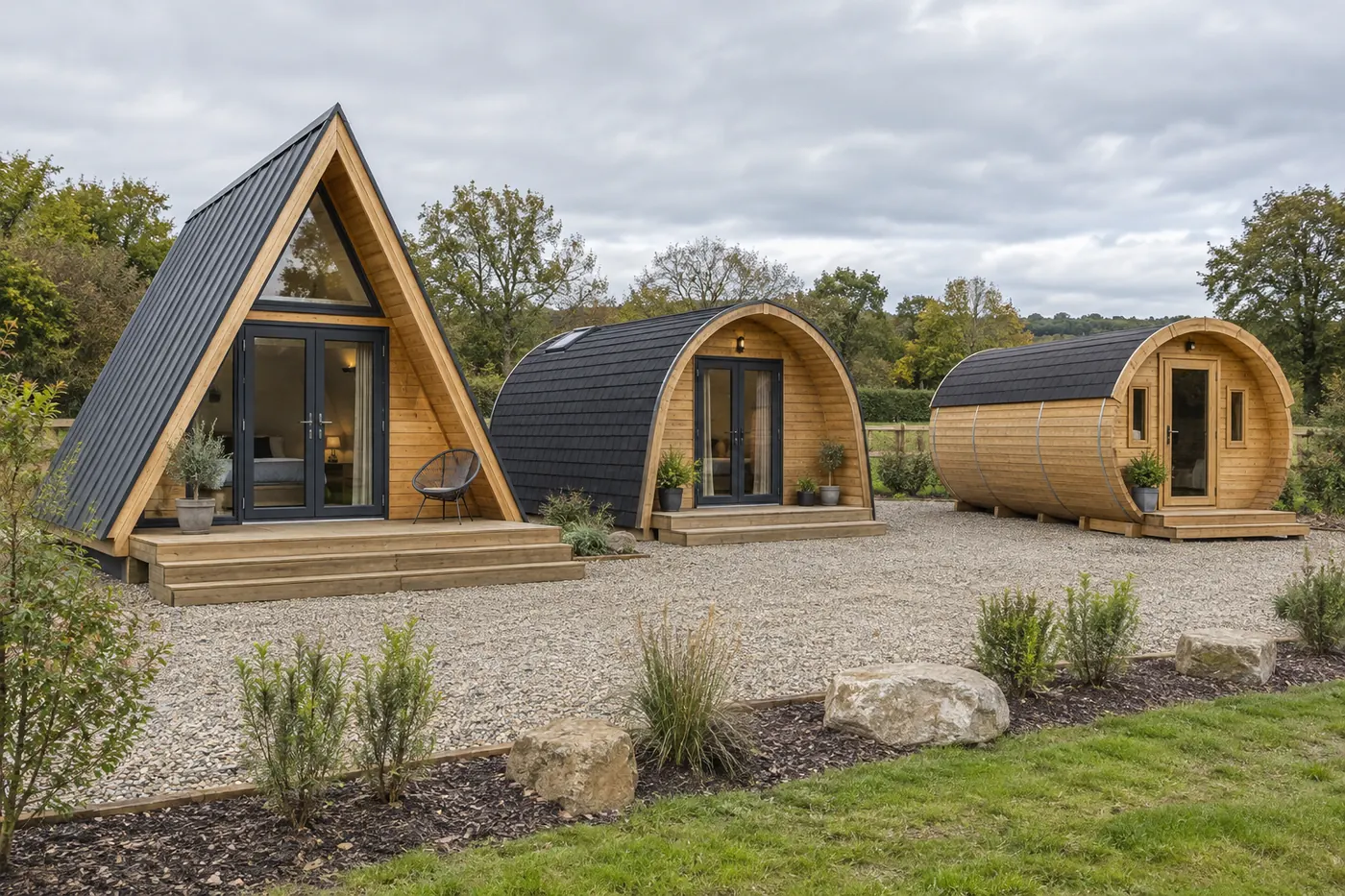
Build an A-frame or glamping supplier shortlist by defining the guest product, site and supply form first. Compare suppliers on the exact structure and envelope proposed, room operation, service interfaces, prototype and change control, repeat-unit capacity, packing, delivery and after-sales records. A showroom, rendering or quoted bed count cannot establish destination suitability or fleet-level operability.
Introduction: turn the search into a controlled purchase
A hospitality shortlist should begin with the guest and operating model, not the supplier gallery. The unit needs to work through arrival, occupancy, housekeeping, maintenance and seasonal closure. Those activities shape layout, storage, wet areas, service access and finish choices. A dramatic roof form or pod silhouette can support positioning, but cannot resolve these operational requirements.
A-frame and pod offers also vary greatly in supply form. One supplier may sell a shell kit, another a panel package and another a fitted module. Repeat-unit buyers need a stable configuration, clear interface schedule and controlled prototype before scaling. The shortlist should therefore combine design fit, factory capability, logistics and support evidence.
This guide is not a ranking or endorsement of CabinWild or any manufacturer. It reports no real project, capacity, test or guest outcome. All examples are hypothetical. Local professionals and authorities must assess the actual design, site, occupancy, access, services and applicable requirements at the destination.
Supplier names describe different commercial roles. A frame cabin manufacturers and a frame house manufacturers may fabricate kits, panels or modules; a frame cabin builders may focus on site assembly. Glamping cabin manufacturers and glamping pod manufacturers may offer distinct forms, fitout levels and operational assumptions. Shortlist the supplied system, evidence and responsibility rather than relying on the label.
1. Define the guest product and operating model
Describe expected party size, stay length, seasonal pattern, accessibility goals, food preparation, bathroom use and outdoor activities. Avoid representing a room label or bed count as approved capacity. Give suppliers the same guest brief and ask them to identify where the standard product differs or requires local review.
Map arrival, cleaning, linen, waste, consumables, inspections and repairs. A compact interior can work well when storage and maintenance are designed deliberately. Ask operators to review the proposed layout with actual equipment. Their feedback should inform the brief without replacing professional design or approval decisions.
Request a guest journey and operator task map for a typical turnover. Ask: "What experience and operating work must every unit support?" Record the answer, owner and due date; do not let selecting the most photogenic unit before testing luggage, housekeeping and service access become an assumed inclusion or approval.
A question to put in the buyer brief
What experience and operating work must every unit support?
2. Classify the product and supply form
Ask the supplier to describe structure, envelope, fitout, service completion, foundations, external works and installation scope. The shape alone does not define the package. An A-frame may be supplied as pre-cut timber, panels or modules; a pod may arrive nearly complete or require substantial local fitout.
Normalize offers using a responsibility matrix. Identify who supplies openings, roof finish, bathroom, equipment, controls, furniture and commissioning. A narrower package may suit a buyer with strong local resources, while a remote site may favor greater factory completion. Make that a deliberate procurement choice.
Request a product definition and inclusion schedule for one selected configuration. Ask: "What physically leaves the factory, and what must happen at site?" Record the answer, owner and due date; do not let comparing a bare A-frame kit with a fitted pod as equivalent guest units become an assumed inclusion or approval.
A question to put in the buyer brief
What physically leaves the factory, and what must happen at site?
3. Request destination-relevant technical evidence
Give the supplier the destination and proposed use, then ask what design information and evidence are available. The EU Construction Products Regulation provides harmonised rules for covered construction products, but Member States retain building-use requirements. A CE mark or declaration for a component is not an automatic approval of the completed cabin.
Review roof, wall, floor, openings and penetrations as assemblies. A-frame geometry can create specific headroom, drainage and junction questions; pods may rely on curved or compact service zones. The local team should identify loads, fire, energy, moisture, accessibility and other applicable matters without assuming the supplier's home-market documents transfer unchanged.
Request a technical document index with assumptions and evidence mapped to the proposed unit. Ask: "Which claims apply to this configuration and destination?" Record the answer, owner and due date; do not let treating a test for one component or market as approval of the complete guest unit become an assumed inclusion or approval.
Further reading: European Commission: Construction Products Regulation; USDA Forest Products Laboratory: Wood Handbook—Wood as an Engineering Material.
A question to put in the buyer brief
Which claims apply to this configuration and destination?
4. Score the room as an operating asset
Walk through a full turnover using realistic linen, luggage and cleaning equipment. Check clearances around beds and bathroom fixtures, storage for guest and staff items, ventilation controls and wet-item routes. The aim is not to maximize furniture count; it is to protect the intended experience while keeping routine work practical.
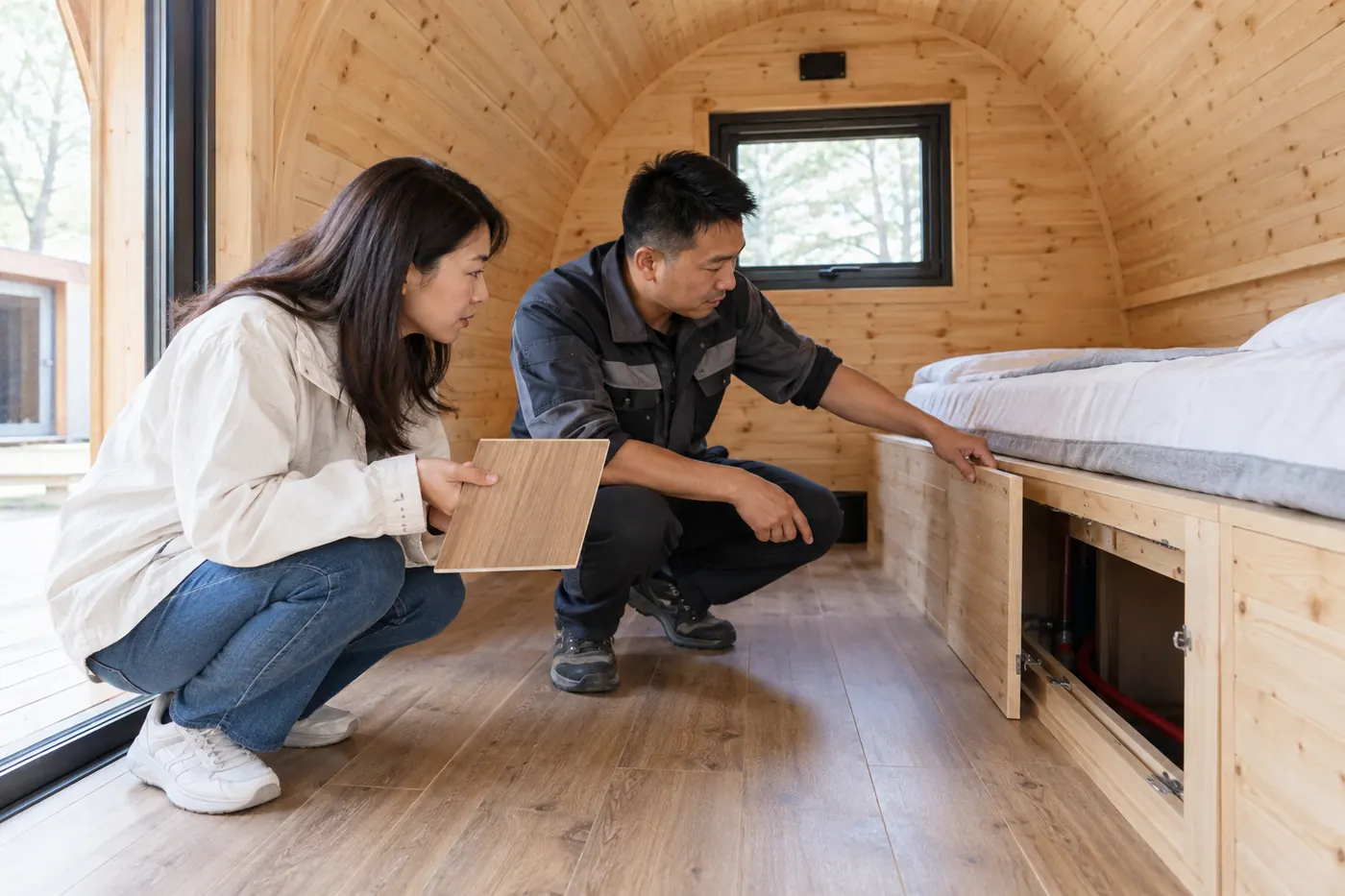
Ask how finishes, fittings and proprietary components are identified for replacement. Review service panels, isolation points and access to equipment. A sealed-looking interior may hide an expensive maintenance problem. Record which parts are standard locally and which require supplier spares, special tools or a long import lead time.
Request a furnished mock-up review and maintenance-access checklist. Ask: "Can staff inspect, clean and replace high-use items without damaging the unit?" Record the answer, owner and due date; do not let approving finish samples without testing their location, cleaning method or replacement route become an assumed inclusion or approval.
A question to put in the buyer brief
Can staff inspect, clean and replace high-use items without damaging the unit?
Turn these questions into a project brief
Share the destination, unit count, guest brief, site constraints and preferred supply form. Ask CabinWild for available model information and a proposal evidence list.
5. Use a controlled prototype before a fleet release
Define prototype purpose before purchase. It may test guest layout, factory workmanship, transport protection, installation sequence or maintenance access. No single prototype proves every long-term result. State what will be observed, by whom, under what conditions and which findings require a design update.
Control lessons as revisions, not informal promises. Update drawings, material schedules, inspection criteria, packing and cost before fleet release. Confirm that corrected features are incorporated into repeat units. A photographed improvement on one prototype does not establish that production documents and purchasing controls have changed.
Request a prototype acceptance record linked to drawings, samples and approved changes. Ask: "What must be demonstrated and closed before repeat production begins?" Record the answer, owner and due date; do not let scaling from a sales model that does not match the ordered specification become an assumed inclusion or approval.
Further reading: ISO: ISO 9001 quality management systems.
A question to put in the buyer brief
What must be demonstrated and closed before repeat production begins?
6. Check repeat-unit delivery and support capacity
Ask for a batch plan that shows design freeze, long-lead purchasing, production, inspection, packing and dispatch. Align it with foundation readiness and installation capacity at site. More units do not automatically justify rushing the first batch; early records can be used to improve control before later releases.
Define defect reporting, spare parts, technical queries and change management after delivery. Identify time zones, languages and document routes. A warranty headline is less useful than a practical process for identifying a unit, recording evidence, protecting work and agreeing disposition without delaying the entire site.
Request a phased program with unit identities, inspection gates, logistics assumptions and support response. Ask: "Can the supplier maintain the accepted configuration through the planned rollout?" Record the answer, owner and due date; do not let accepting a total-unit lead time with no prototype, batch, shipping or site dependencies become an assumed inclusion or approval.
A question to put in the buyer brief
Can the supplier maintain the accepted configuration through the planned rollout?
Use an evidence matrix to compare complete proposals
Build a comparison sheet for A-frame or glamping cabin supplier shortlist. Keep each original customer requirement beside the supplier response, responsible party and evidence status. Compare like-for-like scope before ranking price. A blank cell is not a free inclusion; it is an unresolved assumption that may create design, site, logistics or operating work later.
For a frame cabin manufacturers, use three statuses: accepted with relevant evidence, accepted subject to a named condition, and unresolved. Conditional acceptance needs an owner and deadline before affected work proceeds. Keep provisional answers visible across the drawings, quotations and records used for this purchase.
Further reading: Related CabinWild buyer guide; Related CabinWild buyer guide; Related CabinWild buyer guide; Browse cabin options; Discuss a project.
| Review item | Evidence to compare | Closing question |
|---|---|---|
| Define the guest product and operating model | a guest journey and operator task map for a typical turnover | What experience and operating work must every unit support? |
| Classify the product and supply form | a product definition and inclusion schedule for one selected configuration | What physically leaves the factory, and what must happen at site? |
| Request destination-relevant technical evidence | a technical document index with assumptions and evidence mapped to the proposed unit | Which claims apply to this configuration and destination? |
| Score the room as an operating asset | a furnished mock-up review and maintenance-access checklist | Can staff inspect, clean and replace high-use items without damaging the unit? |
| Use a controlled prototype before a fleet release | a prototype acceptance record linked to drawings, samples and approved changes | What must be demonstrated and closed before repeat production begins? |
| Check repeat-unit delivery and support capacity | a phased program with unit identities, inspection gates, logistics assumptions and support response | Can the supplier maintain the accepted configuration through the planned rollout? |
Run the procurement workflow in four controlled stages
Issue a market request containing the guest brief, destination, indicative unit count, operating season, site constraints, desired supply form and target prototype decision. Ask suppliers to state their standard model and every proposed deviation.
Use a two-stage shortlist. First verify legal identity, comparable process capability and willingness to provide documents. Then assess the selected product on layout, evidence, interfaces, prototype route, logistics and support. Do not spend detailed design effort on an unverifiable counterparty.
Visit or remotely review the relevant production process, not only a showroom. Trace one comparable unit through documents, materials, inspection and packing. Preserve the limits of the review and require independent verification where risk or contract terms justify it.
Release a prototype or first article with explicit acceptance objectives. Close changes into controlled documents before repeat production. Phase shipment so receiving and site teams can learn without mixing revisions across unidentified units.
Worked buyer scenario: an illustrative decision sequence
A hypothetical retreat compares an A-frame kit, a timber pod shell and a fitted modular pod. The A-frame best matches the brand image, the shell offers local design flexibility and the fitted pod reduces site work. Initial prices cannot decide the shortlist because bathroom scope, roof finish, installation and service responsibilities differ.
The operator tests a full-scale room layout, reviews a maintenance-access mock-up and asks local professionals to assess site and technical assumptions. Suppliers submit normalized scope schedules and prototype plans. Two proceed to a controlled proposal stage; none is described as approved solely from the brochure.
This is an illustrative procurement sequence, not a CabinWild resort project, supplier comparison or guest-performance claim. Actual shortlisting needs current evidence and project-specific professional review.
Connect factory testing, shipment inspection and installation preparation
Factory testing for A-frame or glamping cabin supplier shortlist should answer a defined question about the accepted configuration. Agree the method, conditions, acceptance basis and record before the test. Ask what the supplier can genuinely perform and identify features that cannot be verified until site work or services are complete. A demonstration or photograph should not be expanded into structural, regulatory or long-term performance proof.
Shipment inspection for A-frame or glamping cabin supplier shortlist should compare the dispatched scope with the accepted revision, especially A-frame, pod, kit, panel or module boundaries. Check accessible quantity, visible condition, required documents and agreed markings. Preserve discrepancies before unnecessary unpacking. The inspection cannot establish a characteristic that was never specified, measured or accessible.
Installation preparation should give the site team current drawings, instructions, component information and the interface decisions behind stay length, guest profile, staffing and amenity promise. Confirm access, storage, tools, competent labor, weather protection and technical-query routes. Return proposed deviations to the responsible reviewer rather than improvising changes that break the controlled configuration.
At handover for a frame cabin manufacturers, record locally completed work, commissioning, outstanding authority checks and maintenance information. Revisit sample, mock-up, snagging and design freeze and production rhythm, packing, site sequence and after-sales support. Keep customer requirements, product application and responsibility traceable; a checklist describes only the work and observations within its stated scope.
Frequently asked questions
Should I shortlist A-frame and pod suppliers together?
You can compare them against the same guest and operating outcomes, but normalize supply form, usable space, services, site work and evidence. The different forms may create distinct technical, logistics and maintenance implications.
Is a showroom unit enough to approve a resort order?
No. Confirm that it matches the proposed specification and use it for defined observations. Review documents, destination requirements, production controls, packing and site interfaces, then control changes before repeat-unit release.
How many suppliers should receive a detailed RFQ?
Use a manageable number that passed basic legal, capability and evidence screening. Detailed responses take work to evaluate. The appropriate count depends on project complexity and market, not a universal shortlist size.
What should a glamping prototype test?
Choose objectives such as room operation, housekeeping, service access, finish acceptance, transport protection or installation interfaces. State methods and limitations. A short visit cannot prove long-term durability, guest satisfaction or regulatory compliance.
How should repeat cabins be identified?
Use durable unit and package identifiers linked to the accepted configuration, inspection records, packing lists and site location. This helps isolate findings, manage revisions and preserve service history across the fleet.
Conclusion: buy the defined project, not the label
A credible supplier shortlist connects the guest promise to a defined product, evidence set and repeatable delivery system. Compare the complete operational asset rather than a silhouette or advertised bed count.
Send CabinWild the destination, quantity, guest brief, site constraints and desired supply form. Ask which model, document and prototype information can be offered, then use local professional review and controlled acceptance before scaling an order.
Discuss an A-frame or glamping cabin shortlist
Share the destination, unit count, guest brief, site constraints and preferred supply form. Ask CabinWild for available model information and a proposal evidence list.
Prepared with AI assistance for CabinWild Editorial using the linked public sources. Examples are illustrative, not customer results or verified CabinWild test data. Project-specific design and local requirements need review by the appropriate professionals.