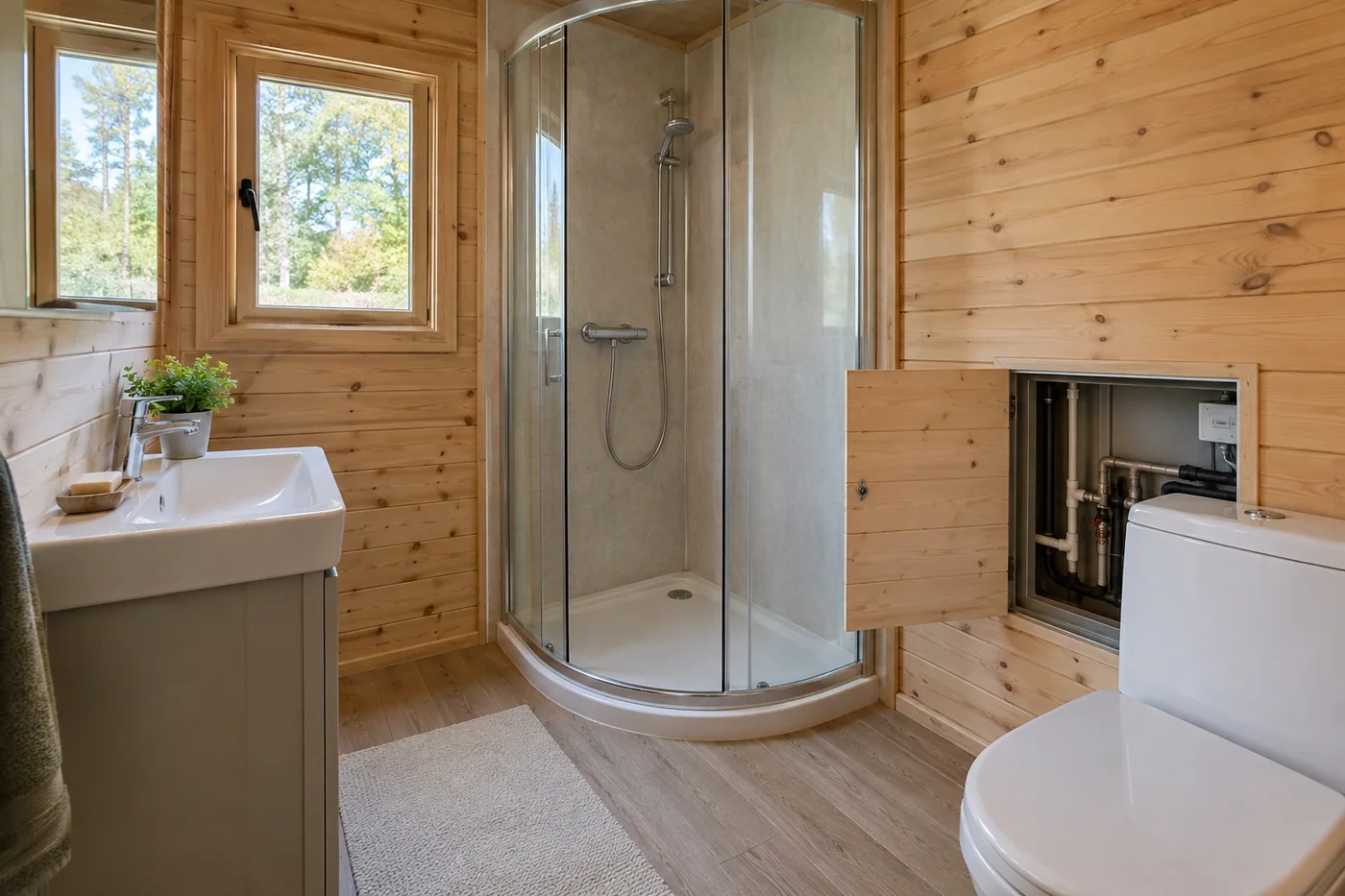
A factory bathroom check is evidence only for the identified system, configuration and conditions that were checked. It cannot automatically verify connections completed later at the destination. Before buying a cabin with bathroom, agree the factory records, transport protection, site rechecks and competent commissioning responsibilities. Keep unresolved findings visible until the responsible reviewer accepts their disposition.
Introduction: checked at the factory is an incomplete description
A buyer sees a finished shower room and asks whether it has been tested. The supplier answers yes. That exchange sounds reassuring but leaves essential questions unanswered: which system was checked, in what configuration, by whom, against which criteria and with what result? It also says nothing about work completed after the cabin leaves the factory.
This guide concerns the provenance and boundaries of evidence. It does not describe how to waterproof a shower, carry out a pressure test or commission electrical equipment. Those activities require appropriate professional methods for the actual system and destination. The buyer's job is to specify the information and responsibilities needed to support an informed acceptance decision.
Whether the offer is a small cabin with bathroom or a larger fitted unit, distinguish physical completion from verified readiness. A complete-looking interior may conceal temporary factory connections, disconnected equipment or interfaces that still belong to local contractors. None of those conditions should remain implicit in the handover paperwork.
1. Divide the bathroom into reviewable systems
Ask for a scope description that separates water supply, drainage, hot-water equipment, ventilation, electrical items, fixtures and wet-area construction. The relevant professionals can then identify which checks and records are appropriate to each system. One general certificate should not be assumed to cover every item merely because they share a room.
Record what the factory actually installs. A prefab cabin with toilet may have a fitted fixture and internal pipework while leaving external connections, equipment or local finishing work to others. The evidence plan should follow that real scope. It should not ask a supplier to certify systems it has neither designed nor completed.
Keep related documents connected without treating them as interchangeable. A component manufacturer's instructions, a factory observation and a site commissioning record answer different questions. A useful handover index identifies their purpose and the configuration to which they apply. It does not simply collect every PDF under a heading called quality.
2. Identify the configuration behind every record
A report should identify the relevant unit or component group, the checked arrangement and the date. Ask how the record connects to the accepted drawings and equipment schedule. If the system changes after the check, the responsible reviewer needs to decide which evidence remains relevant and which questions must be revisited.
Temporary factory conditions should be disclosed. A supplier may use a temporary connection or a controlled setup to examine part of the supplied system. That can provide useful information within its scope, but it should not be presented as a demonstration of the final external services at the destination.
When a report covers a sample rather than every unit, ask what selection and acceptance approach was agreed. Do not infer that every cabin was individually checked. Equally, do not dismiss a properly defined sample record merely because it is not universal. The project team must understand what the evidence can and cannot support.
3. Agree the method and reviewer before production
The competent responsible parties should establish the applicable method, criteria and documentation. Buyers should avoid inventing pressure values, durations or pass conditions from another product. The appropriate requirements depend on the system, local framework and purpose of the check. This article intentionally supplies no technical test settings.
Ask who performs the check and who reviews the result for the purchasing decision. Those roles may differ. Where independent witnessing or specialist testing is necessary, define it before the programme assumes the work is complete. A request made after the bathroom is closed up may require a different scope or additional work.
For England, Approved Document G is an official reference concerning sanitation, hot-water safety and water efficiency. Its relevance and applicable edition need project-specific review. It is not a global cabin-testing procedure, and citing it does not establish that a particular imported unit satisfies the local requirements.
Further reading: England: Approved Document G.
4. Use a two-stage evidence matrix
A two-stage matrix connects the factory information to the questions remaining at the site. It should be prepared with the relevant professionals, not filled in by assuming all factory checks remain valid unchanged. Include the condition in which the system will travel and the interfaces that will be completed later.
The table below is a proposed document structure, not an inspection standard. Add system-specific requirements supplied by the responsible team. Keep not applicable separate from not yet known so that a missing decision cannot disappear behind a convenient abbreviation.
Further reading: Review wet-room construction separately from evidence provenance.
| Record ID and scope | Checked configuration | Installed configuration | Permitted conclusion | Remaining local evidence |
|---|---|---|---|---|
| Factory system record | Identified unit, equipment and temporary setup | Confirm actual equipment and connections | Only the named check under its stated conditions | Responsible reviewer defines destination checks |
| Dispatch condition record | Documented protected or disconnected state | Record arrival and reinstatement changes | Visible dispatch condition within inspection scope | Receiving observations and reviewed discrepancies |
| Component document | Specified component and applicable revision | Confirm supplied model and installation | Component information within its actual scope | Installation and connected-system evidence |
| Site commissioning record | Completed local scope and stated conditions | Identify actual final configuration | Conclusion accepted by the responsible professional | Any exclusions, restrictions or unresolved issues |
Turn these questions into a project brief
Send your destination, intended use and proposed bathroom scope. Ask which factory records can be supplied and which checks your local team must arrange.
5. Record what is disconnected or protected for shipment
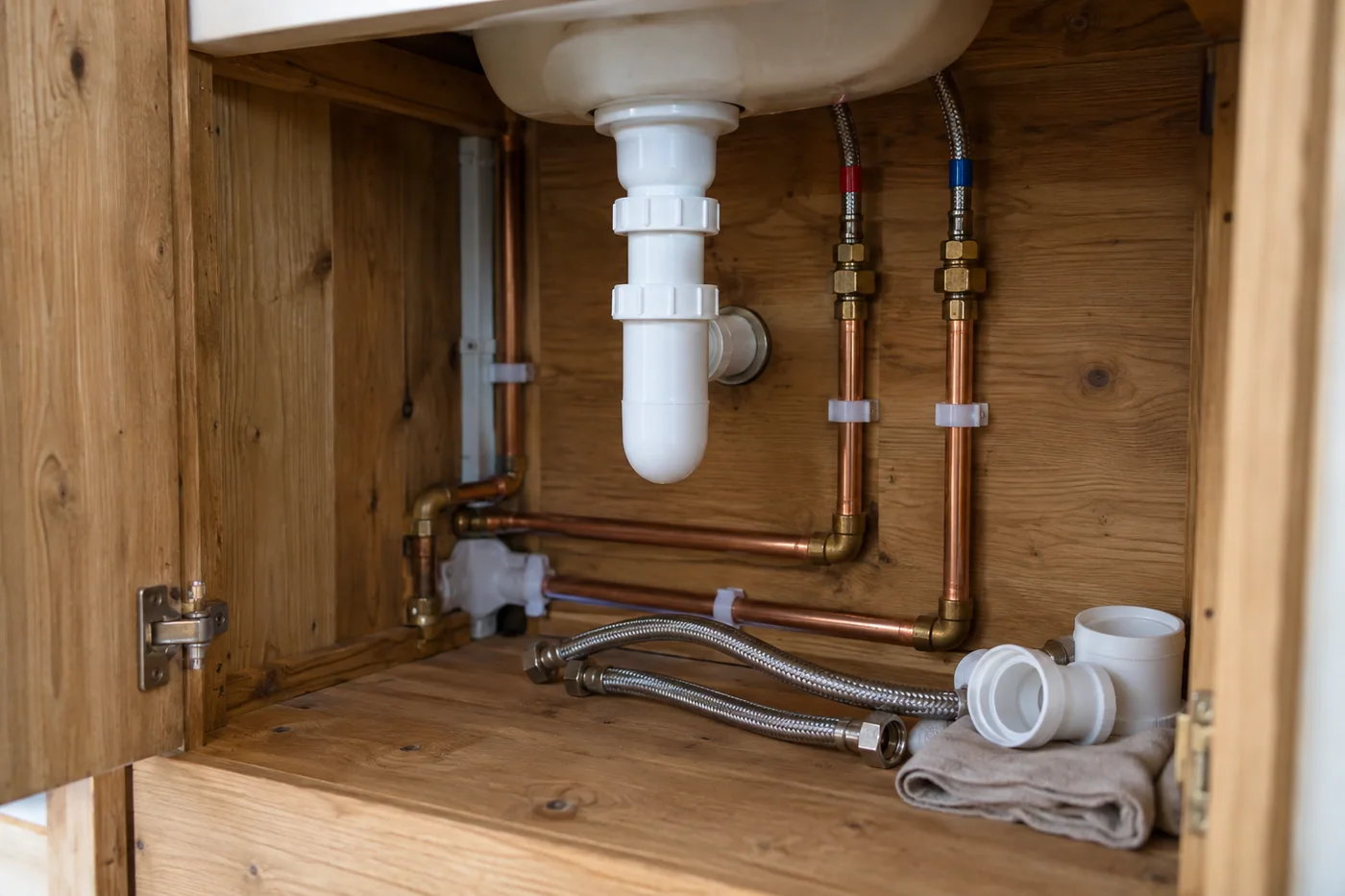
Ask the supplier which fixtures, connections or equipment are removed, isolated or protected for transport. The receiving team needs the corresponding reinstatement information and the appropriate local responsibilities. A bathroom that was complete during a factory review may deliberately travel in a different configuration.
Shipment inspection should record the agreed dispatch condition and relevant package identity. Photographs can support a condition record, but they do not demonstrate the function of a concealed connection. Keep visual evidence, measured observations and professional conclusions clearly distinguished in the report.
Provide the installation team with the identified interfaces before arrival. A bag of loose components without an allocation or instructions creates uncertainty that no amount of earlier testing can resolve. If a component appears damaged or unidentified, use the agreed discrepancy process rather than installing it and hoping that a later check will explain the problem.
Further reading: Record cabin arrival damage and shortages.
6. Determine the destination rechecks from actual work
The competent local team should identify what needs to be inspected or verified after transport, installation and connection. The decision should consider the supplied records and the work performed at the destination. It should not be based on a blanket assumption that everything must be repeated or that nothing needs further attention.
List changes explicitly. A substituted fixture, relocated equipment item or altered service connection may affect the relevance of an earlier record. Ask the responsible reviewer to identify the consequences and required response. The buyer should not decide technical equivalence merely because the replacement has a similar appearance.
Keep the final connection boundary visible. A successful check of internal pipework does not establish the suitability of the external supply or disposal system. Coordinate those matters with the local project team and relevant authorities. A cabin with bathroom for sale is a product offer, not confirmation that every proposed plot has suitable utilities.
7. Understand the limits of leak detection and monitoring
A monitoring device may provide useful operating information, but it is not a substitute for a properly reviewed and completed installation. Ask which conditions it detects, what it does not detect and who receives and acts on an alert. A device that no one monitors can create a false sense of readiness.
EPA WaterSense distinguishes moisture-detection and flow-monitoring approaches in its device guidance. Use that distinction when asking about the proposed equipment. Do not claim that a sensor demonstrates the integrity of every waterproofing interface or that a flow monitor will identify every possible bathroom problem.
Keep monitoring arrangements in the operator's information, separate from construction acceptance. The fact that a system has ongoing observation does not remove the need to resolve an outstanding commissioning issue. Similarly, an absence of alerts is not by itself proof that all concealed details are sound.
Further reading: EPA WaterSense: leak detection and flow monitoring devices.
8. Close findings through evidence, not a status label
Describe the observation precisely
A useful finding identifies the unit, location, condition and supporting evidence. Avoid conclusions that go beyond what was observed. For example, a visible mark may justify further investigation without establishing its cause. Have the appropriate professional evaluate technical questions rather than recording a procurement guess as a diagnosis.
Connect the finding to the accepted requirement or the question needing resolution. Without that reference, the parties may argue about whether an item is a defect, an incomplete task or a requested change. The distinction matters for both the technical response and the commercial discussion.
Verify the accepted response
Record the action taken, responsible party and evidence needed to close the issue. Where the competent reviewer requires another check, retain its actual result. A photograph of a replacement component does not necessarily demonstrate that the original problem has been resolved in the completed system.
Keep the original finding and subsequent response together. Do not delete the earlier record merely because the status changes to closed. A future maintenance enquiry may depend on understanding what was changed, especially where the final installation differs from the initial factory configuration.
9. Hypothetical example: an earlier check does not cover a later alteration
Consider an operator purchasing several fitted cabins. The supplier provides an order-specific record for internal bathroom work. During site connection, a local contractor changes the route of an interface to suit the prepared services. The operator asks whether the original factory record is enough to accept the completed system.
The appropriate response is to identify the change and refer it to the competent responsible team. They determine which review and verification are needed for the altered arrangement. The original record remains part of the history, but its scope is not silently expanded to cover work performed later by another party.
The final pack records the installed arrangement, the relevant local evidence and any remaining limitations. This hypothetical example does not decide whether the alteration is acceptable or who pays for the work. It shows why evidence should follow the actual configuration and why commissioning responsibilities belong in the purchase discussion.
10. Price the evidence and coordination as part of the scope
When comparing a cabin with bathroom and kitchen for sale against a shell or a different fitted package, identify which records and local tasks each offer includes. A lower price may simply leave more coordination to the buyer. Obtain appropriate project-specific proposals rather than treating documentation as a free administrative extra.
Ask for the proposed evidence schedule early. If a required inspection depends on access before finishes are installed, that dependency should be visible in the programme. The supplier and local team can then agree a workable sequence. Last-minute requests may not reproduce the same conditions or answer the same question.
Keep customer requirements specific and proportionate. The goal is a reliable acceptance basis, not the largest possible document folder. A small number of relevant, traceable records is more useful than many generic certificates whose relationship to the actual unit is unclear.
Further reading: Define whole-unit ensuite handover; Specify cabin bathroom and kitchen supply scope.
11. Make the records usable after the project team leaves
Organize the final evidence by unit and system. Include the accepted configuration, equipment information, relevant factory and site records, changes and unresolved limitations. The operator should be able to retrieve the correct information without remembering which contractor used a particular filename.
Assign responsibility for maintaining the record after later repairs or replacements. A useful original handover pack can become misleading if the installation changes and the documents do not. Record subsequent work through the appropriate service process rather than treating the initial completion date as the end of configuration control.
Do not publish technical reports or identifying customer information without permission. The operational team needs controlled access to useful evidence, while a public blog can explain the process without exposing private documents. This article's illustrations are fictional and should not be mistaken for proof of completed tests.
Frequently asked questions
Does a factory test prove the bathroom will work after delivery?
It provides evidence only within its defined scope and conditions. Transport, reconnection or later changes may create additional questions. The responsible local professionals should decide what must be reviewed or checked for the completed installation. Keep the factory record, but do not describe it as covering work it did not examine.
What should a useful test report identify?
It should identify the relevant unit or configuration, the system checked, the agreed method and criteria, the conditions, result and responsible parties. The exact requirements depend on the project. Ask the competent reviewer what information is necessary before accepting a generic report format as sufficient.
Can photographs replace inspection records?
Photographs can document visible condition and support identification, but they cannot establish every concealed or functional issue. Use them alongside the evidence appropriate to the question. A finished bathroom image should not be presented as proof of a pressure test, waterproofing performance or completed site commissioning.
Is leak monitoring enough for acceptance?
No device should be assumed to replace the applicable design, installation and verification process. Understand what the proposed monitor detects and how alerts are managed. Keep ongoing monitoring separate from the decision that the completed system meets the project's acceptance requirements.
Who signs off the destination work?
Identify the competent responsible parties and applicable local requirements in the project scope. The answer depends on the work and jurisdiction, not simply on who sold the cabin. Ensure the buyer knows which records are expected and who reviews them before the unit is treated as operationally ready.
Conclusion: keep every claim attached to its evidence
Buying a cabin with bathroom is easier to manage when each record states what was checked, under which conditions and what remains for the site. Define factory and destination responsibilities early, preserve configuration history and close findings through the evidence the competent reviewer requires.
Send CabinWild your intended location, use and bathroom requirements. Ask for an explicit evidence and handover scope, then coordinate it with the local professionals responsible for the completed installation. Do not rely on a finished photograph or an undefined tested label.
Specify the bathroom evidence you need
Send your destination, intended use and proposed bathroom scope. Ask which factory records can be supplied and which checks your local team must arrange.
Prepared with AI assistance for CabinWild Editorial using the linked public sources. Examples are illustrative, not customer results or verified CabinWild test data. Project-specific design and local requirements need review by the appropriate professionals.