
A bathroom-equipped glamping pod is not ready for guests merely because its interior is complete. Define turnkey handover through four separate states: manufactured, delivered, connected and accepted for the intended operation. Allocate service connections, local reviews, commissioning and operating records before ordering. The supplier's completion milestone should not be confused with permission to occupy or trade.
Introduction: a finished bathroom can still be an unfinished project
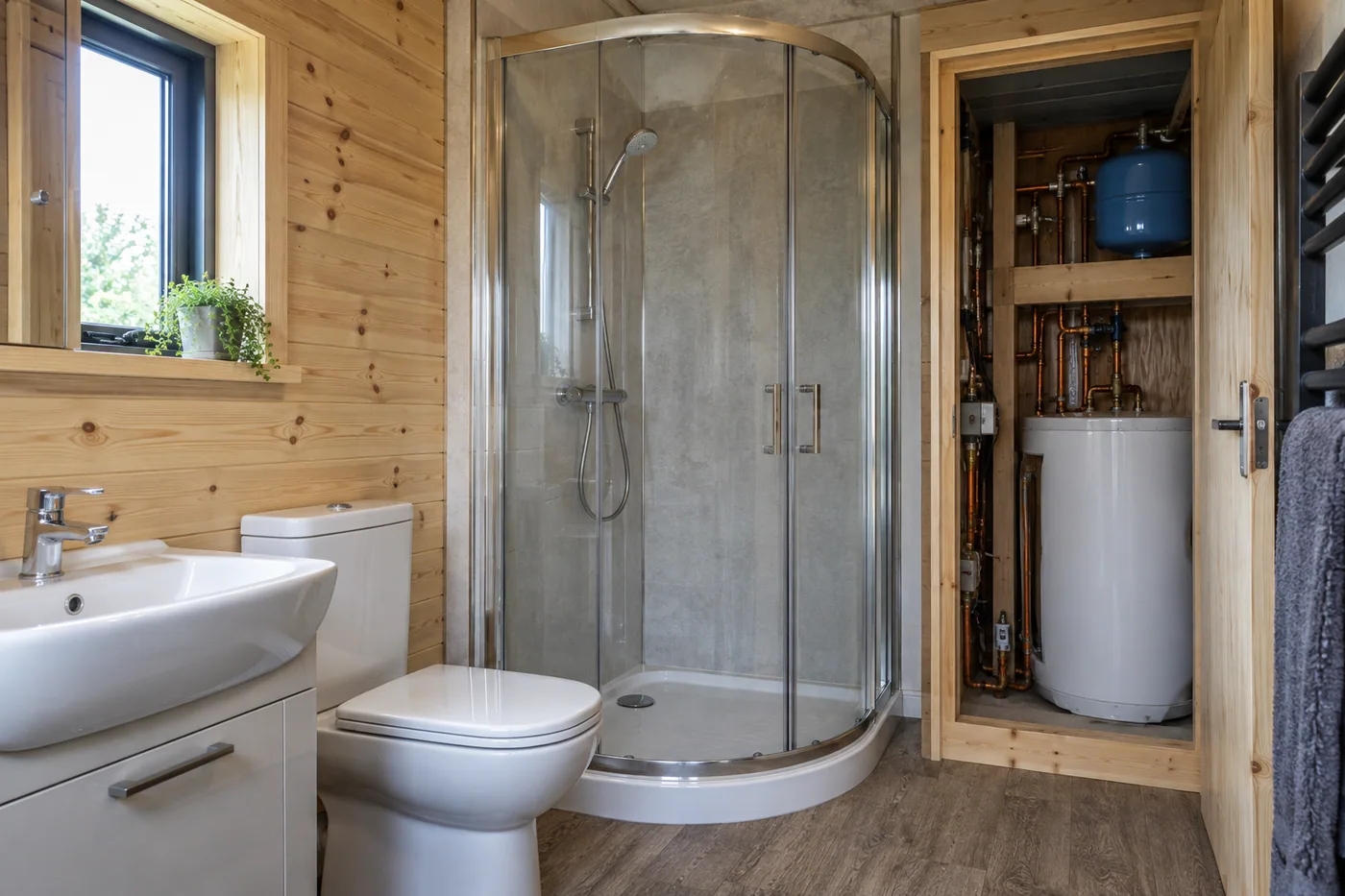
A photograph of a tiled shower room tells a buyer something about appearance, but almost nothing about the work remaining at the destination. The pod may still need foundations, external drainage, water treatment, power, professional checks and operating arrangements. Those are not minor details when the purpose of the purchase is to welcome paying guests.
Buyers comparing glamping pods for sale with bathroom should therefore ask what the quoted completion state means. Turnkey may describe an extensively fitted product, a particular installation package or an informal marketing promise. Only the accepted scope and handover requirements show which interpretation applies to the order.
This article focuses on the transition from supplied unit to operational asset. It does not specify plumbing, electrical or wastewater design, and it does not establish that a product is permitted at a particular site. Use qualified local professionals and the responsible authorities for those decisions. All worked examples below are hypothetical.
1. Name the four handover states separately
Manufactured means the agreed factory scope has been completed to the relevant release stage. Delivered means the goods have reached the agreed delivery boundary. Connected means the designated onsite services have been completed and checked. Accepted for operation means the responsible parties have satisfied the project's applicable technical, regulatory and operating requirements.
The same company may provide several stages, or different providers may be involved. Either arrangement can work when the handoffs are clear. Problems arise when a buyer assumes that a supplier's completed invoice covers stages the supplier never offered, or when local contractors assume factory work has already been verified for the destination.
Create a completion schedule before requesting the final quotation. For each state, identify the scope, evidence, responsible party and remaining conditions. Avoid using a single overall percentage complete to conceal an unresolved water connection or an outstanding professional review. One small-looking dependency can prevent the entire accommodation offer from opening.
2. Compare packages against the same operating destination
A glamping cabin prefab with factory-installed fixtures and a kit assembled locally can reach a similar finished appearance through very different work sequences. Ask where each system is installed, where it is checked and which interfaces are disturbed during transport or final assembly. That determines what evidence can exist before shipment and what must wait until site work is complete.
When comparing glamping cabin kits for sale with fully fitted pods, list the buyer's remaining work explicitly. Do not treat a kit's missing bathroom labour as the only difference. Procurement, coordination, protective storage, local trades and final records can also sit outside the supplied package. Obtain project-specific estimates for those tasks rather than inserting unsupported average costs.
Use glamping houses for sale as a search category, not a technical classification. Product names do not define the approval route, structural system or service standards. Record the actual proposed configuration and intended use. A supplier should be able to explain its offered package without the buyer having to infer the scope from the name.
3. Draw the service boundary in words and on the coordinated plan
Identify the cabin-side connection point for each service and the party responsible on either side. Ask for the available interface information in a format the local designers and contractors can use. A reference to plumbing included should not leave the position, accessibility or scope of the external connection unresolved.
Water supply and wastewater disposal require site-specific review. The U.S. EPA's septic-system guidance describes onsite treatment as a system of connected components, not merely an outlet from a building. A bathroom-equipped pod does not establish that the land has a suitable or approved wastewater arrangement. Do not order equipment on the assumption that the cabin supplier has resolved that question.
The same principle applies to electrical supply and any heating or hot-water equipment. The local responsible professionals should confirm compatibility, capacity, connection and verification requirements. This article intentionally does not prescribe protective devices, cable sizes, pipe dimensions or test settings; those details belong to the competent project team.
Further reading: EPA: how a septic system works; Plan remote cabin water and wastewater responsibilities.
4. Use a handover boundary matrix
Request a written response to each row before the order is finalized. The evidence column should describe what will be returned, not simply promise that the work will be checked. Where the required record is not yet defined, assign the decision to the appropriate professional rather than leaving an empty cell.
Include exclusions in the same matrix. A separate page of small-print exclusions is easily overlooked when another document promises ready-to-use accommodation. Reconcile conflicting descriptions before accepting the offer, and ask legal advisers to review the resulting contractual wording where necessary.
| Stage | Question to settle | Handover evidence |
|---|---|---|
| Factory fit-out | Which systems are installed and checked before shipment? | Order-specific scope and agreed check records |
| Transport | What is protected, disconnected or removed? | Packing and reinstatement information |
| Site connection | Who completes each utility interface? | Coordinated scope and contractor completion records |
| Commissioning | Who verifies the connected installation? | Applicable competent-person records and limitations |
| Operator acceptance | Which remaining actions prevent guest use? | Open-item list and authorized acceptance |
| Ownership care | What must be maintained and how is support requested? | Equipment information and agreed service contacts |
Turn these questions into a project brief
Send the location, guest model, quantity and available service information. Request an ensuite package proposal with explicit connection and commissioning responsibilities.
5. Distinguish factory evidence from connected-site evidence
Factory testing can answer useful questions about the supplied scope when the method and acceptance criteria are agreed. Ask what configuration is represented and whether temporary test connections differ from the final installation. Keep the report tied to the relevant unit or batch, and make any exclusions clear to the receiving team.
Shipment inspection serves a different purpose. It can check the agreed dispatch condition, component identity and protection, but it cannot demonstrate that a future onsite utility connection will function correctly. The buyer should not ask one report to stand in for every later stage of the project.
After transport and installation, the local team should determine which inspections or checks are necessary before systems are used. Record any work that has changed or disturbed the earlier configuration. Do not assume that a factory sign-off remains sufficient after components have been disconnected, moved, reconnected or modified on site.
Further reading: Separate cabin bathroom factory checks and site commissioning.
6. Include moisture, cleaning and service access in acceptance
An ensuite is an operational environment, not just a collection of fixtures. Ask how wet areas, ventilation, cleaning and maintenance access are addressed in the coordinated design. Review the intended use and operating season with the responsible team, especially where a small room contains several systems in a restricted space.
EPA moisture-control guidance treats building design, construction and maintenance together. In a handover discussion, that supports asking for usable care and inspection information rather than relying solely on a finish photograph. It does not establish a universal bathroom detail or prove that a particular cabin is resistant to every moisture problem.
Walk through ordinary service tasks before closing the handover list. Can an authorized maintainer reach the relevant equipment without damaging finishes? Can the operator identify the supplied model and obtain its instructions? If access depends on removing a panel, record the intended method and who is qualified to perform the work.
Further reading: EPA: building moisture control guidance.
7. Keep local authorization separate from supplier completion
A supplier can complete its contractual work while a local approval or site requirement remains outstanding. That does not automatically mean the supplier has failed, nor does it mean the unit can be occupied. The buyer needs a clearly assigned process for resolving the remaining requirements before opening.
For buyers searching for glamping pods for sale USA, begin with the actual state, local authority, intended use and site conditions. Do not assume one nationwide classification for every pod or that the word prefab supplies an approval route. Ask local professionals which product information is required and which inspections or authorizations apply.
The same caution applies elsewhere. English government fire-risk guidance for sleeping accommodation is a jurisdiction-specific reference, not a worldwide cabin certificate. Use the appropriate local framework and competent advice. Keep the operating decision distinct from the commercial decision to accept delivery of goods.
Further reading: England: sleeping accommodation fire-risk guidance.
8. Build a handover pack that an operator can use
Unit identity and installed equipment
Give each unit an identifier that connects the supplied configuration to its documents. Record the installed equipment models, relevant instructions, approved substitutions and the actual service arrangement. A folder containing several unrelated manuals is difficult to use when the operator needs to identify the correct replacement component.
Keep as-built information distinguishable from earlier design drawings. If the final installation differs, have the responsible parties document the accepted change. The operator should not have to guess whether a line on a drawing represents the planned route or the one actually installed.
Outstanding work and the operating decision
Separate minor finish observations from issues that require technical assessment or prevent use. Have the competent responsible parties make that distinction; a salesperson's description of an issue as minor is not sufficient where safety or compliance may be involved.
Record the owner, required response and acceptance route for every open item. A handover pack can include unfinished actions without pretending the project is complete. The key is that the operating decision is based on the actual unresolved conditions, not on pressure from a planned opening date.
9. Hypothetical handover: complete fit-out, incomplete connection
Imagine a small operator buys several ensuite pods. The factory scope includes the bathroom fixtures and internal services, but the local contract covers external connections. On arrival, the receiving inspection finds no obvious transport damage. The operator is tempted to regard the units as ready because the bathrooms look finished.
The handover matrix shows why that conclusion is premature. The local contractor still needs to complete and verify the connections, the relevant professional needs the final records, and the operator needs equipment information and an agreed maintenance route. The team schedules those tasks and keeps the affected units out of guest use until the responsible parties establish readiness.
A later problem with one accessible service panel is documented separately. The team determines whether it is a supplied-component issue, a local installation issue or an unresolved design interface. The example does not decide liability. It illustrates why the purchase should define an evidence and response process before the first guest arrives.
Manage partial handover without implying guest readiness
A project can reach several legitimate partial handovers before the room is ready for guests. The manufactured shell may be accepted for transport, the delivered package may be received on site and the installed fit-out may be ready for local commissioning. Name each event precisely. A document titled complete should explain complete for what purpose and within whose scope.
Maintain a room-by-room release board when several units are being installed. One accepted sample should not automatically release other units with unfinished services or missing records. Identify the specific room, current limitation and person responsible for closure. The operator can then plan opening decisions using actual status rather than the visual similarity of the cabins.
Temporary arrangements need their own review. A working light does not establish that all electrical work is accepted; a visible bathroom does not prove that the relevant services and operating requirements are ready. This is not a reason to create excessive paperwork. It is a reason to avoid using a narrow observation to support a broad readiness statement.
Keep the operator's final acceptance separate from a contractor's invoice milestone. The contractual payment position requires its own appropriate advice, while operational release should rely on the required evidence for the actual use. If the two dates differ, record the difference explicitly rather than changing a technical status to make the administration look simpler.
At the end of the project, consolidate the release records into the room information used by maintenance and guest-service staff. They should be able to identify the installed equipment, relevant support contacts and any remaining restrictions. A handover packet that accurately describes one room is more useful than a generic turnkey brochure repeated across the site.
Frequently asked questions
Does turnkey mean that nothing remains for the buyer?
Not necessarily. The term has to be defined in the actual offer. Ask whether it includes foundations, delivery, unloading, external services, professional reviews, commissioning and operating equipment. Keep any approvals and operator duties visible even where one supplier coordinates several commercial stages of the project.
Can factory checks replace site commissioning?
They may provide relevant evidence for the supplied configuration, but they do not automatically verify later connections or modifications. The responsible local professionals should determine the checks needed for the completed installation. Retain both records and explain what each one covers rather than describing them as interchangeable.
Should I reject a cabin that arrives with an open-item list?
Evaluate the actual items through the agreed acceptance process. Some may be commercial or cosmetic, while others need technical review or prevent use. Do not make that distinction from a generic checklist alone. Record the required action, responsible party and conditions for acceptance or occupation.
Who supplies the final equipment manuals?
Assign that responsibility in the purchase and installation scopes. The operator needs information for the equipment actually installed, including accepted substitutions. If different parties supply different systems, nominate a coordinator for the final pack so the records can be retrieved by unit rather than scattered across separate inboxes.
How should I compare a fitted pod and a locally finished kit?
Compare the same intended completion state and identify who supplies each missing task, document and review. Keep supplier prices separate from local estimates and unresolved allowances. The best comparison is a coordinated scope and evidence schedule, not a ranking based only on how complete the bathroom looks in photographs.
Conclusion: specify an observable handover state
A bathroom-equipped glamping purchase becomes easier to manage when manufactured, delivered, connected and operationally accepted are separate milestones. Connect every milestone to its actual scope and evidence. Preserve the local review boundary, and make the operator's records part of the planned delivery.
Send CabinWild the intended location, accommodation model and known service conditions. Ask for an ensuite proposal that identifies what can be supplied, what remains onsite and which handover records are available. That conversation is more useful than accepting turnkey without a definition.
Define the handover you need
Send the location, guest model, quantity and available service information. Request an ensuite package proposal with explicit connection and commissioning responsibilities.
Prepared with AI assistance for CabinWild Editorial using the linked public sources. Examples are illustrative, not customer results or verified CabinWild test data. Project-specific design and local requirements need review by the appropriate professionals.