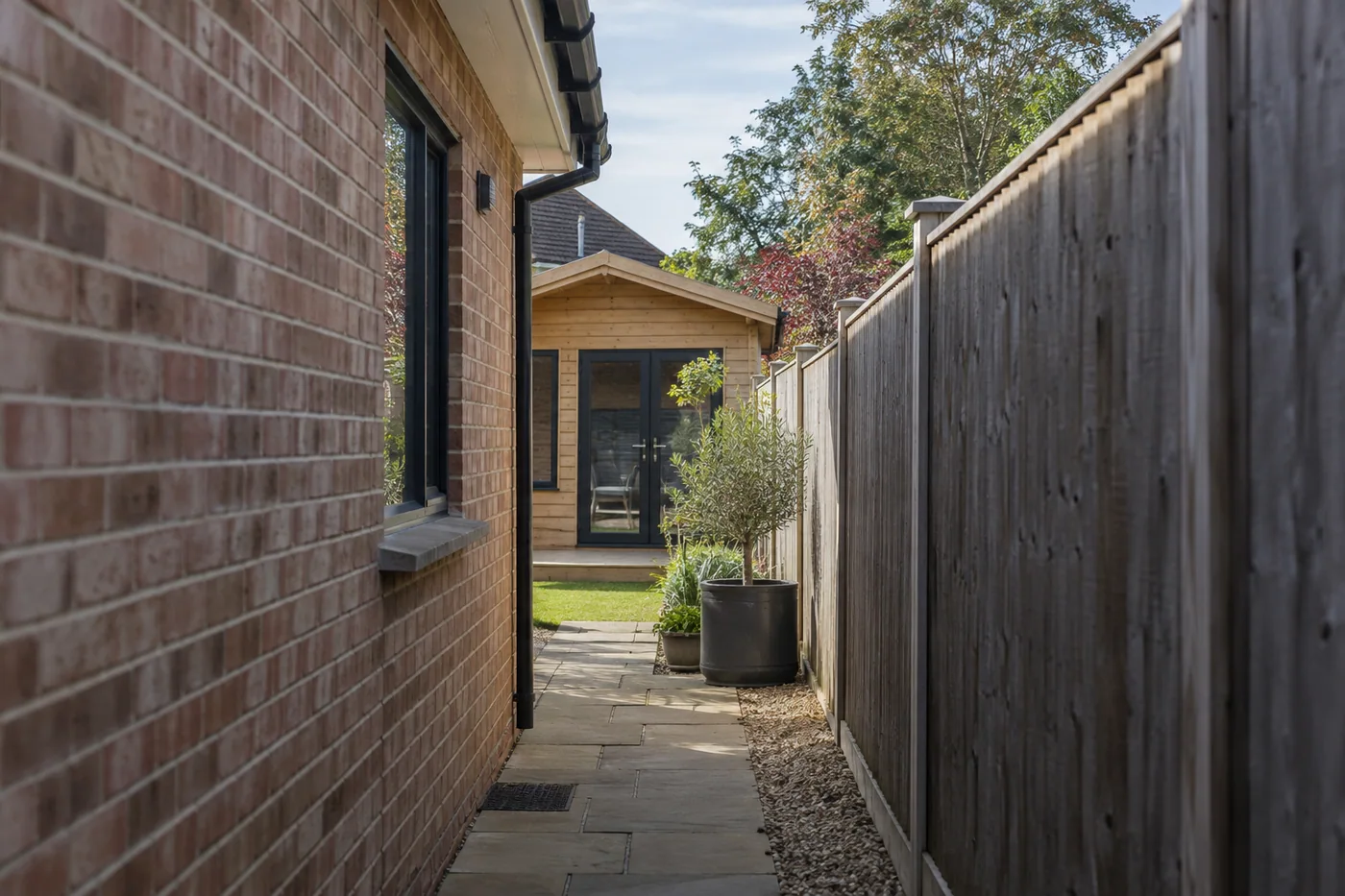
For a restricted-access garden project, survey the complete route from the proposed unloading point to the installation area before choosing a cabin package. Compare measured constraints with the actual packed components, handling equipment and safe method proposed by the responsible contractors. A kit that fits through a gate in one dimension may still be unsuitable because of turns, levels, weight or unavailable staging space.
Introduction: the difficult part may be outside the garden
Buyers searching for garden cabin kits UK often concentrate on the space where the cabin will stand. The route to that space can be more restrictive than the footprint itself. A side gate, shared passage, low branch, tight corner or change of level can affect which package is practical and who must handle it.
This guide describes a procurement survey, not a lifting or manual-handling method. Competent contractors must plan safe operations for the actual site, components and equipment. It does not claim that CabinWild has surveyed a property or that any kit is suitable for a particular route. Local permissions, highway conditions and property rights also need appropriate review.
The aim is to discover constraints while choices remain open. A buyer may be able to change packaging, choose a different delivery arrangement or revise the project. Once a lorry arrives with an unsuitable load, those decisions become urgent and potentially expensive. Good installation preparation begins well before the delivery date.
Survey a continuous route, not a single gate
Draw the route from the proposed vehicle position to the final staging and installation area. Divide it into segments wherever width, direction, level, surface or overhead clearance changes. Give each segment a reference and take photographs from both directions. Record what was measured, when and by whom; approximate estate-agent dimensions are not a delivery survey.
Include the transition between segments. A long component may pass through two straight passages individually yet be unable to turn between them. Similarly, an overhead restriction may matter only as an item is tilted or moved over a step. Submit the complete route information to the party planning handling instead of deciding feasibility from one favourable measurement.
| Route feature | Information to record | Question for the delivery team |
|---|---|---|
| Unloading position | Available space, restrictions and nearby activity | Can the proposed vehicle and operation be accommodated? |
| Gates and passages | Measured clear openings and projections | Which packed items and handling equipment can pass? |
| Turns | Connected spaces and fixed obstructions | Can the complete movement be planned safely? |
| Level changes | Steps, slopes and transitions | What approved handling approach is required? |
| Overhead constraints | Cables, branches, eaves and temporary obstacles | What restrictions affect the operation? |
| Staging area | Usable area, surface and weather exposure | Where can components be received and protected? |
Request component data for the actual order
A brochure's cabin dimensions are not delivery dimensions. Ask for the packed dimensions, component dimensions, masses and packaging arrangement relevant to the selected design and revision. Distinguish the largest individual piece from the largest bundle, and identify fragile or easily damaged items that need particular protection.
Data should be traceable to the proposed order. Similar-looking prefabricated garden cabins may be supplied as small members, larger panels or more complete assemblies. A packaging change can affect both handling and protection. Ask whether the supplier's information is preliminary or released, and define when the final packing information will be available.
Do not instruct a delivery crew to break down a package merely because the parts appear smaller inside. Opening bundles can alter stability, identification, protection and the scope of the delivery contract. Where unpacking before the final position is proposed, obtain an agreed sequence and responsibility for sorting, weather protection and later inspection.
Treat a design substitution as an access change
A replacement door set, longer wall member or different roof assembly may change the route requirement even when the cabin footprint stays the same. Include access data in substitution review. Approval of appearance or price alone should not release a component that the agreed delivery method cannot accommodate.
Separate access feasibility from safe handling
The fact that an item physically fits does not establish that people can move it safely. Handling depends on the load, task, environment and people involved. HSE's manual-handling guidance provides a relevant Great Britain starting point; a project-specific assessment must address the actual work. This article does not provide a universal safe lifting weight or number of people.
Ask the responsible contractor to describe the proposed equipment, access controls and operational assumptions. Do not purchase an oversized package on the expectation that extra labour will solve every constraint. Weather, ground conditions, fragile finishes and nearby occupants can affect what is practical on the day.
Keep household occupants, visitors and other trades in the planning conversation. A route through an occupied property raises different concerns from an open site. The contractor should determine necessary separation and controls. Procurement can make the constraints visible, but should not write an improvised movement method from photographs.
Further reading: HSE: manual handling at work.
Define where the supplier's delivery ends
Terms such as delivery included, kerbside delivery and installation included need an order-specific explanation. Record the intended stopping point, unloading responsibility, waiting assumptions, access requirements and handover evidence. Identify who carries risk and responsibility for each subsequent movement using the actual contract and appropriate professional advice.
For garden cabins for sale through a dealer, the manufacturer, carrier, dealer and installer may be different businesses. Do not assume a sales discussion with one party binds all the others. Obtain written confirmation of the interface, including whom the buyer contacts if the proposed unloading point is unavailable.
A useful schedule assigns the vehicle arrival, unloading, internal movement, protected staging and final placement separately. It also explains who may decide that conditions are unsuitable and how a rescheduled operation is handled. This is a coordination tool, not a substitute for legal interpretation of the transport or purchase terms.
Turn these questions into a project brief
Send the site location, route measurements, photographs and known restrictions. Ask for actual component and packaging information for a handling review.
Check the approach road and unloading environment
The survey should extend beyond the property boundary where the proposed delivery depends on public or shared space. Record parking restrictions, access times, neighbouring operations and apparent limitations for the intended vehicle. Do not assume the buyer controls a street or shared driveway simply because it is convenient for unloading.
HSE's construction traffic-management guidance is useful when planning workplace vehicle interfaces in Great Britain. Refer the operational plan to the competent contractor and investigate any necessary permissions through the relevant authority or property owner. A supplier's standard delivery note does not grant permission to occupy another person's land or a public highway.
Agree a communications plan before dispatch. Give the carrier a contact who understands the approved arrangement, not just a telephone number for someone who may be absent. Explain how changes will be escalated. If the planned position becomes blocked, the driver should not be expected to invent an unreviewed alternative under pressure.
Further reading: HSE: construction vehicles and traffic management.
Reserve space for receiving, checking and protecting the kit
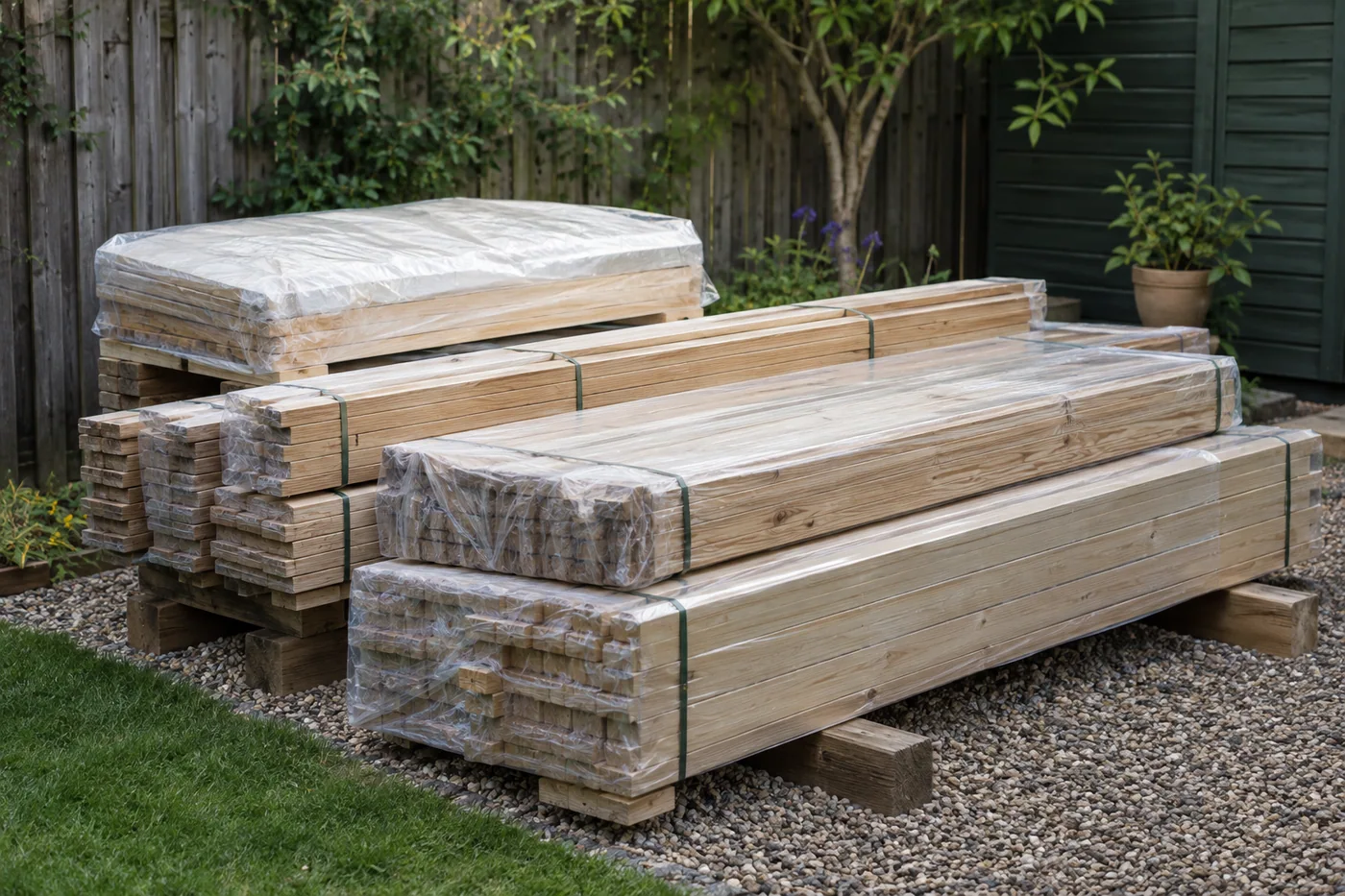
The final cabin footprint is not the entire logistics area. Components may need temporary staging while their identity and condition are checked. Ask the installation team what space its method requires, and whether the route must remain clear throughout assembly. Avoid placing early bundles where they obstruct later deliveries or access to the base.
Shipment inspection and receipt checks should use the package identifiers and current packing list. Photograph visible condition and record discrepancies using the agreed process. An access survey does not replace that inspection, and a clean delivery receipt should not be used to claim that concealed components were examined when they were not.
Protection requirements should come from the relevant supplier instructions and site assessment. Decide who provides the agreed protection and monitors it if installation is delayed. This guide does not prescribe stacking heights, lifting points or a generic storage method. Those depend on the supplied components and the contractor's plan.
Plan for a delay without planning to leave the route blocked
Identify a reviewed fallback before dispatch. This might involve a revised delivery date or an approved alternative receiving arrangement. Any option must be assessed for cost, permissions and protection. A spare patch of ground seen on a map is not automatically available, suitable or authorized for storing the load.
Compare package options against the same route
Once route constraints and order data are available, compare options using a common worksheet. A smaller-component kit may change site assembly work; a larger panel package may change handling needs. Record both consequences instead of declaring one construction method universally superior for restricted access.
For garden office cabins UK buyers should also consider fit-out deliveries. A shell may pass through the route while a later glazing unit, desk or service component does not. Ask who reviews those later deliveries and whether their access needs are represented in the project programme. This prevents the shell's successful arrival from hiding an incomplete workplace.
Where information is insufficient, leave the option unconfirmed. Ask the supplier or contractor for the missing evidence and set a decision date. A cautious unresolved status is more useful than an unsupported statement that delivery should be fine. Only commit to the package when the relevant parties have accepted the documented assumptions.
Further reading: Build a garden office budget around the working day.
Hypothetical example: a clear gate with an impossible turn
Imagine a hypothetical garden reached by a side gate followed immediately by a turn around a fixed outbuilding. The buyer measures the gate and compares that width with a panel's thickness. The comparison appears favourable, but it says nothing about moving the panel through the turn or supporting it during the movement.
A route drawing and the actual panel data allow the handling contractor to review the complete movement. The eventual answer might involve a different package, an appropriately assessed alternative route or a decision that the option is unsuitable. It must not be assumed that removing fencing, entering neighbouring land or using lifting equipment is permitted.
The useful lesson is not a particular technical workaround. It is the timing of the review. By discovering the issue before manufacture, the buyer can compare feasible proposals and understand the consequences. After manufacture, an attractive standard package can become a problem that none of the quoted parties agreed to solve.
- Complete and date the route survey.
- Obtain order-specific packing and component data.
- Confirm the competent handling and installation parties.
- Record property, public-space and operating restrictions.
- Agree staging, protection and discrepancy procedures.
- Close access uncertainties before dispatch authorization.
Reconfirm that the surveyed route still exists before dispatch
An access survey records a condition at a particular time. Building work, parked equipment, seasonal growth or changes to neighbouring activity can alter the route before delivery. Assign a person to confirm that the agreed conditions remain available and to report changes to the responsible delivery team. This is a status check, not permission to remove obstructions without authority.
Use the original route references for the reconfirmation. The contractor should be able to compare current information with the arrangement it reviewed, including the unloading and staging areas. If a segment has changed, identify it explicitly rather than sending a general photograph with the message all clear. Clear communication helps the competent team decide whether its plan remains valid.
Make the dispatch decision depend on the agreed information being available. The buyer and supplier should know who confirms readiness and what happens when confirmation is missing. A carrier being available on a particular date does not establish that the site can receive the load. Likewise, a buyer's travel plans should not pressure a crew to use an unreviewed route.
Include loose fit-out deliveries in the same coordination calendar where they share the access. Several individually feasible deliveries can conflict if their vehicles, packaging or staging areas overlap. Ask the responsible parties to coordinate timing and maintain the required routes. The owner should not assume that each supplier will independently discover the others' plans.
Retain the final route confirmation with the delivery record. If conditions differ on arrival, the record helps explain the discrepancy without relying on competing memories. It should support a calm decision by the responsible people, not be used as an instruction to proceed regardless of the actual conditions found.
Frequently asked questions
Can all garden cabin kits pass through a standard side gate?
No. Package and component dimensions vary, and a single clear opening is only part of the route. Turns, levels, overhead restrictions, component mass and handling conditions must also be assessed. Obtain data for the actual order and have the responsible contractor review the complete movement.
Should I choose small components instead of panels?
Compare the actual options with the route and installation plan. Smaller components can change site work and packaging needs, while larger assemblies can change equipment and access requirements. Neither format is automatically suitable or cheaper once the complete delivery and assembly scope is considered.
Does delivery included mean carrying the kit into my garden?
Not necessarily. Ask for the exact delivery endpoint, unloading arrangements and responsibility for movement beyond that point. Make sure the relevant supplier, carrier and installer accept the same written arrangement. Do not rely on a general phrase in an advertisement.
Can I arrange for neighbours' land to be used on delivery day?
Any proposed use of land outside your control needs appropriate permission and operational assessment before it becomes part of the delivery plan. Obtain relevant professional advice where rights or responsibilities are uncertain. A convenient alternative route should never be assumed to be available.
What photographs should accompany an access enquiry?
Provide dated views of the approach, unloading location, each constrained segment, turns, level changes, overhead features and staging area. Include a route sketch and measured information. Photographs support the assessment but do not replace measurements or a competent review of the actual delivery method.
Conclusion: let the route help choose the package
Restricted access is a purchasing constraint, not merely a delivery-day inconvenience. Survey the continuous route, obtain data for the selected order and define each handling responsibility. Keep physical fit, safe operation and permission as separate questions that all need satisfactory answers.
Send CabinWild your site location, route information and intended use to discuss a clearly scoped package. Ask for the component and packing information your local handling team needs, and resolve the route before treating a garden cabin quotation as ready for purchase.
Check your access before choosing a package
Send the site location, route measurements, photographs and known restrictions. Ask for actual component and packaging information for a handling review.
Prepared with AI assistance for CabinWild Editorial using the linked public sources. Examples are illustrative, not customer results or verified CabinWild test data. Project-specific design and local requirements need review by the appropriate professionals.