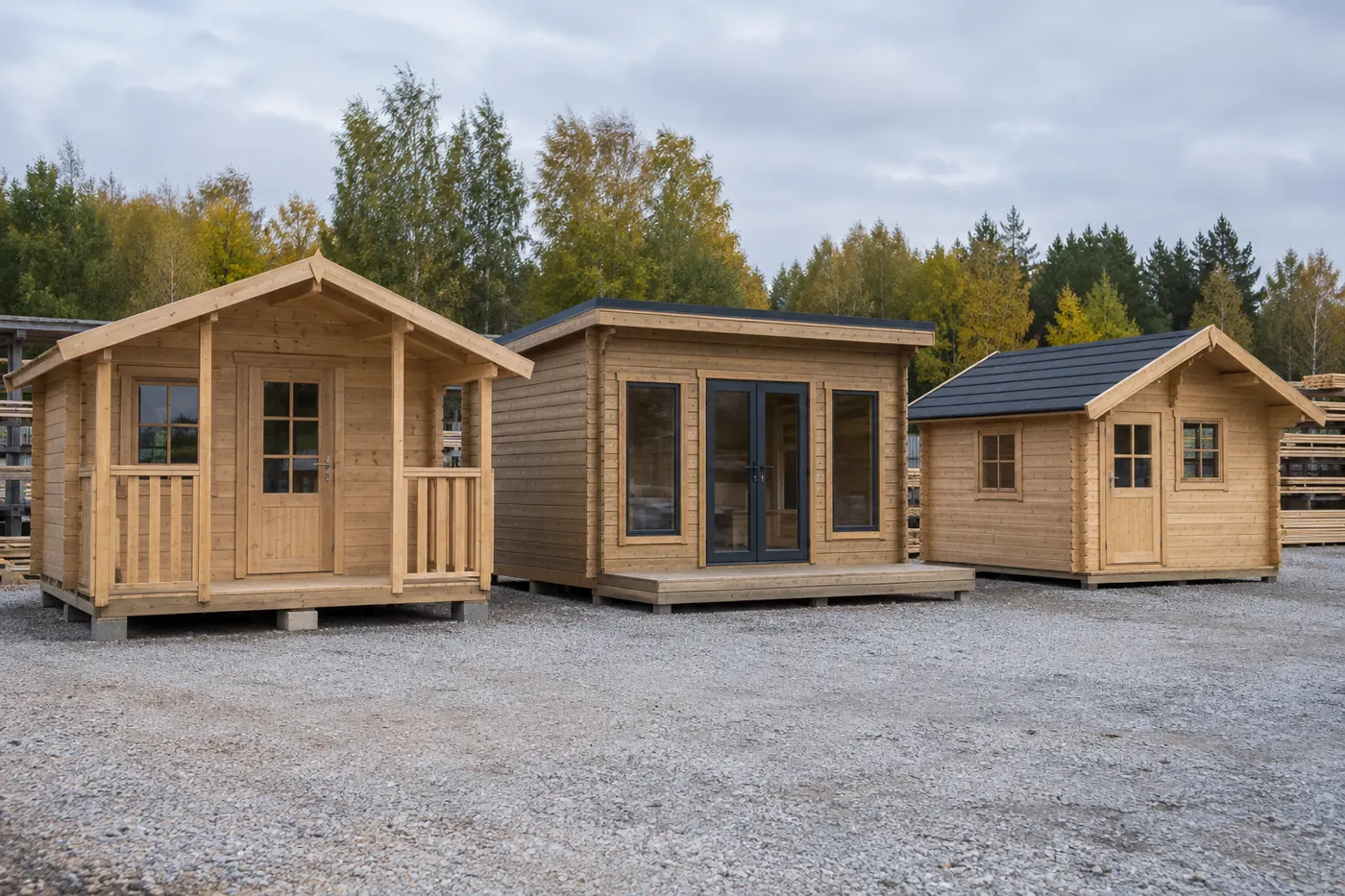
Buy wooden cabins by comparing a defined intended use, destination, supply boundary, technical evidence and complete landed responsibility. A photograph or headline price cannot show whether foundations, services, local approvals, unloading, installation or commissioning are included. Shortlist only offers that identify the exact configuration, exclusions, document status and inspection records available for the proposed order.
Introduction: turn the search into a controlled purchase
A buyer searching for a cabin often begins with photographs and a nominal size. That is useful for finding styles, but it is not enough to compare commercial offers. Two units with similar elevations can differ in structural design responsibility, wall build-up, openings, services, finishes, packing, delivery and installation. The purchasing task is to make those differences visible before a deposit or production release.
For an overseas buyer, the product price is only one boundary in a longer project. The site may still require planning advice, design work, ground investigation, foundations, utilities, transport access, unloading, assembly and inspections. Some suppliers can support parts of that sequence; others intentionally sell a narrower package. Either route can work when the boundary and responsible parties are explicit.
This guide is a procurement framework, not legal, structural or price advice. It does not claim that CabinWild has completed a particular factory test, shipment or customer project. All scenarios are hypothetical. Use current written supplier information and obtain qualified advice for the destination, site, intended occupancy and local approval process.
Search labels are not specifications. Wooden cabins may mean garden rooms, accommodation units, kits or complete modules; wooden cabins for sale and wooden cabin for sale pages may quote different completion levels. Timber cabins and timber cabins for sale are equally broad descriptions. Convert every label into a written use, configuration, scope and destination before comparing suppliers.
1. Define the product application before the product
State who will use the building, for how long, in which seasons and under whose operation. A private garden retreat, a rental unit and a staff office create different expectations for access, fire strategy, services, maintenance and documentation. Avoid asking the supplier to infer these matters from a model name. Give the shortlist the same use brief so replies address the same problem.
Describe the destination and site at the same time. Climate, exposure, access, utilities and surrounding use affect the information the local project team will need. The brief should distinguish a preference, such as a particular cladding appearance, from an outcome that must be reviewed, such as usable capacity or an envelope suitable for local conditions.
Request a one-page use brief with occupancy, season, hours and required amenities. Ask: "What must the cabin support on its busiest realistic day?" Record the answer, owner and due date; do not let choosing a shell by appearance before stating whether it is storage, work, hospitality or accommodation become an assumed inclusion or approval.
A question to put in the buyer brief
What must the cabin support on its busiest realistic day?
2. Normalize the supply boundary
Ask each bidder to classify the offer in practical terms. Is it loose material, a pre-cut kit, panelized elements, a weather-tight shell or a substantially fitted module? Then list foundations, floor build-up, roof covering, openings, internal lining, bathroom, electrical work and equipment. Marketing labels vary, so the schedule must control the comparison.
Record local work next to every exclusion. A component omitted from the supplier price does not disappear from the project. It may require local design, procurement, labor, inspection and interface coordination. A narrower supply package can be deliberate and efficient, but only when the buyer has the resources and documentation to complete it.
Request an inclusion-exclusion schedule tied to the quoted model and revision. Ask: "Which party supplies and accepts every item needed after the factory gate?" Record the answer, owner and due date; do not let comparing a material kit with a fitted module as if both prices represented a completed cabin become an assumed inclusion or approval.
A question to put in the buyer brief
Which party supplies and accepts every item needed after the factory gate?
3. Compare envelope information against the destination
Request cross-sections and material information for the exact option. The USDA Wood Handbook explains that wood properties and moisture relationships matter to engineering use; it does not validate a cabin by species name alone. Ask the responsible designers to review structure, heat, moisture, durability and fire requirements using information relevant to the destination.
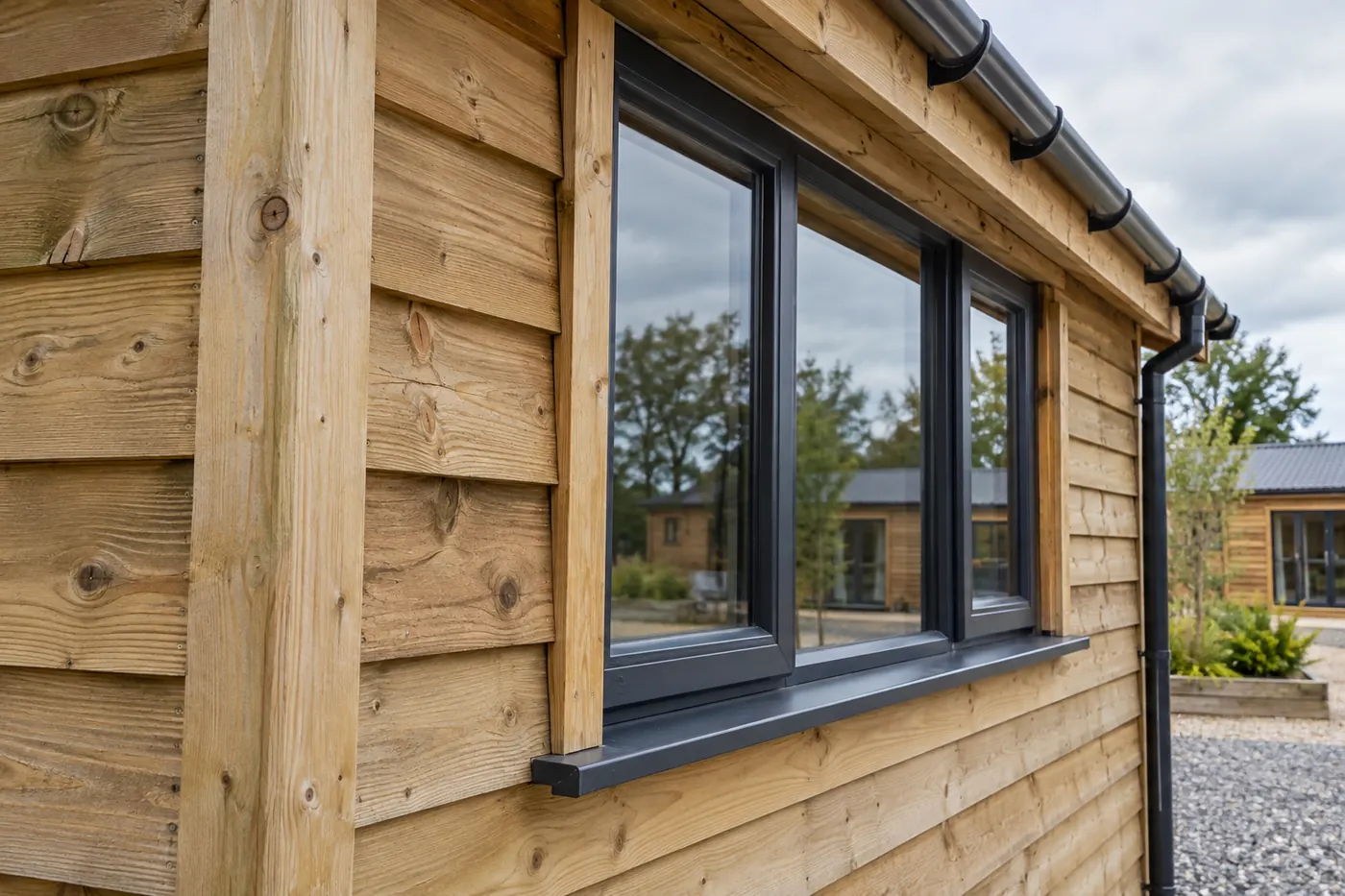
Openings and junctions need equal attention. Window performance, flashing, membranes, ventilation paths and sealants interact with the full assembly. A buyer should not invent a performance value from a photograph or a single component certificate. Identify what evidence applies to the supplied configuration and what remains to be designed or completed locally.
Request proposed build-ups, material descriptions and assumptions for local professional review. Ask: "Which stated conditions and intended use does the proposed envelope address?" Record the answer, owner and due date; do not let treating timber thickness or an insulation label as complete performance evidence become an assumed inclusion or approval.
Further reading: USDA Forest Products Laboratory: Wood Handbook—Wood as an Engineering Material; US Department of Energy: building climate zones.
A question to put in the buyer brief
Which stated conditions and intended use does the proposed envelope address?
4. Separate sales drawings from project documents
Ask for a document index before treating a drawing package as value. A layout can communicate room arrangement without resolving foundations, connections, services or regulatory information. Record the issue status, units, revision and author. Give representative documents to the destination team early enough to identify information gaps before production.
Clarify drawing ownership and permitted use when files will be shared or adapted. WIPO notes that architecture and technical drawings can be protected expression. The buyer needs written rights appropriate to review, manufacture, installation and repeat units, while respecting any limits. Purchasing a cabin or plan does not automatically grant every reproduction or modification right.
Request a document index stating concept, review, fabrication and installation uses. Ask: "Which documents may be relied on at each decision stage?" Record the answer, owner and due date; do not let sending a brochure plan to a local contractor as if it were an approved construction issue become an assumed inclusion or approval.
Further reading: WIPO: copyright protection for architecture and technical drawings; Planning Portal: outbuildings and planning permission in England.
A question to put in the buyer brief
Which documents may be relied on at each decision stage?
Turn these questions into a project brief
Send CabinWild the destination, intended use, quantity, preferred size and the supply boundary you want compared. Ask for available documents, exclusions and inspection options for the proposed configuration.
5. Build the landed responsibility model
Use the agreed Incoterms rule and named place accurately where applicable, then describe services the rule does not settle. ICC explains that Incoterms rules allocate defined obligations, risk and costs but are not a substitute for a sale contract. Installation quality, product conformity, payment remedies and many site obligations still need contractual treatment.
Confirm transport dimensions and masses only from the actual packing or module proposal. Check route surveys, permits, delivery time restrictions, turning space, bearing surfaces, lifting access and temporary storage with competent providers. A low freight allowance based on an assumed package is not comparable with a routed, unloadable delivery plan.
Request a cost-and-responsibility sheet with named locations and current quotations. Ask: "At what named point do cost, risk and physical responsibility change?" Record the answer, owner and due date; do not let calling a quotation delivered without a named place, unloading scope or access assumption become an assumed inclusion or approval.
Further reading: ICC: what Incoterms rules do and do not cover.
A question to put in the buyer brief
At what named point do cost, risk and physical responsibility change?
6. Tie payment and release to usable evidence
Before manufacture, agree samples, drawings, change control and any hold points relevant to the order. Factory testing should answer a defined question with an identified method and acceptance basis. Ask what the supplier can provide; do not describe an informal demonstration as proof of structural, regulatory or long-term installed performance.
Shipment inspection should confirm identity, quantity, visible condition, protection and required documents against the accepted scope. At receipt, preserve package identifiers and photograph discrepancies before moving components unnecessarily. Handover should include current instructions, maintenance information and unresolved local checks, with limitations stated instead of hidden behind a generic quality claim.
Request an inspection and document plan with acceptance points, owners and close-out dates. Ask: "What evidence supports each release rather than merely showing progress?" Record the answer, owner and due date; do not let paying a milestone after receiving attractive photographs with no configuration or acceptance reference become an assumed inclusion or approval.
A question to put in the buyer brief
What evidence supports each release rather than merely showing progress?
Use an evidence matrix to compare complete proposals
Build a comparison sheet for wooden cabin supply scope and buyer quotation. Keep each original customer requirement beside the supplier response, responsible party and evidence status. Compare like-for-like scope before ranking price. A blank cell is not a free inclusion; it is an unresolved assumption that may create design, site, logistics or operating work later.
For wooden cabins, use three statuses: accepted with relevant evidence, accepted subject to a named condition, and unresolved. Conditional acceptance needs an owner and deadline before affected work proceeds. Keep provisional answers visible across the drawings, quotations and records used for this purchase.
Further reading: Related CabinWild buyer guide; Related CabinWild buyer guide; Related CabinWild buyer guide; Browse cabin options; Discuss a project.
| Review item | Evidence to compare | Closing question |
|---|---|---|
| Define the product application before the product | a one-page use brief with occupancy, season, hours and required amenities | What must the cabin support on its busiest realistic day? |
| Normalize the supply boundary | an inclusion-exclusion schedule tied to the quoted model and revision | Which party supplies and accepts every item needed after the factory gate? |
| Compare envelope information against the destination | proposed build-ups, material descriptions and assumptions for local professional review | Which stated conditions and intended use does the proposed envelope address? |
| Separate sales drawings from project documents | a document index stating concept, review, fabrication and installation uses | Which documents may be relied on at each decision stage? |
| Build the landed responsibility model | a cost-and-responsibility sheet with named locations and current quotations | At what named point do cost, risk and physical responsibility change? |
| Tie payment and release to usable evidence | an inspection and document plan with acceptance points, owners and close-out dates | What evidence supports each release rather than merely showing progress? |
Run the procurement workflow in four controlled stages
Issue one RFQ pack containing the use brief, destination, site constraints, desired supply boundary, quantity, program and document expectations. Give every shortlisted supplier the same baseline and ask them to mark assumptions rather than silently filling gaps.
Create a clarification log. Each answer should identify the relevant model, revision and commercial effect. When a supplier proposes an alternative, compare how it answers the original requirement and whether it transfers work to the buyer or local team.
Before placing an order, obtain local professional review of the proposal and interfaces. Close questions that affect manufacture, transport or foundations. Preserve genuine unresolved items with owners and dates instead of treating a provisional allowance as acceptance.
Release production only against the accepted scope and document set. Plan receiving, installation preparation and handover before dispatch. The buyer should know which evidence will arrive with the shipment and which inspections remain the responsibility of destination parties.
Worked buyer scenario: an illustrative decision sequence
Consider a hypothetical holiday-park buyer comparing three offers for twelve units. One quote is a material kit, one is a closed shell and one is a fitted module. The lowest headline price excludes openings, roof finish and installation. The fitted module includes more work but exceeds the site access envelope. None can be ranked honestly until the buyer normalizes scope and logistics.
The buyer issues a common schedule, obtains a route review and asks the local team to identify required site and approval information. Each supplier states document status, packing concept and change rules. The buyer then compares the complete responsibility model instead of a single price line.
This scenario illustrates procurement reasoning only. It is not a CabinWild transaction, price benchmark or performance result. The numbers, suppliers and acceptance decisions for a real project must come from current quotations and competent destination review.
Connect factory testing, shipment inspection and installation preparation
Factory testing for wooden cabin supply scope and buyer quotation should answer a defined question about the accepted configuration. Agree the method, conditions, acceptance basis and record before the test. Ask what the supplier can genuinely perform and identify features that cannot be verified until site work or services are complete. A demonstration or photograph should not be expanded into structural, regulatory or long-term performance proof.
Shipment inspection for wooden cabin supply scope and buyer quotation should compare the dispatched scope with the accepted revision, especially kit, shell, module and completed fitout scope. Check accessible quantity, visible condition, required documents and agreed markings. Preserve discrepancies before unnecessary unpacking. The inspection cannot establish a characteristic that was never specified, measured or accessible.
Installation preparation should give the site team current drawings, instructions, component information and the interface decisions behind intended use and operating pattern. Confirm access, storage, tools, competent labor, weather protection and technical-query routes. Return proposed deviations to the responsible reviewer rather than improvising changes that break the controlled configuration.
At handover for wooden cabins, record locally completed work, commissioning, outstanding authority checks and maintenance information. Revisit trade terms, freight, access, unloading and site work and sample approval, inspection and handover records. Keep customer requirements, product application and responsibility traceable; a checklist describes only the work and observations within its stated scope.
Frequently asked questions
What should I ask when I first contact a wooden cabin supplier?
Send the destination, intended use, quantity, desired size, site access information and preferred supply boundary. Ask for an itemized inclusion schedule, document index, assumptions, exclusions, current lead-time basis and available inspection records for the proposed configuration.
Is a wooden cabin kit cheaper than a completed module?
The factory price may be lower, but complete-project cost depends on local design, materials, labor, tools, storage, weather protection and inspection. Compare the same completed outcome and state unknowns rather than assuming transferred work is free.
Can one cabin specification work in every country?
No universal assumption is safe. Climate, loading, fire, accessibility, energy, planning and product requirements vary. Give the proposal to qualified professionals for the destination and intended use before manufacture or site work is released.
What should shipment inspection cover?
Use an agreed checklist for model and revision identity, package count, visible condition, protective measures, accessible markings and required documents. It cannot prove concealed performance or local compliance unless a defined method and evidence establish those matters.
Does an Incoterms rule define the complete cabin contract?
No. It addresses defined delivery, risk, cost and obligation matters. Product specification, conformity, payment remedies, installation, acceptance, warranties and dispute arrangements still require the sale contract and applicable law.
Conclusion: buy the defined project, not the label
The useful way to compare cabin offers is to make the intended use, supply boundary, evidence and remaining responsibility visible. Normalize the proposal before ranking price, and involve destination professionals before decisions become difficult to reverse.
Send CabinWild the project location, quantity, use brief and desired package boundary. Ask what product information and inspection options are available for the proposed configuration. The reply should become one input to local design, approval, logistics and installation planning, not a substitute for them.
Request a scope-based cabin quotation
Send CabinWild the destination, intended use, quantity, preferred size and the supply boundary you want compared. Ask for available documents, exclusions and inspection options for the proposed configuration.
Prepared with AI assistance for CabinWild Editorial using the linked public sources. Examples are illustrative, not customer results or verified CabinWild test data. Project-specific design and local requirements need review by the appropriate professionals.