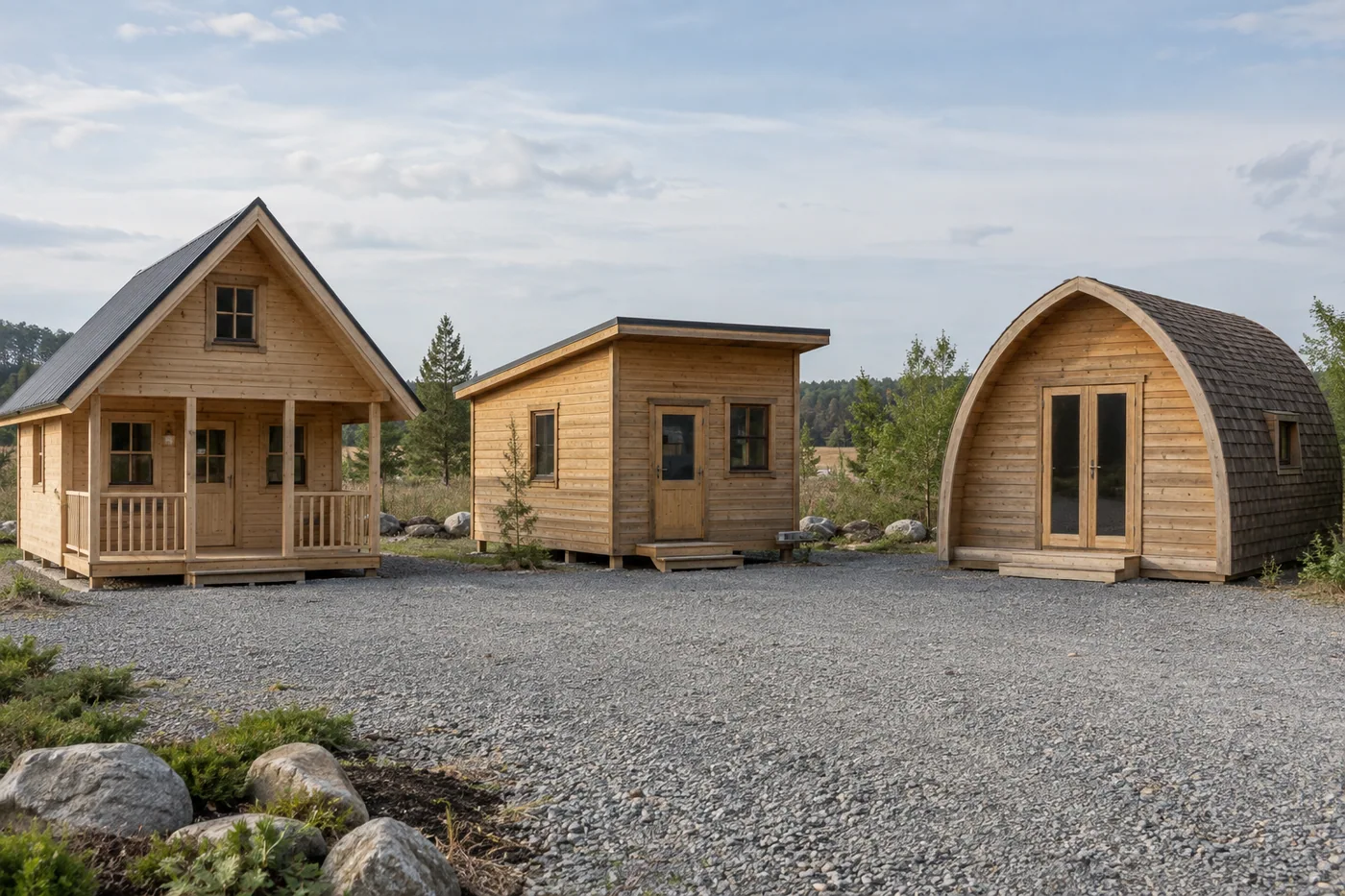
Shortlist wooden cabins for sale by testing each option against the intended use and actual site before comparing appearance or headline price. Identify local review requirements, delivery access, foundation and service dependencies, then mark each option feasible for further review, conditional or unsuitable on current evidence. A supplier's willingness to quote is not proof that the cabin can be lawfully installed and used at your site.
Introduction: start with the project the site can support
A search for wooden cabins for sale produces many attractive buildings. Some offers emphasize style, others price or speed. None of those features establishes that the product is a suitable first choice for a particular site. A disciplined shortlist starts with the buyer's actual use and constraints, then asks which options deserve more detailed investigation.
This guide provides an early decision framework, not planning, structural or legal advice. It does not determine whether a cabin is a dwelling, a caravan or another regulated category. Competent local professionals and relevant authorities must address the actual project. The categories used in sales listings are not substitutes for that review.
The output is a shortlist with visible conditions, not a promise that every selected cabin is ready to order. It helps the buyer spend design and quotation effort on plausible options while preserving uncertainty honestly. A conditional option can be worth investigating; an unexplained assumption should not be treated as a completed check.
Write the intended use in operational terms
Describe who will use the cabin, for what activity and under what operating arrangement. A private workspace, seasonal guest accommodation and permanent residential use can raise different questions. State whether the use is occasional or recurring and which facilities are expected, without assuming that a supplier's general description covers those needs.
For a commercial project, identify the operator and the people responsible for approvals, site work and ongoing maintenance. The party buying the cabin may not be the party running it. A clear brief prevents one business from assuming another will resolve an important requirement after purchase.
Separate essential outcomes from preferences. A particular appearance may be negotiable, while a required facility or a site restriction may not be. Rank requirements through the buyer's actual decision process rather than labelling every desirable feature mandatory. This makes the shortlist more practical and gives suppliers room to identify feasible alternatives.
Record what is not yet known
If the business model or final use is undecided, say so. Ask for information suitable to compare the options rather than pretending the design basis is fixed. A preliminary offer can still be useful when its assumptions are clear, but it should not be accepted as a final fit for several incompatible uses.
Establish the local review route before treating a product as eligible
Identify which professional and authority discussions are needed for the actual location. Planning, building, licensing and other requirements can interact, but they are not the same question. A supplier statement about one process does not prove that every relevant permission or obligation has been resolved.
The UK government's building-regulations approval overview is a useful starting point within its stated jurisdictional context. Its guidance should be followed through to the appropriate local process, not treated as a blanket answer for every timber cabin. Different nations within the UK and other countries have their own frameworks.
Where a UK project might involve caravan-site licensing, the government's licensing information can help identify the relevant enquiry. It does not establish that a wooden cabin is legally a caravan or that a site automatically qualifies for an exemption. Classification and applicable permissions must be determined for the actual proposal with suitable advice.
Further reading: UK government: building regulations approval; UK government: caravan-site licence information.
Create a constraint map before comparing models
Collect the available site information and identify its reliability. Measured access information, professional reports and confirmed service data are different from assumptions based on a map. Record who provided each item and what remains to be checked. The shortlist should reflect the quality of evidence, not merely the amount of material in the folder.
Map constraints by their consequence for procurement. Some may exclude a delivery format, some may require a different layout and others may affect only cost or timing. Avoid labelling every uncertainty a fatal problem. Equally, do not reduce a genuine stop condition to a small note beneath an attractive image.
| Decision gate | Information needed | Possible shortlist outcome |
|---|---|---|
| Intended use | Defined activities and relevant review route | Proceed to review or hold pending use decision |
| Site eligibility | Appropriate local advice and authority information | Conditional, unsuitable or eligible for further design |
| Delivery route | Actual package and route information | Retain feasible formats or seek alternatives |
| Ground and support | Site-specific professional inputs | Identify design dependency and cost uncertainty |
| Services | Known availability and required scope | Retain, revise facilities or investigate |
| Operating layout | User and operator requirements | Compare suitable configurations |
| Commercial scope | Inclusions, exclusions and evidence availability | Request a scoped quotation |
Use delivery feasibility to narrow package formats
Compare the proposed delivery arrangement with actual access information. A cabin's footprint is not its transport or handling envelope. Large assemblies, panels and smaller-component kits can create different constraints. Ask for the relevant order information and have competent contractors review the route and handling proposal.
Do not assume a kit solves every restricted-access problem. Long components, glazing, packaging and safe handling can still matter. Likewise, a site that appears open may have approach-road or unloading restrictions. The purpose of this gate is to identify feasible formats, not to prescribe a lifting or carrying method.
Where access information is incomplete, mark the option conditional and identify the evidence needed. A supplier's phrase should be fine is not a substitute for a reviewed arrangement. This early gate can prevent spending detailed design effort on a package that the responsible delivery team cannot accommodate.
Further reading: Build a complete garden access survey.
Turn these questions into a project brief
Share the location, intended use, access information and known professional requirements. Ask for suitable options with assumptions and exclusions made explicit.
Expose foundation and service dependencies early
Timber cabins need an appropriate relationship with the ground and the services required for their intended use. The shortlist does not need to design these systems, but it should identify who will investigate and provide them. A package described as ready to install may still assume substantial site preparation outside the supplier's scope.
Request the cabin-side information needed by local professionals. Where that information is unavailable or preliminary, record the limitation and its effect on the decision. A quotation can remain conditional while the design develops, but the buyer should understand which assumptions could change price, programme or feasibility.
Services should follow the intended activities rather than a generic amenities list. A cabin used only as a workroom differs from accommodation with cooking and bathroom facilities. Ask local professionals to assess the actual requirements and availability. Do not assume that a nearby service connection has capacity or permission for the proposed use.
Further reading: Coordinate the cabin-to-foundation handover.
Compare usable configurations after the stop conditions
Once an option remains plausible through the early gates, compare its layout against the real operating brief. Identify room functions, circulation, equipment and maintenance access. The objective is not to select the largest advertised area, but to understand whether the configuration supports the required activities.
Keep external size, internal area and other measures clearly defined. A small difference in headline area may hide a more important difference in how furniture or services fit. Ask for suitable drawings and have relevant professionals assess regulatory or accessibility questions. A marketing floor plan is a starting reference, not proof of approved occupancy.
When comparing log cabins for sale with other timber formats, avoid treating construction labels as complete performance specifications. Ask what assembly and evidence are actually offered. Retain the options that can provide the information needed for review, rather than assigning broad benefits to every product with the same name.
Use clear shortlist statuses and exit conditions
A practical status set is retain for detailed review, hold pending named evidence and unsuitable under current requirements. These statuses are not approvals. Define what each means so a sales team does not treat retained as permission to manufacture. The buyer should control the transition from enquiry to order through its normal decision process.
For every hold, identify the missing evidence, responsible party and decision date. Some information may require paid professional work or access to the site. Record that dependency honestly. A hold with no owner can remain unresolved while the project appears to progress around it.
When an option is removed, preserve the reason. This prevents the same unsuitable configuration from re-entering the shortlist later simply because a different reseller uses a new name or photograph. If the underlying requirement changes, the option can be reviewed again on an explicit basis rather than forgotten assumptions.
Do not turn a scoring total into an approval
A weighted preference score can help compare retained options, but it should not cancel a mandatory unresolved requirement. A beautiful layout cannot compensate numerically for a delivery arrangement that has not been shown feasible. Keep stop conditions separate from preferences so the decision remains intelligible.
Request comparable proposals only for the retained options
Send the same brief and evidence request to the suppliers of retained options. Ask them to identify deviations, inclusions, exclusions and assumptions. The response should distinguish what the supplier knows from what depends on local work. A wooden cabin for sale with a lower shell price may have a different complete project scope.
Include the information expected for factory testing, shipment inspection and installation preparation where relevant to the purchase. Do not assume those services exist or apply to every order. Request their actual scope and records, and keep them separate from site approvals or performance conclusions they cannot establish.
Compare the route to a documented, usable outcome. Availability, support, information completeness and local dependencies can matter alongside price. Do not invent a revenue or payback forecast to justify a preferred model. The buyer's financial decision should use its own evidence and appropriate advice.
Further reading: Compare supplier bids against a common RFQ.
- Define use and decision owners.
- Confirm the local review route.
- Map site constraints and evidence quality.
- Check feasible delivery and support dependencies.
- Compare layouts and operating requirements.
- Request scoped bids for retained options only.
Hypothetical example: three attractive options, one useful next step
Imagine a hypothetical buyer comparing three cabin offers for a constrained guest-accommodation site. One larger assembly has an unresolved delivery route. A second has a promising layout but lacks information needed by the local reviewer. A third provides suitable preliminary documents and a package format the handling team can investigate further.
The buyer does not declare the third approved. It is retained for detailed review, while the first two receive specific hold conditions. If those suppliers provide satisfactory evidence, their options can return to comparison. The method does not punish uncertainty; it prevents uncertainty from being hidden beneath a preferred picture.
The next expenditure can then be directed to the appropriate site and design investigation instead of an immediate deposit on an unverified option. This example is a decision exercise, not a report of an actual customer project or a claim that one format is always easier to approve.
Budget the next investigation before paying for the product
A shortlist should identify the cost and purpose of the next information-gathering step. That might be a site assessment, a route review or professional examination of supplier documents. The appropriate scope comes from competent advisers. Spending on targeted investigation can be more useful than repeatedly requesting new product quotations while the same site uncertainty remains unresolved.
Keep investigations proportionate to the decision. An early screening question may not require a complete final design, but it should be answered by someone competent to assess its significance. Ask what conclusion the proposed work can support and what will remain open. This prevents a preliminary report from being used later as a broader approval than it provides.
When several suppliers need the same site information, obtain and distribute it through an agreed process with the necessary rights and limitations. Consistent inputs improve comparison. Do not let one bidder rely on a measured report while another is judged against an optimistic assumption, then interpret the difference in price as a pure manufacturing advantage.
Record the point at which the buyer is ready to move from shortlist to detailed order negotiation. The decision should identify remaining conditions and responsibility for closing them. It need not mean every operational detail is finalized, but it should explain why the chosen option merits commitment under the actual commercial controls.
If an investigation changes the project fundamentally, revisit the shortlist rather than defending the first favourite. The work has still delivered value by clarifying the site's constraints. A disciplined buyer can change direction before purchase without pretending the earlier supplier was defective or that the new option is automatically approved.
Frequently asked questions
What should I check before paying a cabin deposit?
Clarify the intended use, relevant local review route, delivery feasibility, site and service dependencies, actual supply scope and contract terms. Obtain suitable professional advice for legal and technical matters. A shortlist is not approval, but it should reveal unresolved conditions before commitment.
Does a supplier saying no permission needed settle the issue?
No general sales statement should replace project-specific local review. Requirements depend on the location, use and actual proposal. Ask the appropriate professionals or authorities to establish the applicable route and keep that evidence with the project records.
Should the cheapest timber cabin be excluded automatically?
No. Compare defined scope and evidence, not price alone. A lower figure may represent a suitable package or a different set of inclusions and assumptions. Retain options that can meet the requirements and compare their complete, clearly described consequences.
Can one site checklist cover every country?
A general decision framework can organize questions, but legal, structural and operational requirements are location-specific. Use the framework to identify who must answer each question locally. Do not transfer a permission or design conclusion from one jurisdiction to another.
What should a useful first enquiry contain?
Provide the location, intended use, expected users, preferred layout, available access information, known site constraints and the status of local professional review. State which work you expect the supplier to include and which remains with local parties. Identify uncertainty rather than concealing it.
Conclusion: shortlist for the site before choosing the photograph
A site-first shortlist makes broad cabin shopping more purposeful. Define the use, expose constraints and distinguish retained options from unresolved or unsuitable ones. Then compare detailed proposals on a common brief, with local professional review preserved at every necessary stage.
Send CabinWild your site-first brief to request relevant cabin options and information. The goal is a proposal that can be investigated and scoped for your actual project, not a generic promise attached to an attractive image.
Send a site-first cabin brief
Share the location, intended use, access information and known professional requirements. Ask for suitable options with assumptions and exclusions made explicit.
Prepared with AI assistance for CabinWild Editorial using the linked public sources. Examples are illustrative, not customer results or verified CabinWild test data. Project-specific design and local requirements need review by the appropriate professionals.