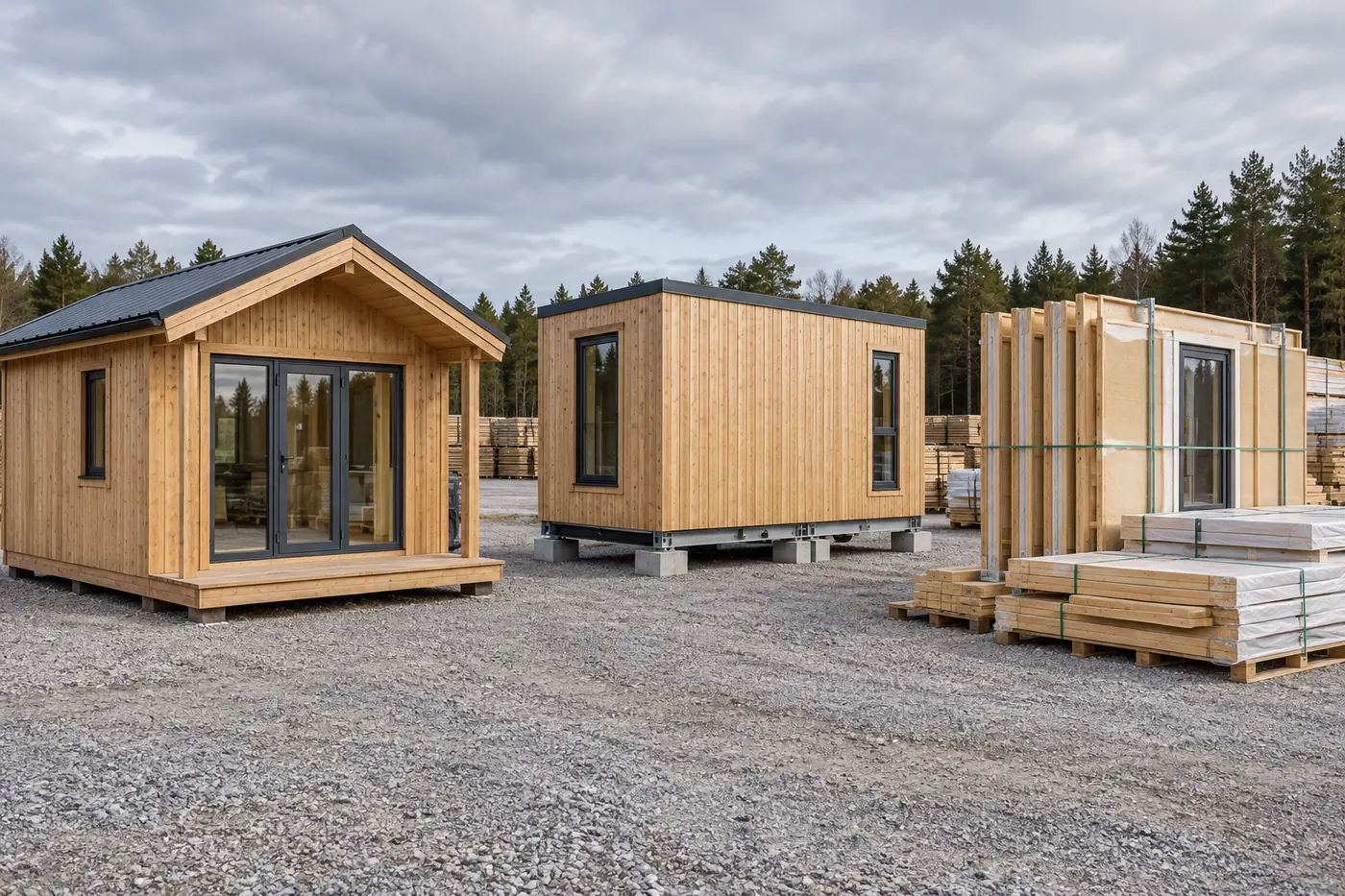
Prefab, modular and prebuilt are not reliable descriptions of one fixed cabin package. A buyer should compare the physical supply state, drawings, destination review, transport, unloading, foundations, services, installation, testing and handover. Use the seller's written inclusions and exclusions, not the headline label, to determine which offer is more complete.
Introduction: compare the complete purchasing decision
Prefab, modular and prebuilt are not reliable descriptions of one fixed cabin package. A buyer should compare the physical supply state, drawings, destination review, transport, unloading, foundations, services, installation, testing and handover. Use the seller's written inclusions and exclusions, not the headline label, to determine which offer is more complete. This article is a procurement framework for overseas buyers. It is not a product quotation, code opinion, engineering design or customs ruling.
For prefabricated log cabins for sale, introduction: compare the complete purchasing decision, checkpoint 1: search results and catalogues can help create a shortlist, but they rarely contain the site, contract and operating detail needed for approval. Use the exact configuration, current supplier documents and advice from the responsible destination professionals before committing funds.
For prefabricated log cabins for sale, introduction: compare the complete purchasing decision, checkpoint 2: examples below are hypothetical decision exercises. They do not describe a CabinWild factory test, customer delivery or verified project result. The aim is to show the questions, evidence and responsibility boundaries a buyer can record.
Further reading: Build a comparable prefab-cabin RFQ.
1. Start with supply state, not the sales label
A listing can call a component kit, panelized shell, volumetric room module or substantially completed unit prefab. Another seller may use modular for the same physical arrangement. Searches for modular cabins for sale and prefab wood cabins for sale therefore mix several physical formats. Write down what arrives, then identify what must happen before weather protection and intended use are achieved.
Request order-specific drawings, an inclusion schedule and a packing description. Product images can show the expected appearance but rarely define concealed layers, connection materials or site labor. When a modular cabin for sale appears more complete, verify whether the photographed finishes and fixtures are actually part of the quoted configuration.
For the comparison record, capture supply state, assembly state and excluded completion work. Link every answer to a dated drawing, quotation, inspection note or professional response. If the evidence is unavailable, mark the issue unresolved and assign an owner rather than replacing it with a sales assumption.
2. Define the intended use and destination first
The same cabin shell can face different requirements when used as a garden room, guest unit, holiday accommodation or dwelling. Record occupancy, season, climate, services and expected operating pattern before comparing offers. A supplier cannot responsibly confirm destination suitability from a country name and floor area alone.
Ask the local authority and qualified professionals which planning, building, fire, energy, accessibility and service requirements apply. The EU Construction Products Regulation provides a common language for certain product performance, but national and project requirements still govern the completed works. A CE-marked component does not automatically approve a complete cabin for every site.
For the comparison record, capture intended use, destination, climate and review authority. Link every answer to a dated drawing, quotation, inspection note or professional response. If the evidence is unavailable, mark the issue unresolved and assign an owner rather than replacing it with a sales assumption.
3. Normalize four common package formats
Component kits can reduce factory completion but place sorting, weather protection and assembly control at site. Panelized systems can close the envelope faster while retaining important panel-to-panel and floor-to-roof interfaces. Volumetric modules move more work off site but create size, lifting and transport constraints. Completed units may reduce site assembly yet still need supports, connections and commissioning.
Do not rank these formats universally. The best option depends on access, local labor, programme, repeatability and the buyer's capacity to manage interfaces. Prefabricated log cabins for sale may be attractive for a skilled installer, while a hospitality operator with limited construction capacity may value a more complete supply state.
For the comparison record, capture format, factory completion, site tasks and buyer capability. Link every answer to a dated drawing, quotation, inspection note or professional response. If the evidence is unavailable, mark the issue unresolved and assign an owner rather than replacing it with a sales assumption.
| Package format | Typical arrival state | Buyer should verify |
|---|---|---|
| Component kit | Profiles and loose components | Sorting, protection, equipment and assembly responsibility |
| Panelized | Wall/roof/floor panels | Panel interfaces, closing sequence and temporary weathering |
| Volumetric modular | Room-sized modules | Transport envelope, lifting, joins and service connections |
| Substantially complete unit | Enclosed building unit | Destination supports, commissioning and approval boundary |
4. Compare drawings and performance evidence
Place the general arrangement, sections, foundation interface, component schedule and finish schedule beside each offer. Confirm revision numbers and configuration. Ask which evidence applies to the exact wall, roof, floor, glazing and connection arrangement being quoted, and which items require destination design or substitution.
Performance should be described within the evidence's scope. A test for one component, orientation or fixing method should not be generalized to another assembly. GOV.UK fire guidance specifically warns that test classifications depend on the tested configuration and field of application. The same caution is useful wherever a buyer compares altered systems.
For the comparison record, capture drawing revision, tested configuration and unresolved evidence. Link every answer to a dated drawing, quotation, inspection note or professional response. If the evidence is unavailable, mark the issue unresolved and assign an owner rather than replacing it with a sales assumption.
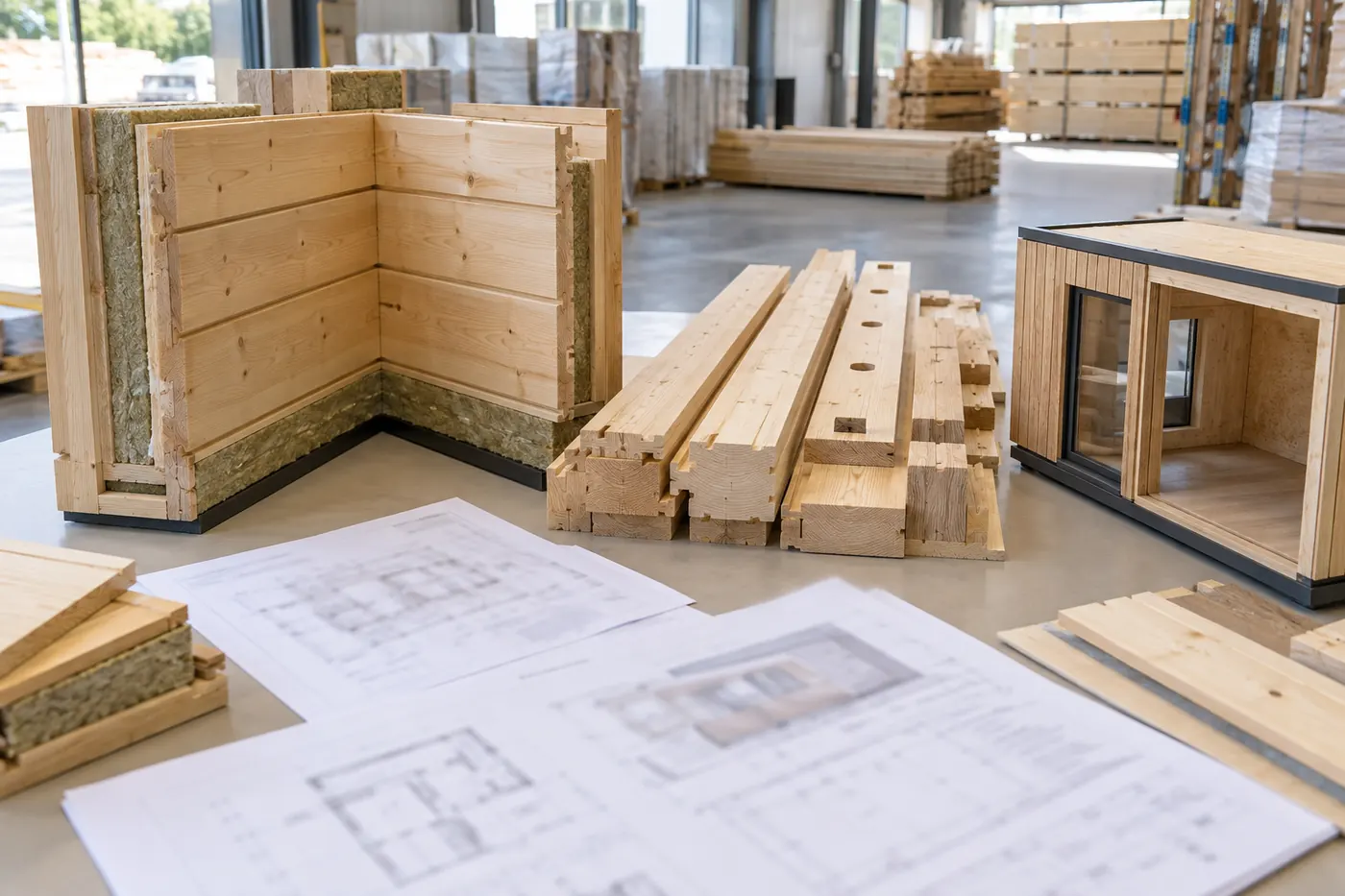
5. Map delivery, unloading and site access
A completed module may need exceptional transport and lifting space that a flat package does not. A kit may fit the route but require protected storage and many handling movements. Request package dimensions and masses, planned transport mode, named delivery point, unloading boundary and site access assumptions for each offer.
Use the chosen Incoterms rule, version and named place precisely in an international contract. Incoterms allocates specified delivery obligations, costs and risk; it does not define cabin quality, installation or final acceptance. Keep the commercial delivery term separate from the site logistics plan and the technical handover.
For the comparison record, capture package data, named place, unloading and temporary storage. Link every answer to a dated drawing, quotation, inspection note or professional response. If the evidence is unavailable, mark the issue unresolved and assign an owner rather than replacing it with a sales assumption.
Further reading: Plan delivery for a complete cabin unit.
Turn these questions into a project brief
Send the destination, intended use and offers you are reviewing. Ask for a scope-aligned response covering supply state, logistics, site interfaces and documents.
6. Separate foundation and service interfaces
Compare what the supplier provides at the underside of the cabin with what the site team must prepare. Support locations, tolerances, drainage, anchorage and access need coordinated information. A generic foundation image is not an installation design for the buyer's ground conditions or destination rules.
List every water, wastewater, electrical, ventilation, communications and heating interface. Identify connection points, supplied equipment, required local work and commissioning responsibility. A prebuilt cabin can arrive with visible fixtures yet remain incomplete until services are lawfully connected, tested and documented.
For the comparison record, capture foundation data, service termination points and responsible trades. Link every answer to a dated drawing, quotation, inspection note or professional response. If the evidence is unavailable, mark the issue unresolved and assign an owner rather than replacing it with a sales assumption.
7. Define factory checks, shipment inspection and acceptance
Ask what can be inspected while work remains visible and what evidence will identify the buyer's configuration. Factory testing should have written criteria and limitations. It may support workmanship or equipment checks but cannot substitute for destination design review or post-installation commissioning.
Plan shipment inspection around package identity, count, protective condition and required documents. Then create a separate site acceptance plan for supports, assembly, weathering interfaces, service tests and handover records. Passing one stage should not silently certify work outside that stage's scope.
For the comparison record, capture inspection stage, acceptance criterion and evidence owner. Link every answer to a dated drawing, quotation, inspection note or professional response. If the evidence is unavailable, mark the issue unresolved and assign an owner rather than replacing it with a sales assumption.
Further reading: European Commission: Construction Products Regulation; ICC: Incoterms 2020.
8. Compare schedule and change exposure
A high factory-completion level can shorten some site activities, but the buyer must include design release, procurement, factory work, transport, preparation and commissioning in the programme. Ask each seller for dependencies and decision dates rather than comparing only a promised manufacturing duration.
Track changes against the accepted drawings and package schedule. A window, roof finish or equipment substitution may affect several interfaces. Require a written description of the change, evidence impact, price, schedule and approval route before accepting it. Informal upgrades make later quote comparison and handover difficult.
For the comparison record, capture programme dependencies, decision dates and change records. Link every answer to a dated drawing, quotation, inspection note or professional response. If the evidence is unavailable, mark the issue unresolved and assign an owner rather than replacing it with a sales assumption.
For prefabricated log cabins for sale, compare schedule and change exposure, checkpoint 3: review this point against the actual customer requirements and product application. The same answer may change with climate, occupancy, route, local rules or installer capability. Preserve those conditions so a later reviewer can understand why the decision was made and when it needs to be reopened.
9. Build a scope-controlled commercial comparison
Create one row for every required outcome: design information, cabin supply, freight, unloading, foundations, assembly, services, inspections, handover and maintenance data. Mark each row included, excluded, provisional or by others. Enter actual dated quotes in a common currency only with the exchange-rate assumption recorded.
Do not fill a missing scope with zero. Obtain a supplier or contractor quotation, or retain it as an explicit allowance. The lowest cabin invoice can produce the highest unresolved project exposure. Conversely, a more complete offer may include items the buyer does not need. Normalize to the same required outcome before recommending a package.
For the comparison record, capture quoted amount, currency, validity, exclusions and allowances. Link every answer to a dated drawing, quotation, inspection note or professional response. If the evidence is unavailable, mark the issue unresolved and assign an owner rather than replacing it with a sales assumption.
Review this point against the actual customer requirements and product application.
Further reading: GOV.UK: Approved Document B fire-safety FAQ; Coordinate the cabin-foundation handover.
10. Use a buyer decision gate
Before selection, hold a review with procurement, local design, logistics and operations representatives. Confirm that the preferred package suits access, competent resources and the opening programme. Record unresolved items with owners and due dates. A commercial preference should remain conditional if a critical technical or permission question is unanswered.
The decision note should state why the format was chosen and what it does not prove. For example, a hypothetical resort might select volumetric modules because repeat layouts and prepared access support that strategy. This does not establish lower cost or faster delivery for another site; it demonstrates how requirements can drive a transparent choice.
For the comparison record, capture decision rationale, conditions, owners and release status. Link every answer to a dated drawing, quotation, inspection note or professional response. If the evidence is unavailable, mark the issue unresolved and assign an owner rather than replacing it with a sales assumption.
For prefabricated log cabins for sale, use a buyer decision gate, checkpoint 4: review this point against the actual customer requirements and product application. The same answer may change with climate, occupancy, route, local rules or installer capability. Preserve those conditions so a later reviewer can understand why the decision was made and when it needs to be reopened.
Practical procurement workshop
Prepare a one-page decision sheet
For prefabricated log cabins for sale, practical procurement workshop, checkpoint 5: put the intended use, destination, site constraints, selected configuration and required operating date at the top. Below them, list the package boundary, local work, evidence, quotation validity and open decisions. This sheet should point to controlled source documents rather than trying to reproduce every technical detail.
For prefabricated log cabins for sale, practical procurement workshop, checkpoint 6: use a simple status of confirmed, conditional, unresolved or not applicable. A conditional answer must state the condition. A hypothetical option can remain under review without being presented as a supplier commitment. The discipline is especially useful when several people join the buying process at different times.
Run the installation-preparation review
For prefabricated log cabins for sale, practical procurement workshop, checkpoint 7: before shipment or site mobilization, bring together the current drawings, package data, access plan, foundation readiness, service interfaces, protection method and installer questions. Confirm which revisions everyone is using. Installation preparation should close coordination gaps while changes are still controllable.
For prefabricated log cabins for sale, practical procurement workshop, checkpoint 8: record the scope of factory testing and shipment inspection separately. Factory testing can verify stated criteria at the manufacturing stage; shipment inspection can record identity, count and accessible condition. Neither automatically establishes final site performance, local approval or suitability for an unreviewed use.
Use a stop rule for missing evidence
For prefabricated log cabins for sale, practical procurement workshop, checkpoint 9: agree which unanswered questions prevent design release, payment, production, dispatch or occupation. The stop rule should be proportionate and assigned to the party able to close it. It protects the buyer from turning an acknowledged gap into an accidental acceptance merely because the schedule becomes urgent.
For prefabricated log cabins for sale, practical procurement workshop, checkpoint 10: if information changes, update the decision sheet and the relevant contract or drawing record. Do not leave a critical instruction only in an email thread or meeting memory. Traceability supports fair clarification with the supplier and helps local teams distinguish accepted information from earlier options.
FAQ: Prefabricated, Modular or Prebuilt Cabins: Compare the Package Before Buying
Is a modular cabin always more complete than a prefab cabin?
No. Sellers use the labels differently. Compare the physical arrival state, inclusion schedule, site tasks and acceptance evidence. A volumetric module may be highly finished or deliberately supplied as a shell, while a prefab package may range from loose components to a substantially completed unit.
Do prebuilt cabins for sale include foundations and utilities?
Only when the offer explicitly defines them. Ask for the cabin-to-foundation interface, site-work boundary, connection points and commissioning responsibility. A photograph of a finished installation does not prove that supports, trenching, utility capacity or local connection work are included.
Which format is cheapest?
There is no responsible universal answer. Compare the same required completed outcome using current package, freight, site, labor and professional quotations. Keep missing items as allowances and record currency and validity. The invoice with the lowest headline price may simply transfer more work to the buyer.
Can factory testing prove the cabin meets local rules?
Factory checks can verify defined workmanship, dimensions or equipment functions within their scope. Local design, approvals, site conditions and final service commissioning remain separate. Ask the destination professionals what evidence they require and confirm whether the supplier can provide the relevant configuration-specific records.
What should I send when requesting a comparison quote?
Provide destination, intended use, occupancy, climate, preferred layout, required completion level, service expectations, site access and target programme. Ask each bidder to use the same response schedule and identify assumptions, exclusions and document deliverables. That makes clarification more efficient and reduces label-driven comparison.
Conclusion: make the package boundary visible
Prefab, modular and prebuilt are not reliable descriptions of one fixed cabin package. A buyer should compare the physical supply state, drawings, destination review, transport, unloading, foundations, services, installation, testing and handover. Use the seller's written inclusions and exclusions, not the headline label, to determine which offer is more complete. The useful output is a dated decision supported by drawings, scope, quotations and responsible reviews, not a label or headline figure.
For prefabricated log cabins for sale, conclusion: make the package boundary visible, checkpoint 11: send CabinWild the destination, intended use, layout priorities, access information and expected supply boundary. Ask for a configuration-specific response, then coordinate it with qualified destination advisers, logistics providers and installers before ordering.
Compare cabin packages on the same basis
Send the destination, intended use and offers you are reviewing. Ask for a scope-aligned response covering supply state, logistics, site interfaces and documents.
Prepared with AI assistance for CabinWild Editorial using the linked public sources. Examples are illustrative, not customer results or verified CabinWild test data. Project-specific design and local requirements need review by the appropriate professionals.